

Month: July 2021

What’s a nursing home combined with a childcare center? A hopeful model for the future of aging
IDEAS.TED.COM
Mar 14, 2019 / Marc Freedman

iStock
Imagine a place for the elderly that’s also filled with the sounds of kids playing. Marc Freedman goes to Singapore to investigate a new model for intergenerational living.
Sister Geraldine Tan, an energetic woman in her 60s, speaks rapidly and is given to sweeping gestures. She wears the flowing white robes of the Canossian Daughters of Charity, and they threaten to engulf her small frame. But Sister Geraldine — trained in the hospice movement in the UK and now the executive director of the St. Joseph’s Home for the Aged and Hospice in Singapore — is not easily overwhelmed.
St. Joseph’s is not your typical nursing home. It’s striking, with tropical flora, open pavilions and airy rooms, and large, accommodating some 400 older people. Natural light and trade winds flow through its floors.
But the people it serves aren’t all elderly. The facility includes a childcare center for about 50 children, ages two months to six years. At the center of St. Joseph’s courtyard is an intergenerational playground, home to spontaneous interactions between the older people at the nursing home and the little ones at the childcare center.
Singapore’s leaders see the generations growing apart. They’re eager to bring them back together, to find new ways to do old things.
The neighborhood isn’t typical, either. St. Joseph’s is in Jurong West, an industrial area gone high tech. Google Singapore is next door; on the other side is the Boys’ Home, which houses young people who have been in trouble with the authorities. Across the street is a primary school. The massive Supply Chain City building — a facility “that serves as Asia’s supply-chain nerve center” — is less than 100 yards away. St. Joseph’s sits in the middle, a bastion of humanity.
While many residents share a strong cultural respect for their elders, Singapore’s leaders see the generations growing apart. They’re eager to bring them back together, to find new ways to do old things. This fits Sister Geraldine’s vision. She is determined to create an environment that encompasses the full “circle of life,” as she puts it, with children at its center. “They remind us of the purpose of life and of the importance of play and simplicity,” she says.
“There is birth and there is death,” says Sister Geraldine. “At both ends, we all need someone to tend to us.”
Today, one in eight people in Singapore is aged 65 and older. By 2030, it will be one in four.
Just as the childcare center aims to foster bonds that benefit young and old, students at the primary school visit regularly, and some of them are being mentored by the seniors. Boys’ Home residents operate a coffee cart in the courtyard, delivering drinks to the older people at St. Joseph’s — another way Sister Geraldine is instigating meaningful, cross-generational relationships.
Sister Geraldine and St. Joseph’s are all part of Singapore’s scheme to deal with their aging population. The wealthy city-state has put forth a national plan to invest $3 billion Singapore ($2.1 billion in USD) and become the envy of other aging societies. It’s a staggering investment given Singapore’s population size: just under four million permanent residents, about the size of Chicago.
Like many countries in Asia and the rest of the world, Singapore is aging fast. In 1970, one in 31 Singaporeans was 65 or older; today, it’s one in eight. By 2030, it will be one in four, or from about 440,000 people over 65 to more than 900,000 by 2030. “Aging is really the single most important demographic shift that will affect the future of Singapore,” says Amy Khor, the government’s senior minister of state for health.
Singapore officials are promoting “3Gen flats” to help older people, younger people, and those in the middle live in close proximity.
As in much of the world, the change is caused by increasing longevity and decreasing birth rates. In February 2016, Khor announced the Action Plan for Successful Ageing, an ambitious collection of some 70 initiatives covering a wide array of issues, including health care, volunteerism, employment, housing, transportation and protection for vulnerable elders. A leitmotif is engaging older people to support the next generation behind them.
To bring the generations together, Singapore is launching programs to help older people retool for second acts, to recruit young people to teach technology and social media skills to older folks, and to help community organizations better use senior volunteers. Officials are promoting “3Gen flats” to help older people, younger people, and those in the middle live in close proximity. One of the Plan’s most striking features is the creation of a “Kampong for All Ages.” Kampong is the Malay word for village, and it envisions a future Singapore built around a cherished element of the past: the multigenerational village.
The Plan also funds a $200 million Singapore ($140 million in USD) National Innovation Challenge, toward research on promising models and incentives to encourage more ideas for a multigenerational society.
The idea is to use community design to re-create natural opportunities for cross-generational support — to move from program to proximity, from concept to reality.
I sat down with two young architects at the CDB, the ministry that oversees land use in Singapore, where space is at an absolute premium. They showed me plans for the Admiralty Kampong, a development created to encourage connection between the generations. It will contain a ground-floor plaza with a grocery store and eateries, a daycare center, assisted-living services, a day center for elders with more extensive needs, and lots of opportunities for socializing.
The idea is to use community design to re-create natural opportunities for cross-generational support — to move from program to proximity, from concept to reality. The conscious effort is all the more striking in an Asian society where interaction and care between young and old, especially in families, occurred naturally for much of its history. But in our fast-paced, highly mobile, globally-oriented 21st-century world, there’s a need to find new ways to cultivate these time-honored values.
I admit being taken with Singapore’s plan, but my burning question on arrival and throughout my visit was: Is it real or a mirage? Some experiences were underwhelming. At one point, I visited the nation’s oldest center that brings together children, adolescents and older adults. The program’s diversity was impressive, mixing many different ethnic backgrounds, as well as ages. Yet the contact between generations was mostly superficial — there was a patina of closeness without much in the way of genuine interaction.
Scarcity of space could have led to conflict; instead, it’s prompting creative thinking about how to wring the most social value from limited square footage.
Still, those experiences were the exception for me. In Singapore, for the most part, I witnessed a sense of common purpose among people to realize the plan’s goals, a shared vision that was more significant in some ways than the sums being spent (although I can’t get over my envy of the money).
Two lessons stood out for me from my trip. First, not having much land can be a powerful impetus for change. Scarcity of space could have led to conflict; instead, it’s prompting creative thinking about how to combine institutional purposes to wring the most social value from limited square footage. Second, I found the instinct to combine old and new — a new-way-to-do-old-things approach — everywhere.
On my final day, I visited a church initiative that was a faith-based bookend to the St. Joseph’s experience that started my trip. St. John’s–St. Margaret’s is a well-established Anglican congregation near the National University of Singapore. The church is in the midst of creating a large senior living facility and early childhood center, having broken ground on it in mid-2017.
When complete, the project may be even more impressive than St. Joseph’s. This redesign was prompted by the expiration of the church’s lease on government-owned land. In order to stay on its prized plot, St. John’s–St. Margaret’s was required to “intensify” its use of the land — to do more social good. The congregation decided not only to build a nursing home and senior programs but also to find ways to simultaneously support young children. I love the notion of intensifying the land; it’s another way of saying every dollar should be spent (at least) twice.
When complete, St. John’s-St. Margaret’s will contain a nursing home, a senior center, and an early childhood center. Its name? Project Spring-Winter.
For insights, the St. John’s–St. Margaret’s team headed to the US and visited facilities that bring the generations together for mutual benefit, including the Providence Mount St. Vincent Intergenerational Learning Center in Seattle (the subject of the 2017 documentary The Growing Season). Another source of inspiration was a passage from Zechariah 8:4–5 that describes the renewed city of Jerusalem as a cross-generational paradise: “Old men and old women shall again sit in the streets of Jerusalem, each with staff in hand because of great age. And … the city shall be full of boys and girls playing in its streets.”
When open in 2021, St. John’s–St. Margaret’s will consist of a 273-person nursing-home facility, a senior center for 100 older people, and an early childhood center for 200 children. The name for the initiative? Project Spring-Winter.
When I visited the congregation members leading this effort, they told me of an unanticipated side benefit. While working on the plans, they realized the church itself had become age-segregated — for example, there were children’s services and adult services, often held at the same time in separate rooms. Prompted by the research that’s gone into Project Spring-Winter, they’re thinking how best to age-integrate the congregation.
Congregant Sherlyn Lee, one of the Project Spring-Winter leaders, told me that she hopes this new effort will restore a sense of the “circle of life” — both at the church and in Singapore. I was struck by the symmetry: Sister Geraldine and Sherlyn opened and closed my trip with the same beautiful phrase.
Excerpted from the new book How to Live Forever: The Enduring Power of Connecting the Generations by Marc Freedman. Published by PublicAffairs, an imprint of Hachette Book Group. Copyright © 2018 Marc Freedman.
ABOUT THE AUTHOR
Marc Freedman is CEO and president of Encore.org, a nonprofit that aims to harness the abilities and experiences of people aged 50 and over. Originator of the encore career idea linking second acts to the greater good, Freedman cofounded Experience Corps to mobilize people over fifty to improve the school performance and prospects of low-income elementary school students in more than 20 US cities. He also spearheaded the creation of the Encore Fellowships program, which helps individuals translate their midlife skills into second acts focused on social impact, and the Purpose Prize, an annual prize for social entrepreneurs in the second half of life. (AARP now runs Experience Corps and the Purpose Prize.)

Celebrate International Friendship Day
I think this is the greatest idea because where would be in life without friends? I was pretty much a loner growing up but did always have one or two close friends I could talk with and share my problems and dreams with.
We have more contact via the Internet and social media today which is very different than the old days but can still give us a place to lay our fears and dreams.

Here’s where it all started.
Friendship Day is a day in several countries for celebrating friendship. It was initially promoted by the greeting cards’ industry, evidence from social networking sites shows a revival of interest in the holiday that may have grown with the spread of the Internet, particularly in India, Bangladesh, and Malaysia. Mobile phones, digital communication and social media have contributed to popularize the custom.
Enjoy the day and let your friends know how much you appreciate them today.
Melinda

#Weekend Music Share *The One and Only Roy Orbison in Pretty Woman

It’s the weekend!!!!!!
I’m so glad you’ve joined me this week for another edition of Weekend Music Share.

Welcome back to Weekend Music Share; the place where everyone can share their favorite music.
Feel free to use the ‘Weekend Music Share‘ banner in your post, and don’t forget to use the hashtag #WeekendMusicShare on social media so other participants can find your post.
Melinda
Friday Quote

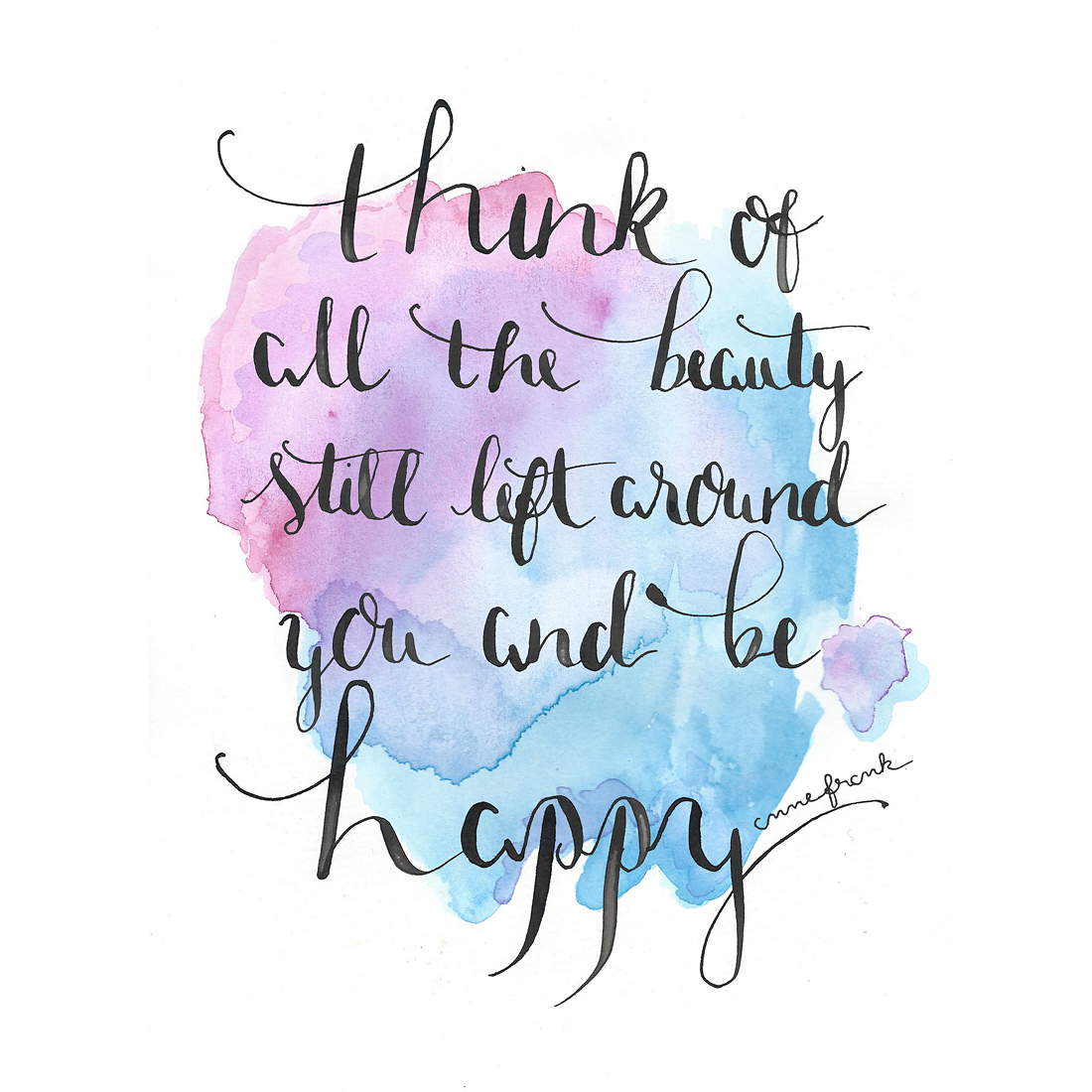
Have a great weekend!
So glad you stopped by today and look forward to hearing your comments.
Melinda

Five Ways To Make New Friends
There is nothing scarier as an adult than making friends. It’s not that you’re unable to do it, it’s that it’s far easier to be five years old, pick a buddy and go and play. As an adult, making friends feels like dating. You want to find people with the same ideals as you, and that’s not always easy! You want to set boundaries and make sure that you are around people you consider to be similar to you.
Speaking to new people isn’t easy for most people – especially the introverts out there who often need a little more support when it comes to talking to new people. The good news is that whether you join a class or start to write an inmate or two, there are ways to make friends out there that make sense for you. You don’t have to talk to people you don’t want to talk to, but there are ways that you can find your circle. Below, here are some tips to make new friends.

Stat Small. You can start socializing easily with people by starting small with people that you know. Hanging out with your existing friends and their friends can help you to expand your circle. You can also reach out to acquaintances past and get to know them a little more. If there are people out there in parenting groups or workgroups that you can resonate with, you’ll be able to ensure that you get to know new people.
This is a collaborative post.
Melinda

4 Tasks That Can Put Your Head Into A More Positive, Productive Space
In life, we have lots thrown at us. Some of it can be handled, and some of it can take a real toll on us. When things get us down, it can be difficult to pick ourselves up again. Sure, if we have the motivation of looking after a healthy family, then getting out of bed in the morning can come quite naturally. When we lack motivation and willpower, life can really stop us from being productive and positive.

Fortunately enough, there are plenty of things we can all do in order to put ourselves in a more positive and productive headspace. There is an endless list of tasks that can get us out of a funk and put us on the road to recovery. It may take a little while, but consistency will ensure that things get better over time. Here are a few ideas:
Write Down Your Goals In Life
When we have goals in life, we become more proactive. When we have a reason to get up in the morning, we suddenly find the energy. If you feel as though you have literally no light at the end of your tunnel, then you’re going to struggle to find the purpose in your life. If you create goals and write them down, you bring them to reality – they’re no longer ideas in your head.
Make It Your Mission To Always Improve Your Life
This is easy to talk about and difficult to actually pull off without the right attitude. Your life should be a continuing journey of moving up ladders. Try to be a better human being and a more accomplished person than you were the year before. Look at quick move-in homes, find jobs that make you happy, look to bring in more money than you did the year before – all of these are great examples of moving up in the world. Just give it a go and you’ll naturally be happier as you’ll subconsciously become more advanced.
Talk To Someone About Your Next Moves
Staying silent and keeping things bottled up never helps. If you let someone know about your problems, the chances are that they’ll be able to help. If they can’t, then the practice of opening up will, at least, make you feel better. Talking about your next moves in life will also be a good step and you can learn something new and find out about the kinds of opportunities available.
Don’t Sit Around For Too Long
When you sit around for too long, your brain can begin to play tricks on you. While the brain is amazing and creative, it can be counterproductive as you can begin to think about pretty negative instances. The best thing to do in life is to keep productive whenever you can. When you need to rest, do it. When you have things to do, get up and do them.
This is a collaborative post.
Melinda
July Chronic Illness Group Writing Prompt UPDATED

It’s the time of the month again! Time for Chronic Illness Group Writing Prompts hosted by A Chronic Voice. Be sure and check out Sherly’s site, it’s full of wisdom, medical knowledge and she’s a great host. I’ve been negligent the past couple of months but hope to get back on track starting this month. These are great to participate in and I learn so much from other Chronic Illness bloggers.
This month prompts are:
Transforming
Aging
Suffering
Visualizing
Navigating
I’ve chosen all five this month, each prompt hit exactly where I was at in life. They are not in order.

Speaking of Immunologists, insurance is refusing to pay for my Plasma Infusion treatments and I’m not paying for them myself. Insurance didn’t cover my Lyme Infusion treatments and we had to take out a second loan on the house, I will not do that again. I don’t feel that sick, and that is the problem. It’s not that I’m sick, it’s that my body doesn’t have the ability to fight anything off so once I resume so type of life outside of the house I’m at risk for everything. Until I am “sicker” than I am, insurance won’t pay. As I mentioned in one post, you need 23 players on your team, I have 11. Apparently, that’s still too many players on the field for insurance to cover my Immune Deficiency Disorder.
I had knee surgery on June 8th and am well into recovery. I do my own Physical Therapy because I’m not driving just to have someone show me what to do. I live in a two-story house and know one of the best ways for Physical Therapy is to walk the stairs. I’m so much further along with this knee than my right knee in 2018. Today my doctor told me I was a month ahead of his other patients. Guess the stairs work fine.
My knee surgery caused a problem with my hip and now I met with another new doctor, which means more paperwork to fill out. He says it’s common for issues to arise after knee surgery so he’s scheduled me for a CT scan of the hips and back. He says it’s possible I have a pinched nerve. That would certainly explain the pain when walking and the limp.


I turned another year older this month, it’s just a number, my body and brain are a different age. I look at my life sometimes a compare it to my granny’s in her 70’s and I’m only in my 50’s. My granny was blind in one eye which prevented her from driving and doing much on her own. I very much relate to her in ways I never dreamed of when she was alive.
I haven’t had a haircut in four years unless you count the cut last summer when I made a ponytail and told my husband to cut it off. I just pull my hair back in a ponytail and it makes me feel like an old maid but I haven’t taken any action until now. It’s one of my priorities because I do care how I look to myself and my husband.
My life is very small, no friends, or errands, not much really, even when health doesn’t put up these walls.
Haven’t driven outside of my comfort area in four years, the first two were spent dealing with acrophobia-like issues but the past two years are mostly desire, need, and pandemic.

I’m visualizing a bigger life for myself this year. The psychological issues that were keeping me from driving have passed, I’m vaccinated and will continue my COVID process while out. I want my life to reflect my goals and dreams.
My car is two years old and has less than 200 miles on it, I want to be able to get in my car and not find a dead battery. I will start driving myself more to appointments and for pleasure the remainder of this year. Who knows maybe even a trip to the mall.
I’m counting the days to a new haircut, about four inches off all over and it will feel so light and new. I’m tired of the ponytail look.
I haven’t eaten out by myself in ages, not even a quick lunch. The pandemic had a huge impact on recent times but even before then I had quit getting out. I want to go to my fav little lunch spot and order my Plum Smoothie, even if’s it’s for taking out, that’s a huge step.
Learning how to use my new camera that is already a year old, I want to go to nature park once it cools off and enjoy our mild winters to get some great outdoor shots.
I live in Texas where it gets very hot in the Summer, which is great for some of my ailments but trying to get outside and take care of my flowers and garden has been difficult not only due to heat but my knee surgery. Luckily my husband is doing most of the watering right now. My flowers brighten my day and are great for my mental health.
Thank you for reading, I hope you enjoyed the prompts and of course the writing. I look forward to reading your feedback.
Melinda

How Every Child Can Thrive By Five

My First Post In 2005 – Dementia Induced Thought’s Of Suicide
I looked back at my very first post written as a blogger, the site was different, it was called Defining Memories then but I have published on Look for the Light before. I started Defining Memories to help me mourn my granny. It was a very dark time for me and writing was the perfect outlet.
I hope the writing is as cathartic for you as it has been for me, the subject matter has changed over time but the feeling and release it gives me is the same.
Thank you so much for reading and following me on my journey.

Being a caregiver to a dying loved one can leave you drained of emotion, exhausted, and frustrated. All perfectly normal feelings. I felt a quilt mixed in my bowl of emotions. I grew up knowing my grandparents wanted to die at home. I would grant the wish if possible. They inspired me, saved me from parental abuse, and blessed me with unconditional love.
Helping my gramps when making difficult life decisions, while working hard to remember she is my Granny. There were uncomfortable conversations, articulate to doctors how she is progressing and butt heads with family members. I ran a tight ship and had no problem telling people it was time to leave, and not allowing people over every day. God blessed me with the ability to turn my depression down and step up to the next level. Love for my Granny drove my decision to give her an extra morphine stick. She died in my hands while I kissed her goodbye.
As our population ages, the number of caregivers increases. It can seem overwhelming at times. If you don’t have a blog I would suggest checking out, it gave me an outlet. Caregivers choose to open their hearts to emotional and physical challenges.
Dementia-Induced Thoughts Of Suicide
Today I used one of four “in case of emergency” pills to keep my Granny from hurting herself during a dementia-related meltdown brought on by my Gramps going to the grocery store. She’s had many of these episodes since her stroke almost two years ago. Today I saw the beginning of the end in her face. As I look at the three pills in the bottle, I try to accept that we will need to “ease” the trauma more times before her memory is gone.
Her stroke caused dementia, and at 84 she continues to slide downhill. The meds do a good job of controlling the anger and aggression but on days like today, nothing short of a miracle works. I had to reach for “the emergency” stash and this sank in as I watched her doze off from the effects.
Today she did not recognize her own home and thought my Gramps abandoned her in somebody else’s house while going to the grocery store. She became enraged and very self-destructive by hitting herself in the head while saying that she would rather be dead than be left “here” by herself. I tried to calm her as I always do but today nothing worked. I tried to get her to focus on what I was saying but it was too late, she was lost in her painful reality. It was a very hard choice but a drug-induced calm over self-inflicted harm is the right thing to do.
While waiting for the drug to work I showed her photos of her and my grandfather from 24 years ago, a photo of my father on a pony when he was a child, and many others I took off the walls to see if she could connect to anything. She recognized my dad but several other family members were a blur. It was so painful to watch her lose touch, it ripped my heart out.
Those four pills were the “holy grail” and they took me back to the night of her stroke when Gramps went home to try to nap and she got upset that he was not there. It took six of us to hold down an 82-year-old who barely weighed 100 lbs. Her aggression reached a point where she needed restraining. Her arms were tied to the bed yet she managed to fight. I used all of my weight to hold her down to the bed, yelling at the nurse where the hell was a shot to knock her out. The nurse did not articulate to the doctor the urgency of the situation so he did not approve a sedative. I told her if she could not articulate the need, pass the phone to me. I would get the message across. The doctor ordered a sedative.
Watching her lose touch with reality is like seeing your child get hit by a car in slow motion and not being able to get a word out. I’m thankful for the time we spent together no matter how painful. I focus on the good moments and do not hold on to difficult days like this.
M
New About Me Page
I wrote my last About Me page in 2014 and it’s was time for a major overhaul. Well, here it is. I’d love to hear feedback or any questions you have. Does this profile give you enough information about me to want to read my blog and follow me or do I need to expand?

Looking for the Light is a Health and Lifestyle blog started in 2005 under the name Defining Memories. I spent my early years blogging about my grandparent’s death, sharing the grieving process and caregiving tips, I openly talked about being sexually assaulted, growing up in the house of domestic violence, alcoholism, emotional, physical, and sexual abuse. I went thru the grieving process of losing my father to suicide in 1992. When it comes to baggage, I have it multiples.
In 2014 I needed a new direction, there wasn’t light at the end of my tunnel, as they say, I went to look for it and hoped to share my life lessons with others who may not be in the same place and Looking for the Light was born.
Today I’m a happy, mostly healthy, pretty adjusted woman who is working hard to lift others up at the same time I expand my horizons.

Looking for the Light
A portion of my post is dedicated to subjects on Chronic Illnesses, for which I have a few. Lyme Disease, and Immune Deficiency Disorder, Fibromyalgia, and Bipolar Disorder. I call myself an armchair advocate, but that I try to educate and share what I know and learn thru my blog not thru a charity or an agency. Due to my ongoing health issues, I’m not able to volunteer at this time.
I have a wide range of interests from Travel, World History, Ancestry, Education for Children, Global Warming, Animal Abuse, Reading, and above Writing is Photography.
You can follow me on Twitter
I would love to hear from you. You can leave your comments below in the comment section below.
So glad you took the time to read my About Me page, I’ve updated it on 8/28/21.
Melinda

34 Best Chronic Illness Blogs [+16 New Entries For 2021]
This is the newest post form Get Blogged on the Best Chronic Illness Blogs for 2021. I’m honored to be listed for the second year and have you to thank for the recognition.
Please take a look thru each and expand your knowledge and who knows what else, maybe a few new to follow, maybe even a new online friend.
A special thanks to Ruth Gray at Get Blogged for her work with the Chronic Illness community.
Each and every day here at Get Blogged, we work with a massively varied selection of bloggers who are consistently publishing the best content, inspiring their audiences, and making waves in their respective fields.
When it comes to websites that really make a difference to the lives of their readers, there’s arguably no niche that rivals that of chronic illness bloggers.
Today, we’re going to share some of the top blogs tackling this subject, to make your blogger outreach easier and more effective and to help you to secure coverage from some of the best sites in the field.
What is a chronic illness blog?
Before we dive into the best chronic illness blogs, let’s take a step back to consider what a chronic illness blog actually is.
A chronic illness blog is one which covers topics such as disabilities, chronic conditions, and mental health issues. Some of the conditions discussed may include, but are not limited to, ME, fibromyalgia, IBD, IBS, cancer, and lupus.
These blogs often share the journeys of their owners and the lessons they’ve learned and challenges they’ve overcome along the way, as well as seeking to provide support and solace to those who are battling their own illnesses.
The writers tend to be strongly patient centric, being the voice of the communities that they represent online. Chronic illness blogs are a lifeline for so many, and the communities built around them are positive spaces where readers can be heard, informed, and inspired.
With such strong relationships with their audience, these creators have the power to ensure your brand is introduced to the people who really need it the most.
There are so many excellent blogs in the niche, and we’ve curated this list of popular, successful blogs that are creating seriously quality content…
1. Melissa Vs Fibromyalgia
Melissa Reynolds writes at Melissa Vs Fibromyalgia about managing fibromyalgia alongside motherhood. She’s been blogging since she was pregnant with her first child back in 2013 and discovered that specialists struggled to give her the help or information she needed. She shares the lessons she’s learned along the way, with a strong focus on how yoga has transformed the way she manages her illness.
2. A Balanced Belly
Seasoned blogger and freelancer journalist Jenna Farmer runs A Balanced Belly, and shares everything related to gut health and digestive issues. From dairy free breakfast ideas, to honest reviews of supermarket finds, her blog is a must-read for anyone living with a digestive health condition. Jenna’s work has been featured in The Guardian, Metro, Mail Online, and more.
3. Despite Pain
Written by Elizabeth Sirrell, Despite Pain shares coping mechanisms for living with constant pain, and explores ways in which sufferers can continue to lead a happy, fulfilling life. Elizabeth has explored fascinating topics such as how breathing techniques can relieve symptoms, how to improve the quality of your sleep, and how mobility aids can allow you to enjoy the great outdoors.
4. Spooky Mrs Green
Catherine Green writes at Spooky Mrs Green about mindful parenting and modern pagan lifestyle, and often shares how her mindfulness practice helps her to cope with a rare eye disease. Catherine also regularly explores the complexities of mental illness and depression, and is an accomplished author with several series of novels under her belt.
5. Brain Lesion & Me
Rhiann Johns writes honestly and openly about living with Functional Neurological Disorder, chronic pain, and disability at Brain Lesion & Me. Some of her recent posts have covered the parallels between chronic illness and living through a pandemic, finding pride in disability, and how CBD oil can be used to manage pain.
6. Painfully Living
Katie Clark was forced to retire earlier than expected from a 32-year teaching career, which left her figuring out what to do at this new juncture of life. She now writes at Painfully Living about living fully despite living with pain from fibromyalgia, interstitial cystitis, IBS, and GERD. Katie particularly enjoys writing about self care, wellness, and finding your purpose, and backs up her experiences with careful research and supporting resources.
7. Looking For The Light
Mel Sandor writes at Looking For The Light about life with multiple illnesses, and talks openly and honestly about her journey. Some of the recent topics she’s tackled include creative projects to help focus the mind, bringing life to your relationships, and how sleep can improve your immunity.
8. Chronically Jenni
Jenni Pettican blogs at Chronically Jenni, and also runs a successful YouTube channel. She writes about all aspects of life with EDS and POTS and her main goal is helping others feel less alone. Jenni share lots of tips, tricks, and hacks that she’s learnt over the years to help with her conditions.
9. Life of Pippa
Pippa Stacey blogs at Life of Pippa about theatre, books, and living your best life with a chronic illness. She has a particular interest in inclusive education and employment, and covers health-related issues with authenticity and humour.
10. Carrie-Ann Lightley
Carrie-Ann Lightley blogs about accessible travel for disabled people, sharing accessibility reviews, disability travel guides, and wheelchair travel tips. The blog aims to encourage and inspire disabled people to travel to, explore, and discover new places.
11. Tales of a Natural Spoonie
Laura Doherty writes at Tales of a Natural Spoonie, and covers trying to live a connected, conscious, and sustainable life with a chronic illness. The blog features a mix of reviews, eco guides, health tips and personal pieces documenting her experiences of living with a chronic illness.
12. The Spoonie Mummy
Natalie Gardner blogs at The Spoonie Mummy about life and parenting with chronic illnesses. She has rheumatoid arthritis, Crohn’s Disease and an ileostomy among other things, and also writes about her big passion – mental health in the chronically ill. Natalie runs a series called Mental Health Mondays, which talks about all different mental health topics and how they can relate if you are chronically ill.
13. The Sickly Mama
The Sickly Mama is created by Mairead Claydon, and is about life as a new mum with chronic illnesses including pituitary tumor, hyperthyroidism, hypermobility spectrum disorder, post-partum thyroiditis. She covers everything from tips for other parents with chronic illness, to baby and child development, reviews, recipes, and sometimes just plain silliness!
14. My Migraine Life
My Migraine Life is written by Sarah, and is about life with migraine through being a mom, a teacher, and more. Sarah loves to travel, dogs, products reviews, beauty ,and nutrition. The blog shares her personal stories of living life through migraine while fundraising and walking for a migraine non-profit, bringing community together and being honest about the ups and downs of treatment, symptoms and triggers.
15. My Rockin’ Disabled Life
Sarah Lynn writes at My Rockin’ Disabled Life about life with Spina Bifida, chronic migraines, and chronic pain, helping disabled people cope by giving them easy simple hacks that will make their life easier.
16. Trend-ABLE
Trend-ABLE is a fashion & lifestyle website for people who wear leg braces and have other invisible physical disabilities. It’s owned by Lainie, a social worker, blogger, & highly regarded speaker with over 25 years of experience empowering adolescents and adults to embrace their imperfections, effectively communicate with others, and live confident and happy lives.
17. Toplady Talks
Toplady Talks is all about Lynley Gregory’s coming to terms with becoming disabled at 47 after a spinal fracture. She’s part time wheelchair user and has severe chronic pain, and uses her blog to chart her progress. Lynley is an ex-teacher who loves writing, and uses it to reach out to others in the same place. She writes about disabled travelling, medication, her bad days and her good ones. She says, “It gives me purpose and also gives me a focus, it’s been a tough journey but there is hope and a good life still in front of us all”.
18. The ME/CFS Self-Help Guru
Sharing self-help ideas for those suffering from energy limiting illnesses such as ME, CFS, fibromyalgia, and Lyme disease, Julie Holliday runs The ME/CFS Self-Help Guruwith the aim of helping people to lead healthier and happier lives.
19. Anomaly/Anomaly
Olivia O’Sullivan blogs at Anomaly/Anomaly about chronic respiratory and airway conditions, and shares more broadly about life with a rare chronic illness and patient experience. She started blogging to process some of her diagnoses and to find community, bust myths and explore rare respiratory conditions.
20. Lights, Camera, Crohn’s
Natalie Hayden writes at Lights, Camera, Crohn’s about living life with IBD fully and not allowing your disease to rob you of your dreams. From handling the diagnosis, to following your career aspirations, to finding love and family planning…as an IBD mom of 2 who has battled Crohn’s for 15+ years, Natalie shares fresh content every Monday in hopes of being the voice she’s needed to hear along the way.
21. Live Well Worry Less
At Live Well Worry Less, Rachel Giffin Boulous blogs about how to find hope when you are hurting. She shares the challenges of living with physical/mental illness, and how her faith impacts both. Rachel started the blog when she was diagnosed with an autoimmune disease, PTSD, and IBS. Her goal is to help readers feel validated and learn how to manage their challenges so that they will experience personal healing and life change.
22. Crohnie Mommy
Suzy Burnett writes at Crohnie Mommy about motherhood and Crohn’s disease. It’s a safe place to share stories, connect with others and offer a message of positivity.
23. Megan Elizabeth Lifestyle
Megan Harrison writes at Megan Elizabeth Lifestyle about wellbeing and sustainability, and features her own experience with Crohn’s whilst helping others with chronic illness/mental health struggles to find wellbeing and discover how to live more sustainably.
24. Life in a Breakdown
Life in a Breakdown is the work of Sarah Bailey, and covers both mental and physical health issues, BPD, and trying to break the stigma, alongside raising awareness of keratoconus, ME, and fibromyalgia. Sarah originally started her blog as a way to try and remember the good moments when she was in the midst of a breakdown after yet another diagnosis.
25. Nyxie’s Nook
Chloe Nyx Faulkner writes at Nyxie’s Nook about mental health and wellness, with a particular focus on eating disorders. She’s recently covered subjects such as how mental health can impact gut health, how to unlock creativity as an adult, and how to cope with menstrual cramps.
26. Brainless Blogger
Nikki Albert writes at Brainless Blogger about fibromyalgia and chronic migraine, as well as more general chronic illness and chronic pain topics. She started blogging over a decade ago to just have connection with people. Now, Nikki shares her story, coping strategies, information and anything she think may help others on their journey.
27. At The Heart Of Wellness
Jill DeMasi writes the self care blog At The Heart Of Wellness about managing stress, pain, and mental health. Jill is a massage therapist and certified wellness coach with fibromyalgia, Lyme, and anxiety.
28. dSavannah Rambles
Written by DS George-Jones, dSavannah Rambles is focused on chronic illness, mostly Myalgic Encephalomyelitis, and also advocacy. It attempts to shine a light into the dark places so they no longer have power over us.
29. Invisibly Me
Invisibly Me is written by Caz Homer, covering all things health and lifestyle to empower people to live a visible life, whatever their health. Caz’s blog is her way of connecting with others, raising awareness, providing a little encouragement and helping others feel a little less alone. Her experience of numerous stoma surgeries, chronic pain and various chronic illnesses have made her hugely appreciative of the online community and the support and friendship that she’s found.
30. Chronic Heather
Heather blogs at Chronic Heather about chronic illnesses and disability, her struggles, and raising awareness for health, disability and chronic illness issues.
31. Fed Up With Fatigue
Donna Gregory Burch writes at Fed Up With Fatigue about fibromyalgia, Lyme and chronic fatigue. Her work focuses on the latest research, treatments and tools to help people live better with these conditions.
32. Thriving While Disabled
Thriving While Disabled is the work of Alison Hayes. She writes about creating and living your best possible life while disabled, focusing on making your way through the US social welfare system, managing your medical care (with a focus on communicating with your doctors), and mindset management. Expect to find concrete and useful advice so you can keep your life moving in a healthier direction!
33. Accessible Rach
When she was diagnosed with primary progressive multiple sclerosis at 51, Rachael Tomlinson could have hidden away. Instead, she took the opportunity to fulfil her ambition of becoming a writer and founded Accessible Rach. Rachael writes insightful blog posts on multiple sclerosis, disability, accessibility, chronic illness, domestic abuse, plus size fashion, and beauty.
34. A Unique Life
Casey Noaz Stanley started her blog A Unique Life as she was coming to terms with her own condition and illness. It then evolved into trying to help others come to terms with their illness. Casey now focuses on fibromyalgia but has a passion for raising awareness of all chronic illnesses.
Working with chronic illness bloggers
This curated list of the best chronic illness bloggers is sure to make your blogger outreach easier and more effective – don’t forget to download your free resource that shares an additional 16 creators making waves in the field in 2021.
Want to get in touch with these bloggers and discuss the possibility of having your brand showcased on their sites?
We can help with that.
Simply create a listing in our Marketplace, and you’ll soon be receiving pitches from the chronic illness bloggers who want to work with you.
Recent Posts
- 34 Best Chronic Illness Blogs [+16 New Entries For 2021]
- 99 Top UK Lifestyle Blogs [+ 51 New Entries For 2021]
- Blogger of the Month: A Year Of Amazing Bloggers
- Blogger of the Month: Jenny in Neverland
- The Ultimate Pitching Guide!
- Blogger of the Month: Jo, Girl Eats World
- Blogger of the Month: Emma, Bee Money Savvy
- Blogger of the Month: Kelly Jackson & It’s More Fun In Your 30’s
- Blogger Of The Month: Ana De-Jesus & Faded Spring
- 12 Red Flags To Beware Of When Selecting Sites For Link Building
- Blogger Of The Month: Sophie’s Plus Size Wonderland
- Blogger Of The Month: Georgie xoxo
- Blogger Of The Month: Sunshine Sarah
- **Applications Closed** Get Blogged Career Opportunity: PR (SEO) Marketing Assistant
- How To Accelerate Your Blog Traffic: Key Takeaways From The Live Event
I hope you will check out these great Chronic Illness Bloggers, they are great people and have so much to offer with their experience.
Melinda

Wordless Wednesday*Scorching Hot
So glad you’re here, you make me smile and feel good inside. Keep the comments coming.
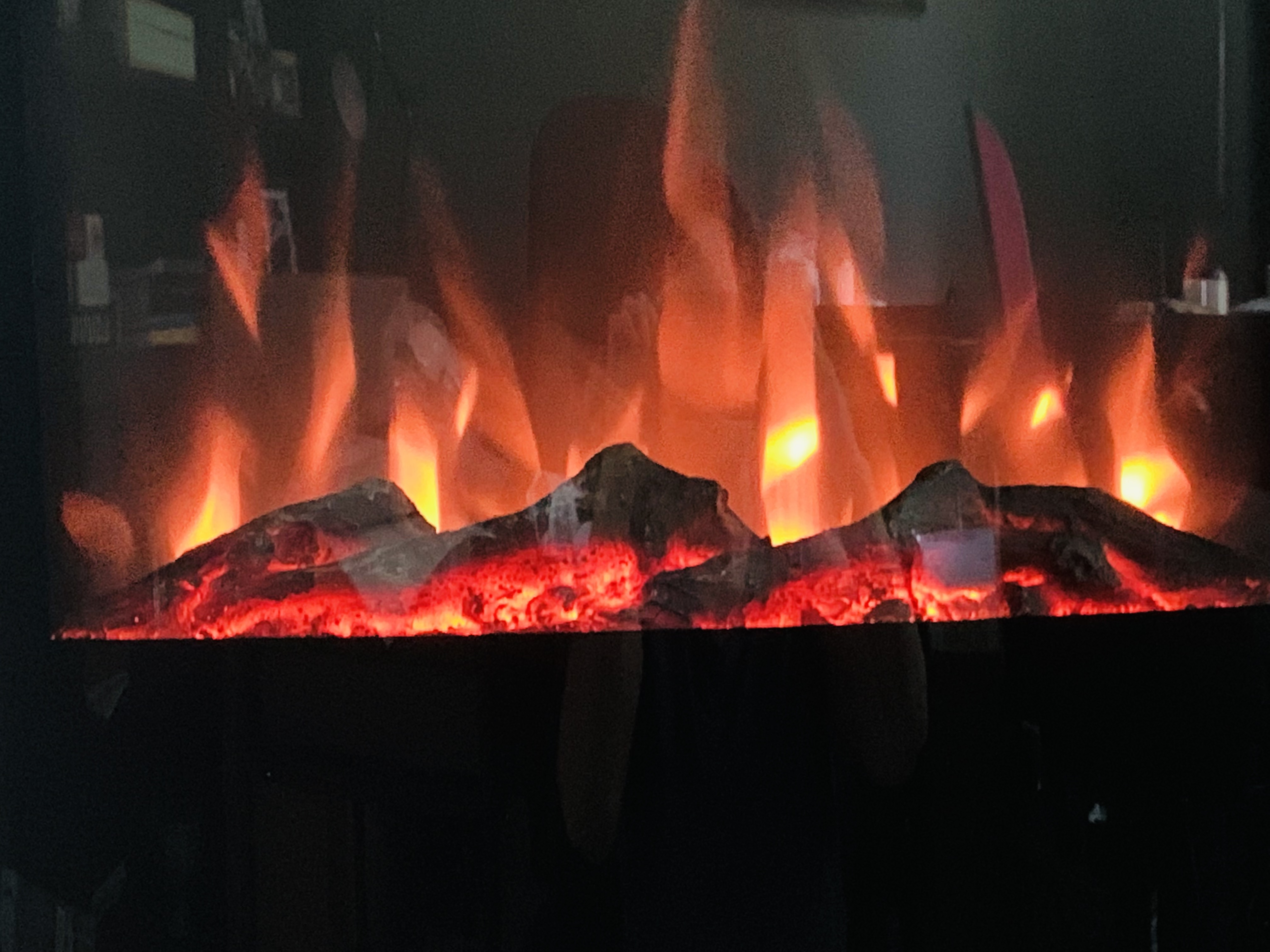
In Texas, the temperatures hit triple digits for the first time on Sunday and will continue for the next two weeks according to the weatherman. We are in the Dog Days of Summer. This is a photo of the fireplace my husband bought for my birthday for my office. It’s only 25″ and it’s a beauty, I look forward to cooler temps this winter.
Melinda
10 Ways To Make Sure The Whole Family Is Healthy
As a parent, there will be very little in life that is more important to you than your family. And because of this, you will want to be sure that they are happy and live good lives. However, that can sometimes be hard to work out. Maybe you’re not sure what you need to do to make that happen? It can seem more complex than it needs to be. Because one sure-fire way to make sure that they live a good life is to keep them healthy. Let’s take a look at ten different ways that you can make sure that your whole family stays as healthy as possible.

Make It A Priority
For starters, you will want to make sure that this is a priority for you. It’s easy to just let things slip by the wayside or for you to think that this is going to need way more time and attention than it does. In fact, being healthy can just become a natural part of your lifestyle and routine. But for that to happen, you have to proactively make it a conscious priority.
Educate Yourself
It’s also a great idea to make sure that you’re educated on health issues. There will always be concerns that you might want to be aware of. Sometimes, you won’t always know when something is wrong and being aware of what could be is a great idea. You might not recognize adult cradle cap or food allergies, but if you’re staying in the loop you’ll know more and what to look out for. Even just reading up on nutrition and health, in general, can put you in a great position.

Get Regular Check-Ups
Then, you might want to be sure that you’re seeing your doctor and dentist as much as possible. Staying on top of your visits is just a quick and simple way to make sure that you’re all healthy. It’s a great way to avoid any issues and catch anything before it’s bad too.
Focus On Nutrition
One of the greatest ways to stay healthy is to make sure that you’re all ticking off the proper nutrition that you all need. This doesn’t mean you have to eat super crazy healthily, but looking to get as much fruit and vegetables into your diets as much as possible can make such a difference to your health.
Limit Toxins
Whether you know it or not, there are so many toxins in life that we can all be exposed to on a regular basis. And so, it’s important for us to make sure that we’re doing what we can to limit that. Minimizing toxins can be such a small way to make sure that you have a huge impact on your family’s health for years to come.
Find A Balance
It’s never too good of an idea to live a life of extremes. Of course, you don’t want your children to be unhealthy. But at the same time, you’re definitely not going to want them to go to extremes and be on the other end of the scale. Because being uber strict with healthy eating can also lead to issues. So, as with anything, you will want to find a good balance. Do this with food, exercise, and your attitude to health and life in general.
Make Exercise Fun
Then, when it comes to the exercise you want your family to do, it’s a great idea to try and make it fun. If you’re a drill sergeant with workouts, it can be quite tough. So try to mix things up and have fun with it. Think about different sports you can try out or games you can play. Even rollerblading or hiking or different things out in the wild can be a great way to work out and stay fit as a family.
Create A Relaxed Environment
If your home is a stressful place to be, it’s going to make your family feel stressed out. That’s never going to be an ideal situation for anyone. So, instead, it’s a good idea to make sure that you’re creating a relaxing space instead. You can manipulate the environment in so many ways and it can be a great idea for you to allow everyone to feel relaxed and able to rest in your family home.
Make Communication Important
It’s also a great idea to make sure that you can all communicate well as a family. This isn’t something that all families make a priority, but it definitely should be. If you can have better communication as a family, it can bring you closer together. It can also mean that you feel happier together and that you’re able to talk and air issues – whether with each other or in general. A close happy family can be so much healthier. It can make a much bigger impact than you’d think.
Care About Health Holistically
Finally, you should make sure that you’re looking at health holistically and not just on the surface. Sure, seeing your doctor is important – and so is what you eat and how much you move. But the mind is also vital too. Mental health should be made a priority. Making sure that you’re all happy and looking after your minds is key. Encourage rest and self-care. Make sure everyone knows it’s okay not to be okay. Because you can make life great together and get through it all together.
It’s always going to be important for you to make sure that your family is happy and healthy. But approaching that may not look the way that you think it should. Instead, you can approach this in so many different ways that can go on and make such a huge collective difference. So take action today, enjoy the process, and know that you’re doing your best to keep your entire family happy and healthy.
This is a collaborative post.
Melinda

No Regrets — Guest Blogger Don’t Lose Hope

There’s a good chance you’ve heard of Bonnie Ware’s book: The Top Five Regrets of the Dying. This was based on her work in palliative care. The fact is, we all make choices everyday which affect the trajectory of our lives. These often feel unconscious and insignificant. And yet, over time, they become significant. They […]
No Regrets — Don’t Lose Hope

Everyday Essentials to Help Your Pregnancy — Guest Blogger Dr. Lori Gore-Green

Dr. Lori Gore-Green discusses a few everyday essentials that can make your pregnancy a little easier.
Everyday Essentials to Help Your Pregnancy — Dr. Lori Gore-Green

The Mental Health Benefits Of Gardening
Have you ever noticed that some of the happiest people you know are massively into gardening? The reasons for this are simple: gardening is one of the best things you can do to boost your mental health.
But why is this? Why do people who spend time in their gardens seem to have healthier inner lives than everyone else? It is a little mysterious.
The reason, it seems, comes down to the ways that our bodies react when we’re working outdoors. Naturally, we’re inclined to spend time in the sunlight, observing the world around us, and trying to get to grips with it. It’s not just about the physical activity of gardening and so-called feel-good hormones. There’s also a sense that you’re really profoundly connecting with nature. It feels very different from spending an evening in front of Netflix.
So what benefits do people who garden regularly report? Check them out below.

A Sense Of Accomplishment
Having a sense of accomplishment and control over your environment is an addictive feeling. The more you experience it, the more you want it.
Gardens are chaotic systems. Over time, they devolve into an all-against-all survival of the fittest. And it can be a challenge to bring them under control. That, however, is part of the joy of the process. It’s nice to feel like you can tame nature – at least on a small patch of land – and get some genuine satisfaction from the process.
An Increase In Creativity

We don’t tend to think of being creative as a health benefit, but it is a vital sign that we are in a good place. Creativity is a mental state that recruits practically every area of the brain. But it can only happen if we are in a positive frame of mind. If you’re using mental resources worrying about something, it’s hard to develop new ideas. Gardening helps to direct your focus on the outside world instead of your internal thoughts, allowing you room for creativity where you would have struggled before.
Improved Mood
Would you like to improve your mood? Well, according to data collected by Plant Life Balance, gardening can help. According to their research, around 58 percent of people experience improvements in how they feel when they spend time in the garden.
Feeling More Connected To Others
We typically see gardening as an individual pursuit. Interestingly, a large segment of people who do it feels more connected to the broader community. Part of this has to do with the fact that some gardening tasks are communal. For example, Lineage Tree Care points out that gardening involves tree trimming and storm clean-up that affect the whole community. If you visit their website, you can see examples of what they mean. Things like overhanging trees can affect both the property owner and their neighbors.
Feeling More Connected To Nature
Finally, a large number of people say that gardening makes them feel more connected to nature – something that tends to enhance overall well-being considerably.
This is a collaborative post
Melinda

How To Deal With Common Gardening Problems
Gardening is such a therapeutic hobby to take up. In fact, it’s been shown to help a great deal with your mental health during the pandemic. You can spend so many hours in your garden tending to your plants and making everything look perfect. Things don’t always go your way, as there are lots of common garden issues to face. If you’re a garden novice, the advice below can help you deal with some of the most frequent problems in your back garden:
A lack of sunlight
Plants need sunlight to grow big and strong. They take the energy from the sun and use it to grow and carry out other plant functions. You may have a lack of sunlight in your garden that’s not caused by the climate. It could be sunny as hell, but your plants are stuck in the shade due to big obstacles.
Combatting this can be both easy and hard – depending on what the obstacles are. If it’s something you can move with ease, then the problem is solved in minutes. However, trees tend to be the biggest culprits. So, you may have to have yours chopped down or trimmed. Don’t attempt this yourself; companies like the Sydney Tree Company can do it for you. It’s never a good idea to attempt to cut something big down as you have no idea where it can fall!
A lack of water
This is a problem for lots of gardeners during the summer months. The sun comes out, the rain dries up, so your garden is left with no water at all. In some areas, this can go on for a good few months. While your plants need sunlight, too much of it and too little water will cause them to burn up and die.
As such, you need to be strict with your watering schedule. You’ll have to be out there at least once or twice a day giving your whole garden a little shower. Personally, I think sprinkler systems work the best as you can turn them on and do something else while they water your garden. Plus, there’s no danger of overwatering the plants as the sprinkles distribute the water evenly.
Too much water
Yes, you can have too much water! As you can probably tell, gardening requires a fine balance of sunlight and water. When the rain clouds come out to say hello, you may be inclined to rejoice. However, if it pours with rain and waterlogs in your garden, your plants will not be happy. Too much water will basically drown the plants and turn them a strange yellow color.
To rectify this problem, you need a good drainage system for your plants. Some people like to hang theirs in plant pots, while others install a proper irrigation system on their lawn. The choice is yours, just be sure there’s a place for the water to run down when it rains.
On that note, you’ve come to the end of today’s tips. I hope they will help aspiring gardeners deal with some of the most common and annoying issues. Now, you can start gardening with more confidence and fewer problems.
This is a collaborative post.
Melinda

How financially literate are you? 3 things you should know about your money
IDEAS.TED.COM
Oct 7, 2019 / Erin McReynolds
Priya Mistry
Most of us received little guidance or instruction on how to handle money when we were growing up, but that’s OK — we can start learning now, a little bit at a time. Financial expert Natalie Torres-Haddad begins with the basics.
This post is part of TED’s “How to Be a Better Human” series, each of which contains a piece of helpful advice from someone in the TED community; browse through all the posts here.
How do most of us learn how to use our money wisely and well? When we’re growing up, we’re given special instruction in important subjects — swimming, driving, sex — to arm us with info and keep us from harm.
Yet when it comes to managing our money — an activity that every one of us needs to do, every day — we receive surprisingly little preparation. We’re not taught much about it in school, because education systems leave it to us to learn from our families and friends. However, those people often don’t fill in the gaps because money can be such a loaded or taboo topic.
Natalie Torres-Haddad, who grew up in southern California, saw many people around her struggling with debt and financial instability. She was determined to be the exception, and she purchased her first rental property in her early 20s and earned an MPA in Finance & International Business. In the process, however, she became buried in debt. Only by teaching herself the basics of money — basics that she’d never learned — was she able to steady herself and her finances.
Today she leads workshops and sessions to prevent others from falling into the money pit. (She’s also the author of the self-published Financially Savvy in 20 Minutes). She’s found that even among the college-educated people she meets, “the majority feel confused and overwhelmed about balancing their income and expenses,” she says. The stats show they’re not alone. A 2015 Ohio State University study reported nearly 70 percent of college graduates in the US say they don’t feel equipped to manage money and deal with their debt.
Not only must we get up to speed on the basics, we also need to start having honest conversations with each other about money, says Torres-Haddad. In the same way we’d tell family and friends that we’re cutting out refined sugar from our diets or practicing yoga to increase our flexibility, we should be open with them about the steps we’re taking to boost our financial health. That way, we can get advice and support. This transparency, she adds, can also make us less susceptible to peer pressure-related spending. How many of us have agreed to a pricey meal or weekend trip because we didn’t want to come clean about our money concerns?
Becoming financially literate does not require a huge time investment. Torres-Haddad believes we can start by dedicating 15 – 20 minutes a day to developing our skills and knowledge by learning new terms and resources. Just like attaining literacy in a foreign language, she says, “it’s an ongoing education.” Here are three things you need to know about your money.
1. Know how much money you’re bringing in every month vs. how much you’re spending
Most of us can rattle off our salaries in our sleep, but could you do the same for your monthly after-tax income and where you’re spending your money every month? If you can’t, that’s normal. But now is the time to learn your actual take-home pay and your actual expenses (and not just ballpark figures or estimates).
For your income, look at your physical or online pay stubs, and start keeping a record of the after-tax amounts. If you’re a salaried employee, that number should be fairly steady; if you’re not, those numbers will vary.
For your monthly expenses, Torres-Haddad suggests writing down — whether it’s in a physical or online notebook — every single daily purchase (coffee, take-out, Uber, online shopping, etc) you make and every single ongoing payment you make through autopay or credit cards (Netflix, gym membership, car insurance, utilities, etc.).
If you’ve never done this before, you may find this uncomfortable — even painful — but it will force you to face up to your spending habits. It will also make these purchases visible. Often, our regular outlays (such as Netflix, Hulu, etc.) can go unnoticed or unquestioned, and our daily spends — especially if we pay by debit card so the funds are instantly drawn from our bank accounts — can go forgotten. Torres-Haddad calls the latter “runaway spending” — “when the little things that you thought cost only a few dollars actually cost much more” in the long run. Take a daily $5 green smoothie. By making them at home, you could save yourself a few hundred dollars in a month.
After you have a fundamental understanding of income and expenses, you can download an app to help you track these categories; see your bank account, credit-card and loan balances; and organize your purchases into buckets so you can identify areas where you might cut back. Two free apps to try are Mint or Charlie, says Torres-Haddad. But, she cautions, apps can be a little “out of sight, out of mind,” meaning if you need extra help to be aware of your spending, stick with the pen-and-pad (or fingers-and-keyboard) method a while longer.
2. Know your FICO score and your other credit scores
While you don’t need to have a good credit score to be financially literate, you must know what it is. (Note: Most of the information in this section applies to people living in the US.) In the US, FICO was the first company to offer a three-digit credit-risk score for lenders to use when deciding whether or not to approve a loan or line of credit, a credit limit, and an interest rate. There are three other national credit reporting bureaus — Experian, Equifax and Transunion — which also keep track of all your loans (student, auto, personal, etc.) and your balances and histories for all your credit cards (whether issued by banks, stores or businesses).
However, the FICO score is the one most frequently used when you apply for credit cards, mortgages and most types of loans; rent an apartment; or sign up for utilities. FICO scores range from 300 to 850; 670 and up is seen as a good score and 800 and up is excellent. While the FICO score is calculated with a proprietary algorithm, the primary factors that go into it are your repayment history (do you pay your credit-card bills on time? how late are you?), how much debt you’re carrying on cards and loans, how long you’ve successfully held a credit card or loan for; and whether you’ve managed to hold a mix of different kinds of credit.
Most banks and credit cards offer free access to your FICO score on their mobile apps and websites (here’s a list of the ones that do). If you don’t use one of these companies, you can also find out how to access your score on FICO’s helpful FAQ, including a chart showing where your score falls between “Poor” and “Exceptional.”
Besides checking your FICO score every year, do an annual check of the reports issued by Experian, Equifax and Transunion. This is so you can verify that they’re correct, make sure no one has opened up a line of credit in your name, and see where you might improve. You are entitled to a free copy of a credit report from each bureau once a year. Beware: Many sites will charge you a fee, so use the federally approved and secure Annual Credit Report site.
If it’s your first time checking or you’re about to make a big purchase (such as a car or a home), Torres-Haddad suggests getting all three reports at once. After that, she recommends spacing them out throughout the year. That way, you can quickly catch any errors, fraud, identity theft or any other actions that could hurt your credit history. Mark your calendar so you know when you can request your next free credit report.
3. Know how much credit card debt you’re carrying
Knowing how much credit-card debt you’re carrying — and how quickly it’s increasing due to interest — is critical to your financial literacy. Make a list (on paper or on a computer) of each of your credit cards, their current balances, and their current interest rate. Then, put them in order from highest interest rate to lowest.
In general, says Torres-Haddad, this should be how you should prioritize paying them off, paying as much as you can towards the card with the highest interest rate while paying the minimum on the other cards. Called the “debt-snowball method,” this was popularized by money expert Dave Ramsey.
If you have any cards that offered a 0% APR as a promotion when you signed up, mark down the date on which the promotional rate expires because that’s when you can expect your debt to accumulate at a high interest rate (20% or more). Try to budget your monthly payments so that this card will have little to no balance when that expiration date arrives.
Believe it or not, having a credit card can be a great thing for a person’s FICO and credit scores — if you use it responsibly. Of course, carrying no debt on your cards is best. Otherwise, Torres-Haddad recommends using no more than 30 percent of your available credit limit. So if you have two credit cards with limits of $6K apiece, totalling $12K in available credit, make sure the total balances you’re carrying do not exceed $4K.
If you’ve managed to pay off a credit card, congratulations. But while you may be tempted to close it, Torres-Haddad advises against it. Why? Closing the account will shrink your total amount of available credit and cause your credit score to dip. Instead, delete the card number from any online shopping accounts, cancel any auto-pays billed to it, and freeze the card in ice. It may sound silly but it means that if you want to use it, you’ll be forced to wait for it to defrost — and forced to take a little time to think about your purchase.
When choosing a new credit card, look for ones that offer incentives — such as travel points or cash back — which could help you and your finances. Torres-Haddad recommends going to nerdwallet.com and bankrate.com to compare credit card offers.
Obviously, these three points represent just a small part of financial literacy. That’s why Torres-Haddad urges people to be patient and to learn gradually. Two books she recommends are Napoleon Hill’s Think and Grow Rich! and Robert T. Kiyosaki’s Rich Dad, Poor Dad. For those who like to get information through listening, she suggests the “Popcorn Finance” and “Her Dinero Matters” podcasts.
When you can, supplement your research with an in-person workshop, adds Torres-Haddad. “Even going to one financial literacy workshop can have a life-changing effect,” she says. A good time to find free workshops is April, which is Financial Literacy Month in the US. One of the best investments you can make in your life is to educate yourself about money, says Torres-Haddad. “It can really give you a lot of peace of mind.”
ABOUT THE AUTHOR
Erin McReynolds in a writer and editor in Austin, Texas.

The Real $Cost Of Lyme Disease
We are cleaning out our paper files and trying to get everything down to scans. I picked up the two-inch-thick notebook I kept my Lyme paperwork and found the contract that had the cost of my Antibiotic Infusion treatments.
It will blow your mind, it costs $40,000 to $60,000 a month for just the Antibiotic Infusion Treatments and necessary medical supplies. That did not include prescriptions for which I took well over 20-25 at a time or supplements which I took at least 15 a day. Insurance only covered part of the prescriptions, not one penny towards my treatments or supplements.

$40,000 a month! We had to take out a second mortgage on our home since my treatments went on for 18 months! Now tell me it’s not a serious illness. I almost died, I had Adrenal fatigue which was getting close to adrenal failure. That’s after all the money spent.
I’ve written many times about the time importance of what you need to do to prevent Lyme Disease but have not focused on the real cost, it’s not just your health, it hits your pocketbook damn hard.
This is a photo of the day my Infusion post was inserted at George Washington Hospital in D.C.
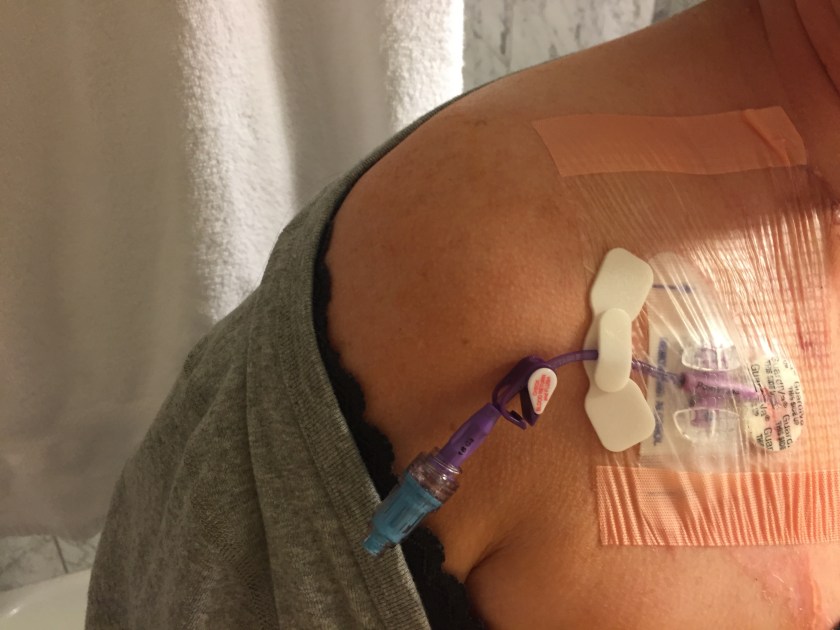
This bandage had to be changed every Sunday, it was a very sterile complicated, painful process. It’s extremely tender and due to the risk of infection, the adhesive is very strong making it difficult and painful to take off.
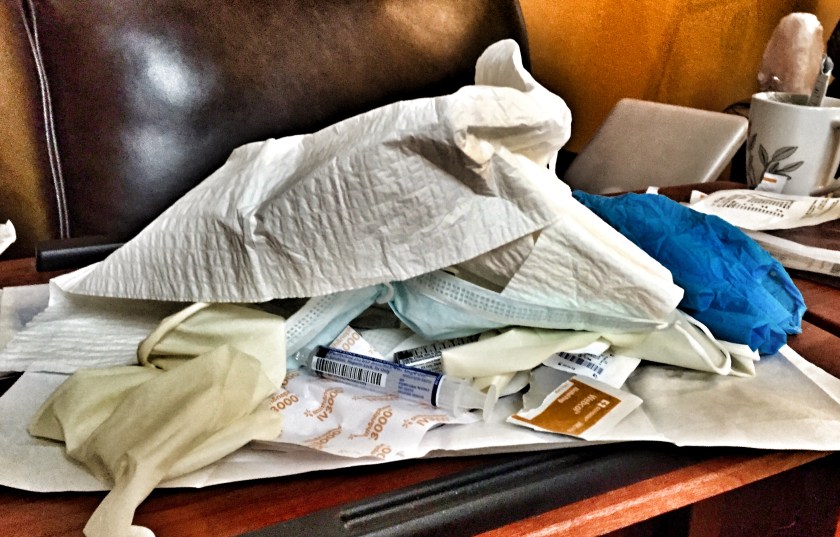
Here’s a great photo of what was involved in taking it off each week and the medical waste. It was about an hour-long process due to how slowly you have to take the bandage off due to the pain. You have to put the bandage back in the same place every week to keep the port infection-free.
I have permanent Brain damage in the form of early-onset Dementia from Lyme. What happens is the Spirokets look for a major organ to set up a house and do damage. Some have the virus go to their kidneys or liver, mine went to the brain. It’s like 58 years of memories with a machine gun bullet put in them. It’s devastating and will someday rob me of my complete memory.
Dementia is not an easy topic, I watched my granny die from Dementia and it’s an ugly one. If you’ve read my Lyme journey you know that I chose to commit suicide before I lost my memory. That’s how harrowing it was to watch my granny die and I won’t do that to my husband. This is my reality. I don’t know when it will come and I hope it’s a long time from now. I do have a plan, no one knows and that’s best.
I hope this post gives you a different perspective than my other post and will make you think very hard the next time you are out and about. I wish Lyme on no one!
Melinda

Everyday Health Hacks Summer Edition
This was one of the most popular posts last year and now is a good time to update, almost eight months into the year and some of my routines have changed, yours probably have too. New Year’s Resolutions or goals as I call them, can start to lose their luster and get thrown out the window by summer so now is a good time to examine where you are.
The key to lack of motivation is understanding what’s missing, what is the root cause of the lack of interest in pushing forward with your goal. We have to constantly reassess as life and our health change, as life, and health changes so do our goals. Maybe your goals are outdated and no longer fit where you are today.

I have Chronic Lyme Disease, Fibromyalgia, and Hypogammaglobulinemia., which is an Immune Deficiency Disorder however, I’ve been fairly healthy. Insurance has rejected my claim for Plasma Infusion Treatments so I haven’t been able to start treatment. As I mentioned before, my immune disorder means my body doesn’t make enough antibodies. It’s like needing 23 players on the field and I only have 11. It’s a losing game but I’m not sick enough for insurance. The same ole, wait till it cost three times as much to take care of you.
I do chalk my good health to some lifestyle changes including learning to forgive and giving myself some grace. If I get off track, I can’t beat myself up or feel quilt. I don’t own an alarm clock and have not found a need for one. I’m fortunate to not work or I would be in big trouble.
For me, self-care is the things we do every day to stay healthy, not just the special treatments we spend taking care of ourselves. I’m learning more about the importance of how my mental health plays an important role in my physical health, they are very intertwined.
Here are some simple but steps I work hard to accomplish every day, there are days when I don’t get outside or go to Starbucks but as a general rule this is my daily schedule.
Daily
One big change you will notice if you read my original post is I’m taking far fewer supplements. I go thru phases and now I don’t want to take that many pills.
Taking all of my medications is critical to my physical and mental health. Just one day of skipped medication can throw off my system and wreck havoc on my Bipolar Disorder.
Women’s over 50 Multi-Vitamin with Calcium.
Mixinolin 2%, for Hair Loss, twice a day. (It works)
Biotin for healthy hair which also boosts my self-image.
Manuka Honey, Certified UMF 20+ (MGO 850+) One tablespoon per day.
Use Vegan CBD products.
Eat fresh fruit, most weeks four pounds of fruit, strawberries, blueberries, and sometimes mangos and yogurt for lunch and/or dinner every week.
We have meal kits, Home Chef, delivered three days a week. I pick the healthiest options with a medium level of preparation. That way dinner prep is easy and not stressful. We cook together which takes the load off of me.
Eat dinner by 6:00 PM every night.
We go to the Starbucks drive-thru for a coffee. We take the dogs with us and it’s like a family outing. When time allows we take them for a short walk at the park. This is where I get my exercise each day, or however many days I can. Now that it’s triple digits in Texas we are not walking in the afternoon. Most days it’s walking the stairs for exercise and for recovery after my knee replacement surgery. Now that it’s triple digits in Texas we are not walking in the afternoon.
I reduce stress by meditating several times a day for at least 5 minutes. Nothing fancy, no special location in the house, just in my chair or wherever I am. I don’t know a particular method, I just work to clear my mind and let everything go.
Only watch one hour of news, 30 minutes local, and 30 minutes national per day! Any more than an hour is regurgitated and adds to the stress level.
Limit my Social Media time and involvement. You won’t find me chatting with people all hours of the day and most days not chatting at all. Just posting and helping others by retweeted.
During the day I light an aromatherapy candle, placed somewhere I won’t forget it’s burning.
In spite of COVID, I still schedule critical doctor’s appointments and lab work.
Getting outside for fresh air even for 10 minutes. Just hearing a bird call can change the outlook on my day.
Nature! There are several bird feeders and a birdbath at the kitchen window. I get to see the birds, woodpeckers, and squirrels, it’s great entertainment.

Bedtime Routine:
Go to bed 1to 1.5 hours before my husband. During that time, there is no sound, no computer, no phone, nothing! I lather up with my CBD and hand creams. I bought a new UltraSonic Aroroma diffuser, what a difference it makes! It’s not noisy like my old one. It has three timers settings and an auto shut-off if the water runs out. I found a great Essential Oil mix called Dream and I let it run for an hour, it’s so relaxing. I’m usually nodding off by the time my husband comes to bed.
That extra time gives my mind a chance to wind down, get all the ramblings out, and let my mind completely calm down. At bedtime, I take my sleeping meds and another round of CBD cream. I’m now ready. Rarely do I have trouble going to sleep.

I don’t accomplish these every day, it’s impossible to always have the motivation to do what’s best for our health. Looking at the big picture each week I can see if I’m focused on the right things, if not I have to ask why. Sometimes it’s just that life gets in the way.
There’s no one size fits all to have the best healthy life but we all can take steps every day to push ourselves forward.
Melinda

Let’s Talk About Women’s Hair Loss Summer Update

When I started writing the original posts Let’s Talk About Hair Loss, I had no idea the changes my hair would take.
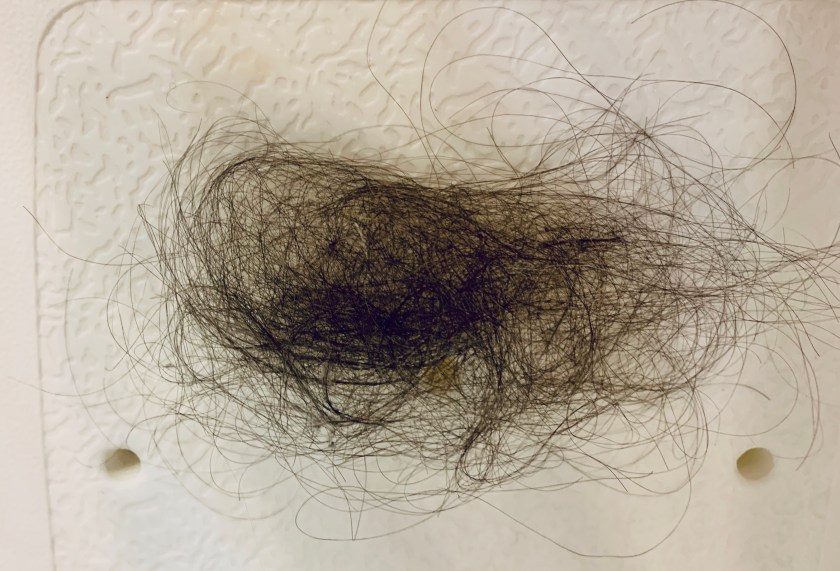
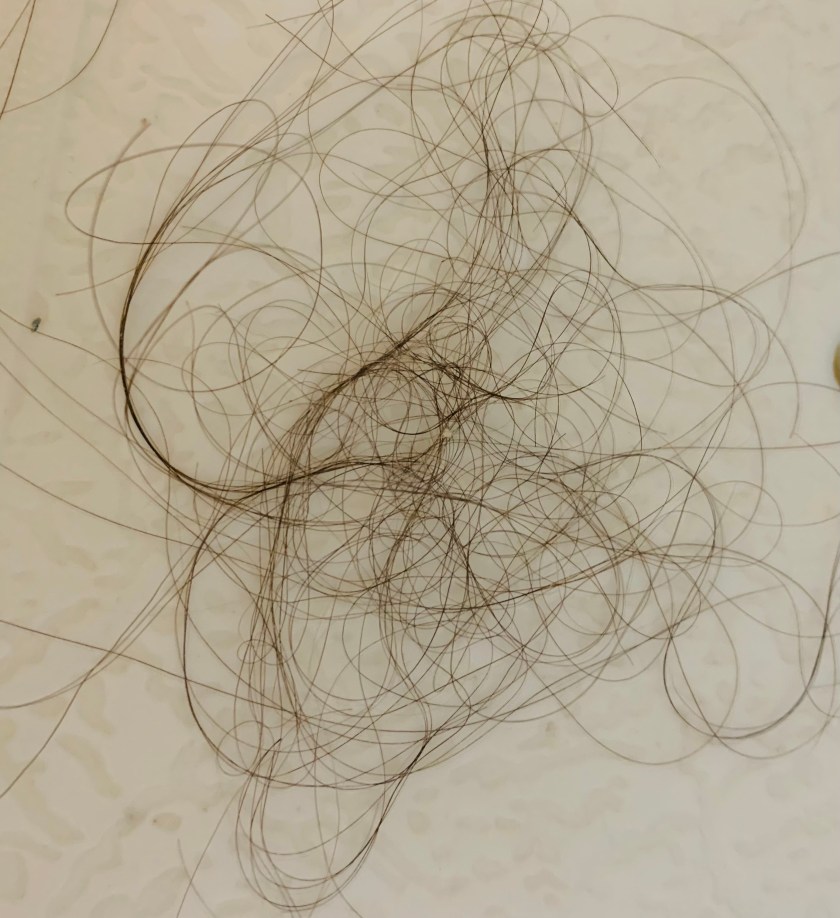
Eight months ago I started using Minoxidil 2% on the areas I felt had the most hair loss twice a day to encourage growth. I think six months is the magic number before you start to see real results. It works by shedding old hair and making room for new hair to grow. It took about three months to start to see a difference in the amount of hair loss but now I’m losing much less than when I wrote this last post. I’m beyond surprised by this last photo when I compare them side by side below.

My scalp was very dry and had developed flakes on one side of my head. I read that extra sebum build-up on the scalp can cause hair loss. After changing brands several times, I’m very happy with Nioxin Scalp Recovery. I sometimes use the Nioxin Soothing Serum and the difference in irritation is noticeable. The shampoo and conditioner leave my scalp clean and my hair nice and shiny. Previous conditioners weighed my hair down and made it feel oily from day one.
I started taking Biotin around the same time so it’s hard to say how much hair growth can be contributing to Biotin. I read multiple articles while researching the previous posts and reviews on the Internet and Amazon are very positive.
Hair Growth
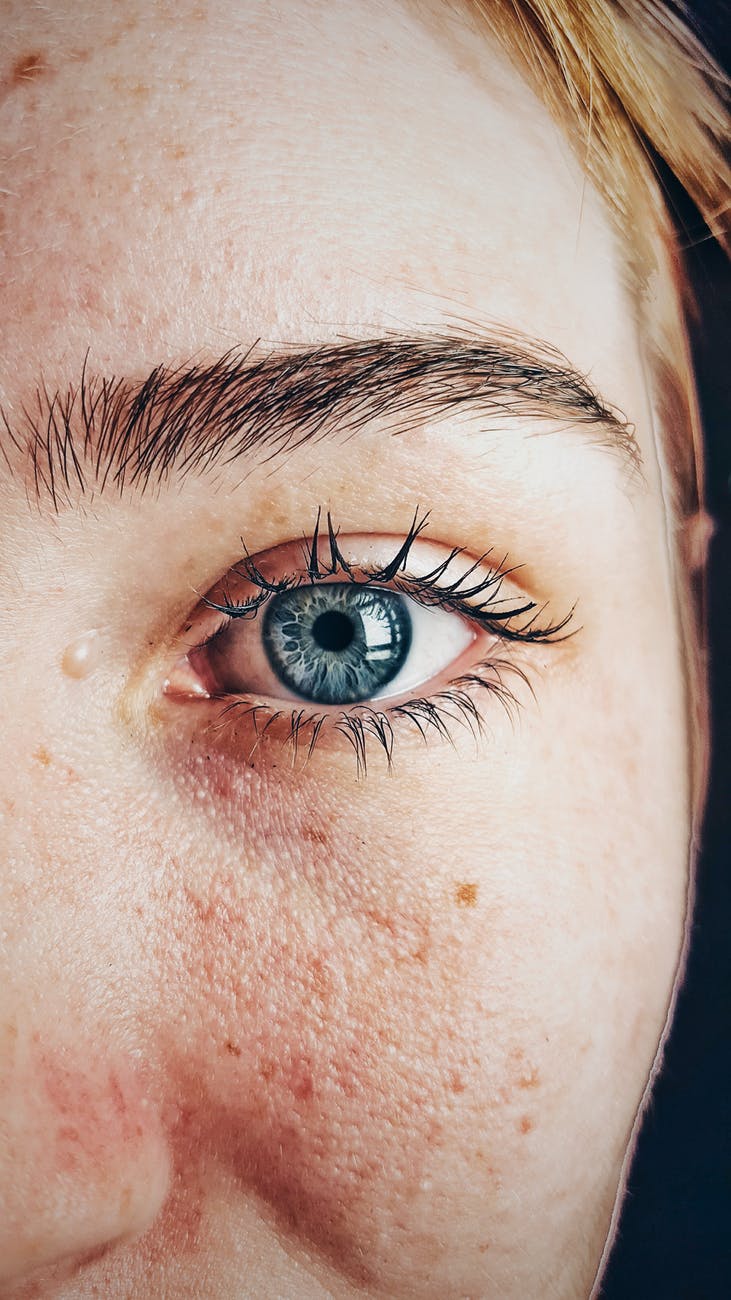
One of the most exciting discoveries is Castor Oil will make your brows and lashes grow. I purchased a bottle in December of 2020 for $11.99 and the results are so shocking. I put on mascara the other day just to see how long they had grown. I looked like I had false eyelashes, it felt like WOW. I even bought a new brow brush with lash gel, which feels weird, I’m still getting used to seeing my thin and faded out brows transformed. The bottle of Castor Oil came with one mascara wand and a liner container.
I use the mascara wand with the oil on my eyebrows and lowers lids. The liner is used for the upper eyelid and lower lid if you like. I found using the liner puts too much oil on the bottom lids. I have a routine of putting it on two or three times a day, I put heavy amounts on my brows and a small amount on lower lids and use the liner to put on lashes at night. The oil does get on your pillowcase.
I’m am so shocked! I looked at products claiming hair growth that ranged in price from $30 to over $200. A bottle of Organic Castor Oil will last a year for $12.00. My lower lids are much longer than I could have expected and my brows have grown slightly darker and filled in a few areas that were missing hair. I’m addicted. It’s one of the best beauty finds to date.
Castor Oil has many uses including a hair massage or for dry scalp, great on dry skin, and cuticles, and you can ingest it as a laxative, according to my granny.
Melinda

How To Prepare For These Home Nightmares?
Your home should be a haven for you and your family. But we think you’ll agree this isn’t always the case. Indeed, it’s possible and in some cases even common to encounter numerous issues with your home. You need to be prepared for these possibilities with the right solutions and that’s where this article is going to help you a great deal.

An Infestation
One of the nightmares that you could experience is an infestation of some sort. These are actually extremely common, and you want to try and avoid letting it get any worse, as soon as you notice a problem you’ve got to call a professional like Mosquito Authority, of course depending on what the pest is. If you notice one bug, this isn’t really a cause for concern, but if you notice the same bug over and over again, you know there’s probably an issue. You can try to find the source yourself, but this could take you a long time and you still might never find it. At least if you hire a professional, you know that the problem will be dealt with quickly and efficiently.
But can you take precautions to prevent it? Sadly, the answer is not really. In some cases, if you keep your home clean as much as possible you’re less likely to experience this problem, but that isn’t the case with all pests. Some will come no matter what the state or your home, so it’s not a foolproof plan.
Problems With The Roof
It’s absolutely vital that you fix a problem with the roof as soon as you notice an issue. Usually, an issue with the roof will be a small yet significant hole. This could be small enough that it only lets in water or large enough that insects and pests can break through. Regardless, it could cause major headaches and health issues for you. Water leaking into your home can bring the issue of damp and potentially even flooding. As well as costing you thousands in repairs, it might also make it impossible to sell your property until the problem is resolved. Problems with the roof are why you should always check your roof after a storm or a period of bad weather. You can use a professional team to complete this task for you and ensure that there aren’t any problems that need to be addressed.
Of course, one of the easiest ways to check for issues is to head up into the attic and try to see if there is any natural light creeping through where it shouldn’t be.
Flooding
Since we already mentioned water dripping through the roof, it’s also worth exploring the problem of flooding. Usually, an issue with flooding will start in the basement and it could be because water is building up outside your home, pressing on the foundations. When this occurs, the water begins to seep into the property. If it is left alone it will lead to a problem with flooding. You can take preventive action here by speaking to a landscaper. They will be able
to alter the permeability of the ground around your home. Alternatively, they can change the level of the ground to ensure that water drains away from your home rather than towards it.
It’s perhaps worth noting that a sump pump is the best way to handle water once it is inside your home. You do need to make sure that you have a working sump pump in your property. Be aware that most insurance companies won’t even cover your home if there isn’t a sump pump that is functional.

Mold
Finally, mold is a problem that is often overlooked by homeowners who assume it’s not a massive issue. But it can be a nightmare because of the health issues that it could cause. This is particularly true if you have young children. Research has shown that mold can lead to breathing difficulties and similar problems. This is due to the spores that are released into the air. Luckily, it’s easier to deal with mold than other issues. You just need a dehumidifier to keep the moisture levels in your home at the right point.
We hope this helps you understand some of the nightmares that you can encounter around your home and the right way to deal with them. Remember, sometimes, the best option is going to be taking preventative action. With the right steps, you will be able to guarantee that these problems never plague your property.
This is a collaborative post.
Melinda

Tips For Finding Your Ideal Home
One of the most exciting things that can happen in life is searching for and buying your new home. Finding that dream location or home takes time and you need to be meticulous about it. You want to make sure that you move into a home that you have chosen and in an area in which you are happy to live. There are a lot of ways to hunt down the perfect home for you so that you can make the moving day one of pure excitement.
Searching for your new home doesn’t have to take forever, whether you are looking for luxury homes for sale or you are looking at building companies to help you to build your first home, you can live exactly where you want to live. With this in mind, here are five great tips for finding your ideal home.
Make A List
What does your ideal home look like in your head? Where is it located? Do you build it or buy it? When you make a list of what you want, you can ensure that you write down the things that are most important to you. Know what you would be willing to sacrifice and what you are looking for the most, and you can bet you’ll learn what’s important for you very quickly.
Know Your Budget
You can’t buy a new house – or build one – without knowing what you can afford. Speaking to a mortgage broker or a lender at the bank can give you a better understanding of what you can afford going forward. Knowing exactly what you can afford each month will help you to work out where you should live.
Location, Location, Location
The world is your oyster – literally. Wherever you want to go, you can go there, all it takes is some research and some savings to get it right. Have a look at the different areas in the world that appeal to you, and you can make some choices for your new home based on those areas.
Conduct Your Search
Bringing on a mortgage broker or a personal real estate agent to help you to find your new home is smart. You can search for the ideal home more efficiently when you have the right resources on your side. You can even ask family and friends to help you if you are looking in specific areas. Find success with your search when you have more help on your side!
Dig Deeper
Once you find your ideal home, think about what you need in the future. Can you afford the long-term costs of living in a new house? The fixes you may need to make if the house settles incorrectly and cracks? These are costs that you have to consider on top of all of the other costs of a mortgage and owning/running a house. You should dig into the costs and know that you have the right salary and monthly paycheck to cover all of these costs.
This is a collaborative post.
Melinda

Transform Your Garden Into The Perfect Place For Pilates
Clear A Space
The first part of this journey is going to involve clearing a space for your pilates area. You won’t need too much room for this, with just enough space for you and your friends to do your exercises while maintaining proper social distance. The more people you have, the more space you will need, and this can often mean having to break into parts of the garden that can long be taken over by nature. Tree removal, weed services, and even landscaping companies can help you with this process, making it possible to make a good start on this side of your garden.
Add Some Ambience
Once you’ve made space, it will be time to start making your garden feel extra relaxing. There are loads of ways to do this, but you want to make sure that your changes are ambient, rather than sticking out and demanding attention. Water fountains, wind chimes, and speakers can be used to generate sound that will make your garden feel natural and open, while different materials can be used to highlight different aspects of your garden. Many people go over the top when they are doing this, but it is worth keeping in mind that you’re trying to capture nature, rather than making your space feel like a disco.
Start Planning
Planning your pilates area will always be a good idea as you go through this process. You need to think about when you’re going to use it, building a routine that will make it easier to keep up with your exercise. Alongside this, though, it can also be good to think about who will be joining you for each workout. Having friends to enjoy a space like this with you will always improve the way that it feels and the use you’re able to get out of it. Of course, though, you will need to take the first step and invite people if you’re going to find success.
With all of this in mind, you should be feeling ready to get started on making your garden perfect for pilates. Having a space for activities like this can make it much easier to keep on top of them and continue your good work. Of course, though, at the same time, and a lot of people find themselves struggling when they get to points like this, and you may need some help from friends along the way.
This is a collaborative post.
Melinda

Building Self Confidence To Workout When You’ve Suffered A Setback
Getting into a fitness routine, pushing yourself, and reaching your goals takes a lot of time and energy, as well as a big commitment to yourself and your health. So when your health suffers, either through an injury or an illness, it can really set you back and put you right back at square one.
Feeling like you’ve got to start over with your fitness is a common feeling, and it can really affect your confidence. Whether you feel like you can’t do it or that things are harder than they used to be, it’s important to get back on that horse. Exercise will help improve your physical health and boost your mental health, and it can be a welcome part of your routine once you’ve found your feet again.
Here is some advice to help you regain the confidence to work out when you’ve suffered a setback.
While it’s understandable that you’ll want to be back where your fitness used to be, it isn’t going to happen overnight. If you try to move too quickly, you could end up injured or losing further confidence from not getting the same results as you once did.

Set yourself some manageable goals
Start by setting yourself some manageable fitness goals, aims you can work towards slowly, helping you to regain technique and basic fitness first. From increasing the times of your workouts to making it to the gym a certain number of times a week, start with goals that are realistic before building up to bigger ones.
Choose workout clothes that help your performance
The workout clothes you wear can help you feel more confident about working out. You should choose items that are comfortable, supportive, and can help keep you cool too. Treating yourself to some new outfits will help you feel in a better mindset for working out. Brands are more attune to the different needs of people now, so you can find great selections for curvier shapes, as well as amputee leggings and other items that can help give you a boost. Always make sure you have the right type of shoes for your workout to make sure you’re better protected against injury.
Ease yourself in, and consider working with someone else
Fitness is something that needs to be built up over time. So if you’re getting back into things after a long period away, ease yourself in gently. Walking and swimming can be gentle, effective exercises to start until you’re feeling fitter and stronger. Take a look at fitness plans from others in your position to see how they’ve eased themselves back into exercise.
It can also help if you work out with someone else, such as a friend or personal trainer who can help make sure you’ve got the right form to prevent injury, as well as help you train as needed.
If, for any reason, you feel pain – stop! Consult your doctor or take a rest to stop yourself from overdoing things.
Exercise is something that can help you begin to feel a semblance of normality, helping you form a routine and get back into activities that you once enjoyed. Take it slow, put your health first, and soon you’ll see your confidence creeping back up as you start to reach your goals once more.
This is a collaborative post.
Melinda

Today in History
Welcome to the weekend edition of Today in History. Thanks for all the great feedback. Have an awesome weekend.

1911
On July 24, 1911, American archeologist Hiram Bingham gets his first look at the ruins of Machu Picchu, an ancient Inca settlement in Peru that is now one of the world’s top tourist destinations.
Tucked away in the rocky countryside northwest of Cuzco, Machu Picchu is believed to have been a summer retreat for Inca leaders, whose civilization was virtually wiped out by Spanish invaders in the 16th century. For hundreds of years afterwards, its existence was a secret known only to the peasants living in the region. That all changed in the summer of 1911, when Bingham arrived with a small team of explorers to search for the famous “lost” cities of the Incas.
1847
Religious pioneers settle Salt Lake Valley
After 17 months and many miles of travel, Brigham Young leads 148 pioneers into Utah’s Valley of the Great Salt Lake. Gazing over the parched earth of the remote location, Young declared, “This is the place,” and the pioneers began preparations for the thousands of followers of …read more
1982
“Eye Of The Tiger” from “Rocky III” tops the U.S. pop charts
Whether it’s Oliver Stone setting a scene from Platoon to Adagio for Strings by Samuel Barber,or Quentin Tarantino setting a scene from Reservoir Dogs to “Stuck In The Middle” by Stealer’s Wheel, filmmakers often depend upon certain passages of music to produce specific emotional …read more
1567
During her imprisonment at Lochleven Castle in Scotland, Mary Queen of Scots is forced to abdicate in favor of her one-year-old son, later crowned King James VI of Scotland. In 1542, while just six days old, Mary ascended to the Scottish throne upon the death of her father, King …read more
1969
Apollo 11 safely returns to Earth
At 12:51 EDT on July 24, 1969, Apollo 11, the U.S. spacecraft that had taken the first astronauts to the surface of the moon, safely returns to Earth. The American effort to send astronauts to the moon had its origins in a famous appeal President John F. Kennedy made to a special …read more
Melinda

Are You feeling lost? Steps You Can Take To Stop The Confusion
Are you currently feeling lost, not knowing what to do or where to go? While you may be confused and unsure of yourself in certain moments, you have much more clarity than you may be willing to admit. The feeling of confusion arises when you have too many conflicting thoughts running through your mind, and you do not have a way to hold them back and keep them at bay.
But life is full of ups and downs. So, it is not a surprise that anyone can fall victim to confusion. Even though you may feel all alone, you are not. Try focusing on persevering and getting through the problem.
But how do you go about it? What should you do when you are feeling lost and confused with life?
Be Honest with Yourself and Accept the Situation
Running from problems never solves anything. Rather than pretending that everything is okay, admit that you have a problem and take responsibility for it. You will only make the situation worse by ignoring it. The first step towards solving any confusing situation is by admitting that you have a problem. Only then can you get clarity of the confusing situation that you are facing and find a solution.
Relax and Avoid Panicking
Every time you run from a problem, there is a high probability of panicking and developing anxiety—panic and fear sets in when you start becoming afraid. If you allow it to drive you, you may create negative thoughts that may lead you to make the wrong decisions.
Instead, it would help if you strengthened yourself to face the problem through relaxation. Relaxing helps to quiet your mind making you feel calm and peaceful. Relaxation is not only good for overcoming confusion but also for stress relief. Some relaxing methods you can use include practicing mindful meditation, listening to soothing music, soaking in a warm bath, and breathing exercises.
Focus on What you Know
When confusion sets in, your mind may be thrown through a web of repetitive and consistent thoughts without a beginning or end. To get yourself out of such a situation, you should focus more on first solving what you can understand. Only then can you slowly lift off the cloud of confusion that hovers over your life.
Be Patient
Confusion is a sign that you need to take some more time before making a decision. You should accept and be at peace with the fact that you may not have all the answers. Instead of rushing to make a decision when your mind is clouded with confusion, you should take a step back and consider listening to your gut feeling.
You do not have to make your decision quickly. Take your time until you are comfortable and confident enough to trust your gut.
Take Away
Apart from stress, panic disorder, and anxiety, several other reasons may lead to confusion. For this reason, you should seek medical attention if you or anyone you know shows signs of confusion and anxiety. It may not be very comforting at first, but you can quickly deal with it by taking immediate action to boost your mental health.
Being stuck in confusion is not necessarily bad. It highlights that no matter the path you decide to take, you will overcome the feeling of being lost.
This is a collaborative post.
Melinda
#Weekend Music Share *John Mayer New Light
It’s the weekend!!!!!!
I’m so glad you’ve joined me this week for another edition of Weekend Music Share.
This is a new tune by John Mayer off his new album which is reminiscent of his early work. Enjoy.
Welcome back to Weekend Music Share; the place where everyone can share their favorite music.
Feel free to use the ‘Weekend Music Share‘ banner in your post, and don’t forget to use the hashtag #WeekendMusicShare on social media so other participants can find your post.
Melinda
Friday Quote
Have a great weekend!
So glad you stopped by today and look forward to hearing your comments.
Melinda
 lookingforthelight.blog