
Children · Communicating · Health and Wellbeing · Men & Womens Health · Mental Health

Helping Your Adolescent Build Self-Confidence

PSYCHOLOGY TODAY

Self-confidence is a can-do attitude that empowers determination and effort. 

For the adolescent, confidencecan often be hard to come by. 

During childhood, the girl or boy may have felt relatively self-assured in the smaller, simpler, and sheltered world of home and family. But with the onset of adolescence (around ages 9 to 13), developmental insecurity begins. Now the teenager separates from childhood and parents to start the daunting coming-of-age passage through the larger world toward young adult independence – to young womanhood or young manhood. 

Growing up keeps introducing more changes and challenges in the teenager’s path, creating fresh cause for self-doubt. “I can’t keep up!” “I won’t fit in!” “I’ll never learn!” “How will I get it done?” Parents may not always appreciate how, when youthful confidence is lacking, adolescence requires acts of courage to proceed. “Some days just showing up at school can feel scary to do!”

Coping with lack of confidence

How to help a young person cope with lack of confidence? By way of example, consider the common case of social shyness in middle school that can keep a young person more alone than she or he would like to be. 

The child who had playmates in elementary school can become more socially intimidated in the push and shove of middle school when physical self-consciousness from puberty and social competition for belonging and fitting in can make making friends harder to do. As young people vie for standing, there can also be more social cruelty – teasing, rumoring, bullyingexcluding, and ganging up – to assert and defend social place. 

As I was once told on lonely eighth-grader authority: “With all the meanness going around, middle school can be a good time not to have a lot of friends.” At the same time, she had a fervent desire to have a more socially satisfying high school experience. But how to accomplish this change when lack of confidence from shyness was holding her back? 

I suggested that like all feelings, shyness can be very a good informant about one’s unhappy state, but it can also be a very bad advisor about how to relieve it. For example: “I’m not confident mixing with people, so I’ll feel better if I just keep to myself.” Following this emotional advice only makes shyness worse. 

While it’s true that feelings can motivate actions; it’s also true that actions can alter feelings. So the prescription for the shy middle school student lacking social confidence was to put on an act. “Pretend to be more outgoing, and you’ll build confidence as you increasingly practice behaving that way.” 

Empowering confidence

Worth parents listening for and affirming are adolescent statements of confidence. These express a can-do attitude and they come in many forms, a few of which are stated below. 

“I can earn money.”

“I can make friends.”

“I can lift my spirits.”

“I can perform well.”

“I can finish what I start.”

“I can compete to do my best.”

“I can sustain important effort.” 

 “I can solve problems that arise.”

“I can speak up when I have need.”

“I can make myself do what needs doing.”

“I can keep agreements to myself and others.” 

“I can work with people to help get things done.”

One job of parents is to encourage practices that enable their adolescents to make these and other kinds of self-affirming statements. 

Confidence matters. It can inspire determination, empower effort, and support a sense of effectiveness: “I’m going to give it a shot.” Lack of confidence can reduce motivation, discourage effort, and lower self-esteem: “There’s no point in trying.” 

Within the family, parents need to keep a tease-free, sarcasm-free, embarrassment-free home. Why? Because such belittling, like criticism, can injure confidence at a vulnerable age when believing in oneself becomes harder to do. So, no put-downs allowed.

Caution

All this said, supporting confidence in adolescents is not enough. Teaching adolescents how to direct it must also be done. After all, while human confidence can create much good, it can also inflict a great deal of harm. As history unhappily instructs, people who are very confident that they are right can commit a lot of wrong. So, by instruction and example, imparting ethical and responsible conduct matters even more. 

Melinda

Repost

Carl Pickhardt Ph.D. is a psychologist in private counseling and public lecturing practice in Austin, Texas. His latest book is WHO STOLE MY CHILD? Parenting through four stages of adolescence.

Online:Website: Carl Pickhardt Ph.D.

Communicating

Are You Having This Issue With WordPress? It’s Strange.

I noticed that some of my post old and new no longer have contect when I reread them. Others have spaces in the paragraphs that give some type of error message. What’s even stranger is when I go to my blog live and search for the post, the content is there.

Some post from 2014 are fine but one from 2020 was not. Is the one the many mysteries of WordPress?

I would love to hear you feedback and if have found a work around. I don’t want to lose my content over time.

Thanks so much.

Melinda

Children · Communicating · Family · Health and Wellbeing · Mental Health

Researchers: Parents can help their children to face anxiety

Behavioral science expert gives some ways to help your child beat separation anxiety

Photo by Daria Shevtsova on Pexels.com

NEW HAVEN, Conn. – According to the National Institutes of Health, the numbers of kids and adolescents struggling with anxiety, depression, and other mental health conditions have been steadily on the rise. Cognitive-behavioral therapy, which teaches the child coping skills, and medication may help. But for some kids and their families, there is little relief. Now, researchers are studying a new method that helps parents help their children.

Bedtime for some families can become a struggle. But when the goodnight routine for Nicole Murphy’s son began to stretch for up to three hours, she knew she needed help with his separation anxiety.

“His little mind was always racing nonstop. So, it was kind of hard for him to shut that off, I think,” Nicole explained.

Eli Lebowitz, Ph.D., Psychologist, Yale School of Medicine Child Study Center, and his colleagues, developed a method of training parents to support anxious children. It’s called SPACE, or supportive parenting for anxious childhood emotions. Parents go through training to help their child face anxiety. Lebowitz says the first step is to show support and not downplay what their child is feeling.

“I get it. This is really hard, but I know you can handle it,” shared Dr. Lebowitz.

Lebowitz said parents also learn to help their children by not accommodating them. For example, a parent who would limit visitors for a child who gets anxious around strangers, or speaks for a child who gets nervous speaking, learns not to take those steps. In a study of 124 kids and their parents, the Yale researchers examined whether SPACE intervention was effective in treating children’s anxiety.

“Even though the children never met directly with the therapist and all the work was done through the parents, we found that SPACE was just as effective as CBT in treating childhood anxiety disorders,” stated Dr. Lebowitz.

The Murphy’s used the techniques learned through SPACE to coach their son through bedtime. Within a few weeks, he was falling asleep in 30 minutes.

“For us, it was like life-changing, honestly,” smiled Nicolle.

Melinda
Repost

Children · Communicating · Family · Health and Wellbeing · Trauma

Why Children Stay Silent Following Sexual Violence

Kristin’s video is invaluable because children are scared, confused and if it’s a parent or someone in the family the Childs emotions are even heighten. I know from experience.

Melinda
Celebrate Life · Communicating · Health and Wellbeing

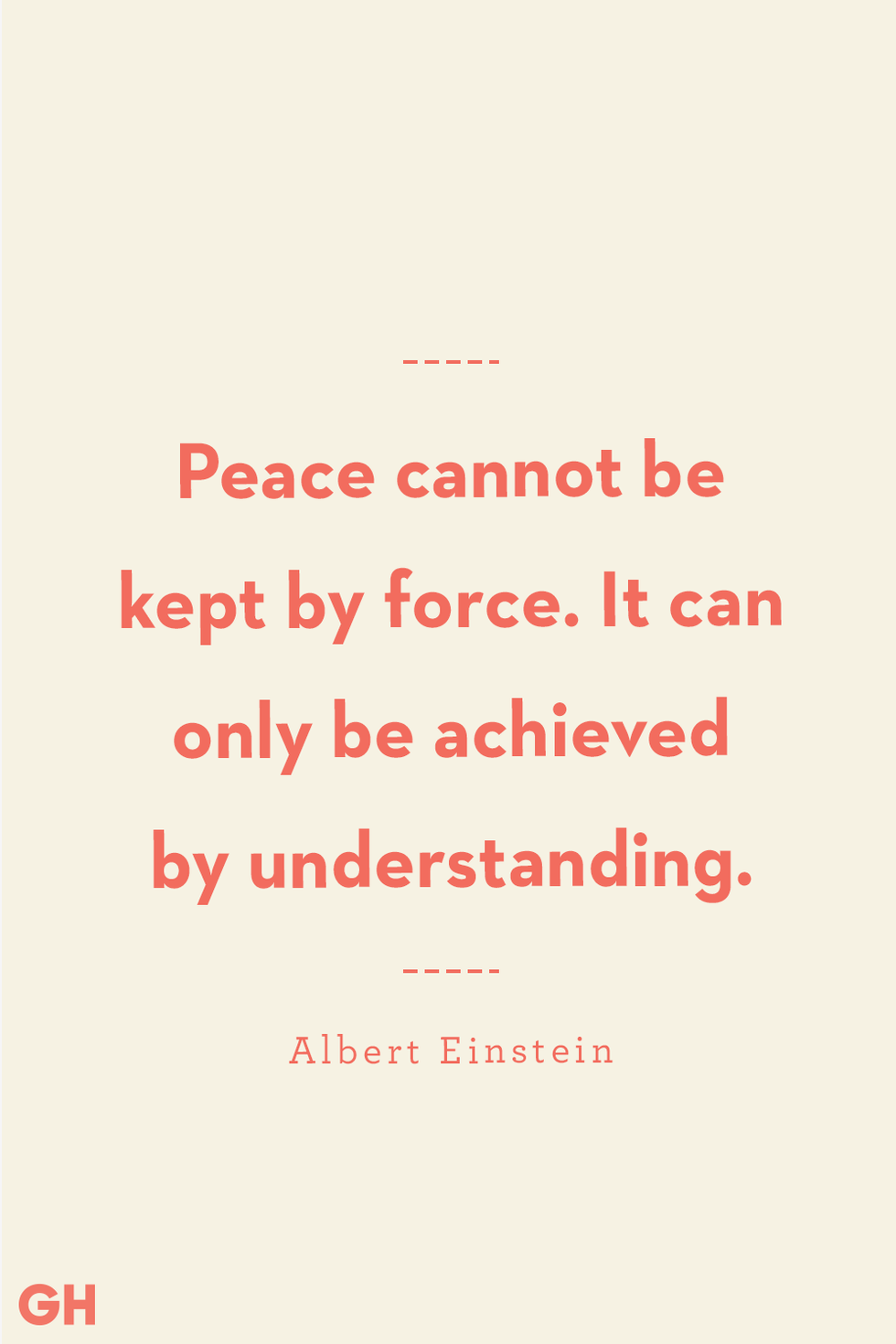
Friday Quote

Thank you for joining me for this week’s Friday Quote.


This quote came to me years ago when an employee told me that the client’s perception was wrong. Perception is never wrong but it can be changed. 

Melinda
Children · Communicating · Family · Health and Wellbeing · Mental Health

Why Kids And Teens May Face More Anxiety Far More These Days

When it comes to treating anxiety in children and teens, Instagram, Twitter and Facebook are the bane of therapists’ work.“With (social media), it’s all about the self-image — who’s ‘liking’ them, who’s watching them, who clicked on their picture,” said Marco Grados, associate professor of psychiatry and clinical director of child and adolescent psychiatry at Johns Hopkins Hospital. “Everything can turn into something negative … [K]ids are exposed to that day after day, and it’s not good for them.”

Anxiety, not depression, is the leading mental health issue among American youths, and clinicians and research both suggest it is rising. The latest study was published in April in the Journal of Developmental and Behavioral Pediatrics. Based on data collected from the National Survey of Children’s Health for ages 6 to 17, researchers found a 20 percent increase in diagnoses of anxiety between 2007 and 2012. (The rate of depression over that same time period ticked up 0.2 percent.)

Philip Kendall, director of the Child and Adolescent Anxiety Disorders Clinic at Temple University and a practicing psychologist, was not surprised by the results and applauded the study for its “big picture” approach.

The data on anxiety among 18- and 19-year-olds is even starker. Since 1985, the Higher Education Research Institute at UCLA has been asking incoming college freshmen if they “felt overwhelmed” by all they had to do. The first year, 18 percent replied yes. By 2000, that climbed to 28 percent. By 2016, to nearly 41 percent.

The same pattern is clear when comparing modern-day teens to those of their grandparents’ or great-grandparents’ era. One of the oldest surveys in assessing personality traits and psychopathology is the Minnesota Multiphasic Personality Inventory, which dates to the Great Depression and remains in use today. When Jean Twenge, a professor of psychology at San Diego State University, looked at the MMPI responses from more than 77,500 high school and college students over the decades, she found that five times as many students in 2007 “surpassed thresholds” in more than one mental health category than they did in 1938. Anxiety and depression were six times more common.

Those responding yes were asked to describe the level of both anxiety and depression in their children: 10.7 percent said their child’s depression was severe, and 15.2 percent who listed their child’s anxiety at that level.

Among the study’s other findings: Anxiety and depression were more commonly found among white and non-Hispanic children, and children with anxiety or depression were more likely than their peers to be obese. The researchers acknowledge that the survey method — parents reporting what they were told by their child’s doctor — likely skewed the results.

 Grados often identifies anxiety in the children and adolescents he sees as part of his clinical practice in Baltimore. “I have a wide range [of patients], take all insurances, do inpatients, day hospital, outpatients, and see anxiety across all strata,” he said.

The causes of that anxiety also include classroom pressures, according to Grados. “Now we’re measuring everything,” he said. “School is putting so much pressure on them with the competitiveness … I’ve seen eighth graders admitted as inpatients, saying they have to choose a career!”

Yet even one of the latest study’s authors acknowledges that it can be difficult to tease out the truth about the rise in anxiety.

“If you look at past studies,” said John T. Walkup, chairman of the Department of Psychiatry at Lurie Children’s Hospital in Chicago, “you don’t know if the conditions themselves are increasing or clinicians are making the diagnosis more frequently due to advocacy or public health efforts.”

Nearly a third of all adolescents ages 13 to 18 will experience an anxiety disorder during their lifetime, according to the National Institutes of Health, with the incidence among girls (38.0 percent) far outpacing that among boys (26.1 percent).

Identifying anxiety in kids and getting them help is paramount, according to clinicians. “Anxiety can be an early stage of other conditions,” Grados said. “Bipolar, schizophrenia later in life can initially manifest as anxiety.”

For all these reasons, Kendall said, increased awareness is welcome.

“If you look at the history of child mental health problems,” he said, “we knew about delinquency at the beginning of the 20th century, autism was diagnosed in the 1940s, teenage depression in the mid-’80s. Anxiety is really coming late to the game.”

Melinda
Reference:

Celebrate Life · Communicating · Daily Writing Prompt · Health and Wellbeing · Men & Womens Health

Daily Writing Prompt

Daily writing prompt
If you had to give up one word that you use regularly, what would it be?

The list includes many but one word used when my emotions are not under control, like frustration and anger. I heard the word and many curse words growing up but using Gods name in vain never makes me feel good about myself as a stronger believer in God. It’s not used often as the prompt asked for but once is enough.

I rush to have a conversation with God asking for forgiveness and to give me strenght to banish the word from my thoughts.

Melinda

Looking for the Light

Chronic Illness · Communicating · Family · Health and Wellbeing · Medical · Men & Womens Health · Mental Health · Mental Illness · Moving Forward · Self-Care · Survivor · Trauma

Happy Birthday Daddy 1940-1992

The morning after you killed yourself, we went to secure the house. I knew immediately you suffered slowly. Among the papers, trash, and clothes  and I found your lockbox. The divorce paperwork to my mother, every card I gave you as a child. I found the pad you were writing on. Your Bible on the coffee table, dried tears as you were reading Job in the Bible.

The note had 11:30 a.m. written in the corner. I could see you called your best friend and the phone number to a suicide line. There were words and a drawing that made no sense. Granny paralyzed, crying, asking why. The house ransacked, nothing anything made sense to her.

Dirty dishes piled high, nothing in the refrigerator, how did you live like this, how long? You phoned me several times in the months before your death. Delusional and highly paranoid each time. Someone was tapping your phone, they were trying to get you and the rest I could not understand, you were already gone. As much as I hated you, I cried, begged you not to kill yourself, trying to reason with him that Granny would never be the same. I paid your bills for months. You weren’t in touch with reality.

The outcome will not change if determined. I knew you would take your life and told no-one. I’ve wondered what went through your mind in the hours doodling to writing the note, then killing yourself. I received the call at 10:00 p.m., Gramps said your dad has done away with himself. I called right back to see if you were dead or going to the hospital.

The boxes of cassettes next to your bed, taking months to listen to. You were mentally ill, not under the care of a Psychiatrist, no medications. Your temper went 1-10 in seconds, obnoxious, loud, racist, screaming, out of control.


You had hit the bottom and I didn’t know because we were estranged,

I’ve experienced being suicidal more than once, God and my husband saved me. If you are thinking about suiside, call your Psychiatrist right away or go to closet hospital, be open with your doctor and follow all medications instructions, these actions may save your life. I’ve stayed in Psychistratic Hospitals multiple times, I had 21 ECT Treatments, and I feel no shame. My mental heath is critical to living a balanced life.

I think of you one day a year.

Melinda

Reposted

Celebrate Life · Communicating · Health and Wellbeing · Men & Womens Health · Mental Health

Mark the anniversary of the 988 Lifeline by taking action today!

Action is needed!

Melnda,  

Three years ago, the 988 Suicide & Crisis Lifeline launched to connect people in emotional distress with trained crisis counselors – 24/7, free, and confidential. Since then, 988 has fielded about 16.5 million calls, texts, and chats from people needing urgent support. But a crisis resource like 988 is only as strong as the resources we give to it. Congress must continue to invest in 988 to ensure it’s there when people need it most. That means more capacity at local crisis centers, more training for staff, and more availability of follow-up services that can save lives. Take 2 minutes today to urge your members of Congress to support robust federal funding for 988.
Take Action
Together, we can protect and strengthen this vital service. According to today’s new poll from NAMI and Ipsos, 86% of Americans believe that funding 988 should be a priority for Congress. Let’s make sure we tell Congress how much we care about continuing to build and improve 988 and crisis services. Read more about the poll here.

Melinda

Reference:

 nami.org
Celebrate Life · Communicating · Fun · Health and Wellbeing · Men & Womens Health

Daily Writing Prompt

Daily writing prompt
If you could host a dinner and anyone you invite was sure to come, who would you invite?

My dinner party would be non-traditional in that each guest is deceased. First it would be multiple parties to talk with everyone I have questions for. The first party would include Jesus, The Virgin Mother, Peter, and Moses. Each shaped my would profoundly and I would love to expaned on certain topics I’m not clear on. I believe Jesus has the ability to see present day but not so much the others. I would love to hear Jesus take on the world today and his new rally cry to Christains. Since the Bible is the foundation of the Christain religion, Jesus might not have anything else to add.

Melinda

Looking for the Light

Celebrate Life · Communicating · Family · Fun · Health and Wellbeing · Men & Womens Health

Daily Writing Prompt

Daily writing prompt
What’s your definition of romantic?

It’s hard to define romantic because romance is different to everyone. Romance has to be pure without an agenda or expecting something in return. The action makes you happy as well, meaning that you are happy because they are happy. Romance doesn’t have a price tag or have to be a big deal, a hug or helping to fold clothes works great for me.

Melinda

Looking for the Light

Celebrate Life · Communicating · Fun · Men & Womens Health

Daily Writing Prompt

Daily writing prompt
How do you express your gratitude?

Gratitude is easy to express, from saying thank you, giving hugs, letting people know you appreciate them or sending a card or text. I’m a card person myself, it feels extra special to me.

Melinda

Looking for the Light

Celebrate Life · Communicating · Health and Wellbeing · Medical · Men & Womens Health

July Awareness Months

Summer is picking up speed and July brings us new awareness. If you want to see the complete list that included awareness days, click HERE.

Disability Pride Month

Minority Mental Health Awareness Month

National Cleft & Craniofacial Awareness & Prevention Month

Plastic Free July

Sarcoma and Bone Cancer Awareness Month

UV Safety Awareness Month

Wild About Wildlife Month

Take good care.

Melinda

Reference:

https://www.goodgoodgood.co/articles/july-awareness-days-months

Communicating · Health and Wellbeing · Medical · Men & Womens Health · Mental Health · Mental Illness

Would You Recognize The Signs That Someone May Be Contemplating Suicide?

Years ago my father’s roommate committed suicide in his bedroom. The signs were clear but my father had no idea. The roommate woke up one morning and mowed the yard, cleaned the house, he returned everything he had borrowed including money owed. He then went to his bedroom and didn’t come out for hours. For reasons unknown to me my father went to check on his gun and it was missing. He knocked on the door repeatedly with no answer. Growing concerned he called the police, the moment the police breached the door the gun went off.

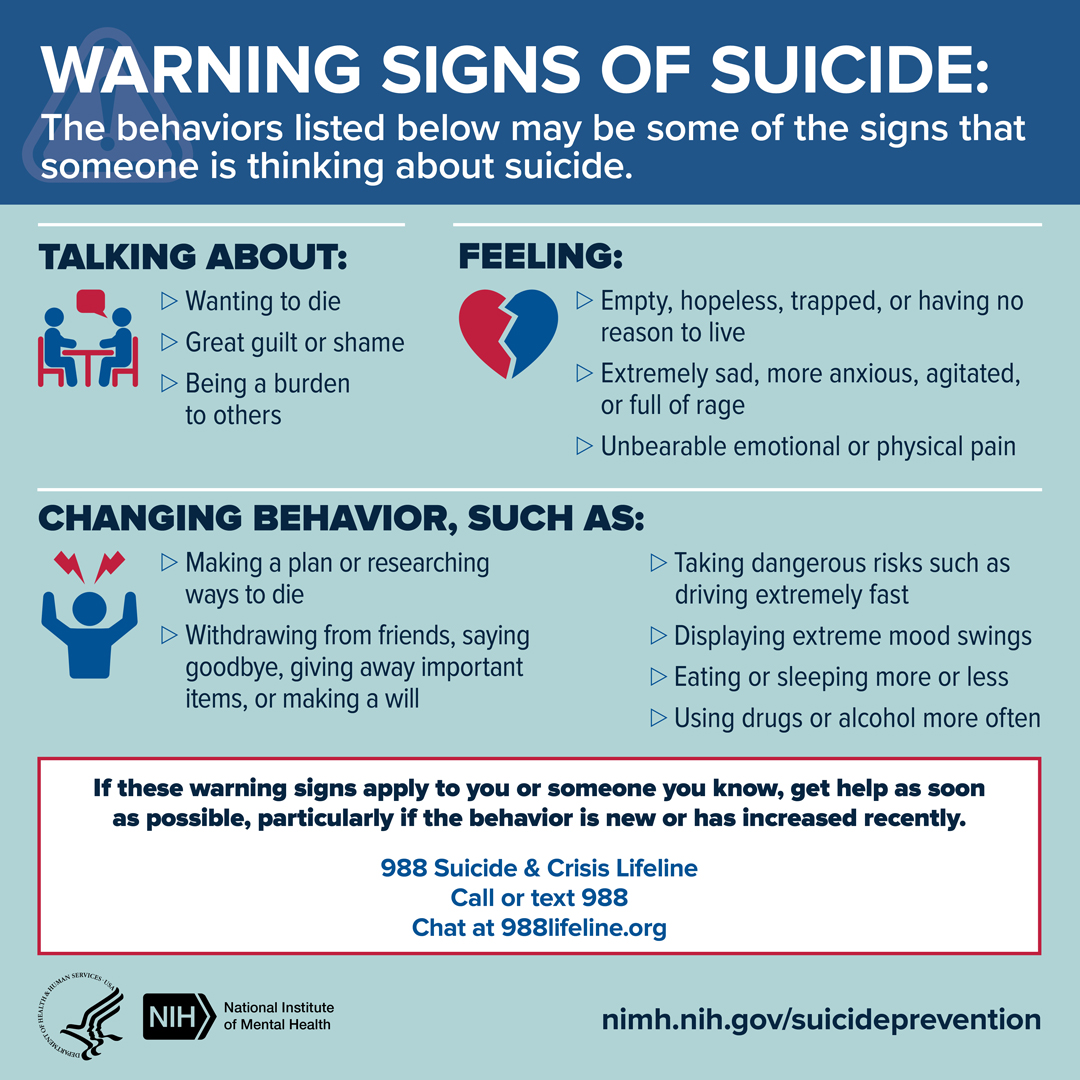
Being familiar with the signs that someone may be in a mental health crisis may save their life, the key is understanding the signs and knowing how to approach the conversations. This is not an easy task and often you will not be let in. That should not stop us from trying. This is a very fragile time and it takes great empathy, patience, and understanding to help someone in crisis. This is not a short-term, wham-bang fix and doesn’t involve your ego.

These are warning signs shared by The National Institute of  Mental Health.


Presents behaviors and feelings that may be warnings signs that someone is thinking about suicide. Points to www.nimh.nih.gov/suicideprevention.


In the post How To Start A Conversation About Suicide, Jeremy Forbes has done a great job in his TED Talk video, check it out.

I hope you or someone you care about doesn’t ever reach the point of planning suicide, please reach out or be the person who tries hard to help.

Melinda

Celebrate Life · Communicating · Family · Health and Wellbeing · Men & Womens Health

Daily Writing Prompt

Daily writing prompt
List the people you admire and look to for advice…

My Grandparents had learned so much in their lifespan, and I always sought their advice. My husband is my trusted partner for advice for close to 23 years, and the only person I’ve turned to since my Grandparents died.

Have a great day.

Melinda

Looking for the Light