
Book Review · Celebrate Life · Chronic Illness · Health and Wellbeing · Men & Womens Health · Mental Health

Book Review Finding Joy with an Invisible Chronic Illness by Christopher Martin

I was kindly gifted an advanced copy of Finding Joy with an Invisible Chronic Illness, Proven Strategies for Discovering Happiness, Meaning, and Fulfillment by Christopher Martin from NetGallery for a review. 

Published 2021

I am a school psychologist, husband, father, and – pertinent to this website – an author who has multiple invisible chronic illnesses. 

And an invisible chronic illness is a beast.  On top of draining you physically, a chronic illness can impact all aspects of your life ranging from causing financial hardship to harming your relationships to dampening your spirits.  Try to be cheerful when you have this unremitting “monkey on your back” known as an invisible chronic illness that constantly demands your attention 24-7.  Needless to say, it’s easy to let yourself and others down. 

      Plus, your family or friends can’t see your illness, as it’s invisible, and they may not understand.  Most with an invisible illness are familiar with “advice” ranging from “stay positive” to “you look good” to “Have you tried ___ for your condition?”  Yup, you probably have, and it didn’t work. 

      On top of that, best wishes in accessing (and maintaining) high quality medical care when you are too tired to even take care of yourself.    

      Welcome to the world of an invisible chronic illness.  I should know.  I suffer from multiple invisible chronic illnesses, including a primary immune deficiency disorder and bronchiectasis. 

 But it doesn’t have to be this way – for you or for me.    While I am not cured of my illness, I enjoy a fulfilling life and experience ongoing joy, peace, and happiness.  Because of outstanding medical care, extensive self-educating and self-care, a supportive family, and a strong faith, I effectively manage my chronic illnesses.  But I didn’t want to be the only one to benefit.  It was my goal, in turn, to give back to others by doing what I love to do:  authoring books on these conditions. 

Blurb

“Finding Joy is a vital guide on how to best manage and navigate life with a chronic illness.”—James Nestor, New York Times bestselling author of Breath: The New Science of a Lost Art

“Finding Joy provides a comprehensive, evidence-based roadmap for not only coping with chronic illness, but personally optimizing self-growth and resiliency from the experience.” —Joanne Joseph, PhD, professor of psychology and interim dean of the College of Health Sciences, SUNY Polytechnic Institute, and author of The Resilient Child: Preparing Today’s Youth for Tomorrow’s World

* How can you experience those good thoughts and feelings, enjoy life to its fullest, and de-stress when faced with relentless physical suffering?

* How can you enhance your relationships, find support, respond to the naysayers, and possibly even help them understand you and your illness?

* When seeking medical care, how can you get the answers you deserve, and access and maintain quality healthcare?

Early Reviews

“”Finding Joy is absolutely phenomenal. Chris Martin’s heartfelt approach offers numerous meaningful strategies to thrive when faced with the many unseen and unrecognized issues of living with an invisible chronic illness.””—Heather Lewis-Hoover, MS, CAS, school counselor

““Finding Joy is a vital guide on how to best manage and navigate life with a chronic illness.””—James Nestor, New York Times bestselling author of Breath: The New Science of a Lost Art

“Finding Joy provides a comprehensive, evidence-based roadmap for not only coping with chronic illness, but personally optimizing self-growth and resiliency from the experience.” —Joanne Joseph, PhD, professor of psychology and interim dean of the College of Health Sciences, SUNY Polytechnic Institute, and author of The Resilient Child: Preparing Today’s Youth for Tomorrow’s World

My Thoughts

I think Chris says it best, the diagnosis is a step forward, it’s not the last. 

Finding Joy with an Invisible Chronic Illness is a great find, one for all to read, patients, loved ones, and, family members. It is a simple and practical approach to taking control by understanding how we think and what we have control over when it comes to our chronic condition and healthcare treatment. 

Enjoy Reading,

Melinda

Looking for the Light

@LookingLight

Celebrate Life · Friendships · Health and Wellbeing · Men & Womens Health

Daily Writing Prompt

Daily writing prompt
What quality do you value most in a friend?

For me, it’s a combination of qualities that build a solid friendship. Honesty and a shared confidence are critical to me. When I having a conversation it’s between us only unless we discuss other wise. Truth is the foundation of all relationships to me, I don’t have time for fake friends.

Melinda

Looking for the Light

Celebrate Life · Fun · Mental Health · Music

#Weekend Music Share-Michael Jackson Billie Jean Live 1997

WOW!!!! What can you say?

It’s the weekend!!!!!!

 I’m glad you joined me for another edition of Weekend Music Share this week.

Have a great weekend!

Melinda

Welcome back to Weekend Music Share, the place where everyone can share their favorite music.

Feel free to use the Weekend Music Share banner in your post, and use the hashtag #WeekendMusicShare on social media so other participants can find your post.

Communicating · Health and Wellbeing · Medical · Men & Womens Health · Mental Health · Mental Illness

Would You Recognize The Signs That Someone May Be Contemplating Suicide?

Years ago my father’s roommate committed suicide in his bedroom. The signs were clear but my father had no idea. The roommate woke up one morning and mowed the yard, cleaned the house, he returned everything he had borrowed including money owed. He then went to his bedroom and didn’t come out for hours. For reasons unknown to me my father went to check on his gun and it was missing. He knocked on the door repeatedly with no answer. Growing concerned he called the police, the moment the police breached the door the gun went off.

Being familiar with the signs that someone may be in a mental health crisis may save their life, the key is understanding the signs and knowing how to approach the conversations. This is not an easy task and often you will not be let in. That should not stop us from trying. This is a very fragile time and it takes great empathy, patience, and understanding to help someone in crisis. This is not a short-term, wham-bang fix and doesn’t involve your ego.

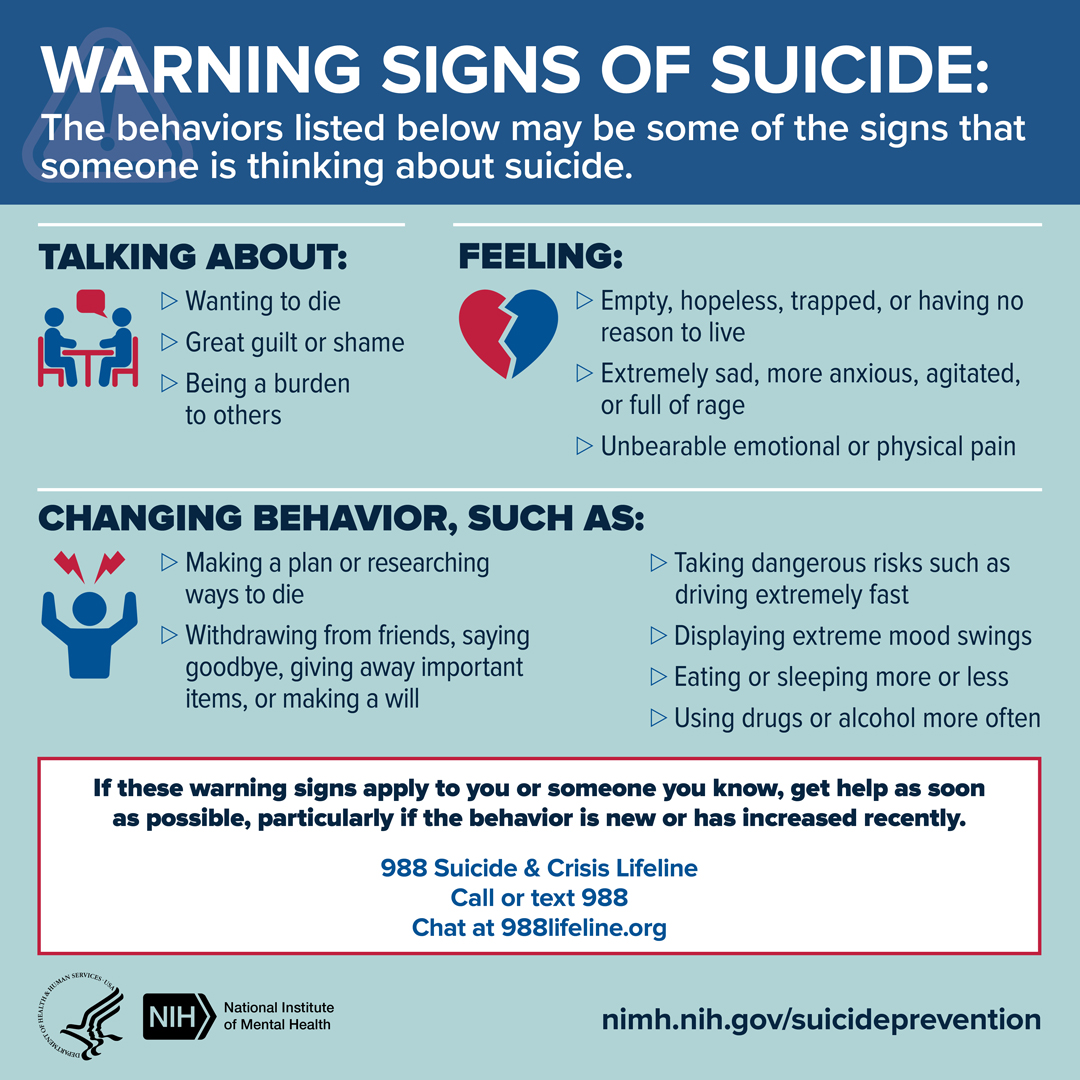
These are warning signs shared by The National Institute of  Mental Health.


Presents behaviors and feelings that may be warnings signs that someone is thinking about suicide. Points to www.nimh.nih.gov/suicideprevention.


In the post How To Start A Conversation About Suicide, Jeremy Forbes has done a great job in his TED Talk video, check it out.

I hope you or someone you care about doesn’t ever reach the point of planning suicide, please reach out or be the person who tries hard to help.

Melinda

Celebrate Life · Health and Wellbeing · Men & Womens Health · Religion

Daily Writing Prompt

Daily writing prompt
Do you practice religion?

My parents were not active in church when I was little, so I would ask different neighbors if I could go to church with them. I was baptized but felt no connection to a church. At 14 years old I converted to Catholicism and was active in the church for many years. I’ve realized that going to church doesn’t define my relationship with God. I practice religion directly with God.

Melinda

Looking for the Light

Celebrate Life · Fun · Health and Wellbeing · Mental Health

Wordless Wednesday-Tomato Beds

I’m glad you joined me on Wordless Wednesday and I hope to see you soon.


I’ve planted basil and mint in the beds to deter pests.

Melinda

Celebrate Life · Chronic Illness · Chronic Pain · Health and Wellbeing · Medical · Men & Womens Health · Self-Care

Heat or Cold Therapy for Arthritis

Arthritis is a condition that causes joint pain, inflammation, and stiffness. Though there’s no cure, you can use natural treatments such as heat and cold therapy to slow its progression and manage symptoms. 

Heat and cold therapy are common treatments for arthritis due to their ability to alleviate pain, discomfort, and stiffness in joints, muscles, and soft tissues. The treatments may help to improve mobility, increase flexibility, and boost blood circulation, which may bring you immediate relief. Heat and cold therapyTrusted Source may also be slightly beneficial in improving function and quality of life.

You can use a combination of heat and cold therapy based on your symptoms and which treatments you find most effective, convenient, and enjoyable. Depending on time, convenience, and preference, you may add some of these therapies to your routine. Aim to do heat or cold treatments a few times daily. 

Continue reading to learn more about the various types of heat and cold therapy. These simple treatments may relieve arthritis symptoms and help you to feel better.

Types of cold therapy for arthritis

Cold therapy, or cryotherapy, decreases blood flow to the affected area, which can reduce swelling and inflammation. It may have a numbing effect and help to relieve pain. However, it may exacerbate muscular tension. 

In general, cold therapy is best for painful, inflamed joints, making it the best option for acute pain, inflammation, or swelling. It may be beneficial to do cold therapy after exercise or physical activity that causes discomfort. For best results, elevate the affected area.

Do not use cold therapy if you have poor circulation or a sensory condition such as diabetes that inhibits your ability to detect particular sensations. Talk with your doctor before using cold therapy if you have cardiovascular or heart disease.

To prevent nerve, tissue, and skin damage, do cold therapy for a maximum of 20 minutes. Continually check to make sure you can feel sensations in the affected area.

Ice pack 

Apply a bag of frozen food, a bag of ice, or an ice pack to the affected area. You can also freeze a wet towel or sponge before applying it to the affected area. Wrap a towel around your ice pack to protect your skin. 

Apply the pack for up to 20 minutes at a time. Stop the treatment if your skin begins to feel numb.

Check out some of the best ice packs for joint pain here

Ice massage 

Use an ice cube to massage the affected area. You can make a large ice block by freezing water in a paper cup. 

Have a towel handy to absorb excess moisture.

Ice bath

You can take a full or partial ice bath to reduce inflammation and muscle pain. Stay in an ice bath for a maximum of 15 minutes. 

Cold bath or shower

For an option that’s less extreme than an ice bath, take a cold bath or shower. According to a 2017Trusted Source study, cold mist showers may help to reduce pain in people with chronic inflammatory arthritis.

Types of heat therapy for arthritis

There are several types of heat therapy, called thermotherapy, options for arthritis. Heat therapy improves circulation and causes your blood vessels to expand. This helps your body to deliver more blood, oxygen, and nutrients to the affected area, which may reduce inflammation, stiffness, and pain. Heat therapy may also improve mobility, which makes it easier to relax, loosen up, and move.

If a heat therapy session causes swelling, redness, or inflammation avoid further treatments until your symptoms subside. Avoid using heat therapy during a flare-up or the acute stage of an injury. Talk with a healthcare professional before using heat treatments if you have heart disease or high blood pressure. 

Do not use heat therapy if you have any of the following conditions: 

  • diabetes
  • dermatitis
  • vascular diseases
  • deep vein thrombosis
  • multiple sclerosis (MS)

Hot shower 

Hot showers may be beneficial to prepare for exercise or the day ahead. They may alleviate stiffness, improve mobility, and increase flexibility. Make sure the water isn’t too hot, especially if you have any cardiovascular concerns.

Warm compress 

Apply a hot water bottle, electric heating pad, or homemade heating pad to the area of concern for up to 20 minutes at a time. For a full-body treatment, use an electric blanket.

This therapy is not suitable for people who have diabetes, have impaired sensation, or have had a stroke. 

Swim or exercise in warm water 

Swimming and exercising in warm water allows you to build muscle strength, improve flexibility, and increase mobility while reducing compression to your joints. This may help to ease discomfort and alleviate stiffness. 

If you live near a warm body of water, take a dip in a natural setting. Otherwise, find a heated pool in your area. Aim to spend at least 20 minutes in the water.

Bath

Take a warm bath to relax and release tension or pain. For more benefits, add ingredients such as baking soda, Epsom salts, or essential oils. You can bathe for up to 2 hours. 

Saunas and steam rooms 

You can use a dry sauna, infrared sauna, or steam room to improve circulation and alleviate stiffness.

The results of a 2018Trusted Source review suggest that consistent use of a dry sauna is beneficial for people with rheumatoid arthritis as well as chronic pain syndrome. It may also help athletes to improve performance.

You can stay in a dry sauna or steam room for up to 15 minutes though you may want to begin with shorter sessions. Give yourself plenty of time to cool down in between sessions.

If you’re pregnant, talk with your doctor before using a sauna or steam room. 

Paraffin wax treatment 

This treatment may help to boost circulation, receive tension, and alleviate stiffness. 

To do a paraffin wax treatment, dip your hands or feet in hot paraffin wax and cover the area with plastic or a towel. After 20 minutes, remove the wax. Pay attention to how your skin reacts and look out for any adverse reactions.

Does alternating heat and cold therapy help?

Many people find it beneficial to alternate between heat and cold therapy. You can switch between hot and cold therapies throughout the day. Usually, it’s best to wait at around 20 minutes between sessions, though you can also alternate between hot and cold water in the shower. Always start and finish with a cold treatment. 

Talk with your doctor before alternating between full-body treatments such as an ice bath and a sauna or hot tub.

The bottom line 

If you’re looking for remedies for arthritis to add to your existing treatment routine, heat and cold therapy are great options. You can use hot and cold therapies to manage symptoms of arthritis and improve your overall comfort. 

Heat treatments help to relieve stiffness, improve circulation, and increase flexibility. Cold treatments alleviate pain and inflammation, which make them useful to do following physical activity. The effect of heat and cold therapy may only last a few hours, though over time they may help to reduce the severity of pain and keep symptoms at bay for longer.

Choose the remedies that yield the best results and add them to your self-care routine. Always make sure to protect your skin since hot and cold therapy have the potential to cause skin damage. Talk with a healthcare professional before starting any new therapy, especially if you have any additional medical conditions or take medications.

Melinda
Reference:

Chronic Illness · Chronic Pain · Health and Wellbeing · Medical · Men & Womens Health · Mental Health · Self-Care

Fibromyalgia Awareness Month

Fibromyalgia Awareness Month is important to me because I have it and know others that do. One of the biggest challenges Fibromyalgia patients face is there are so many different symptoms and they mimic other illnesses. That’s one reason it can years to get a proper diagnosis.

Why National Fibromyalgia Awareness Day?

Fibromyalgia is a chronic, complicated disease that affects millions of men and women throughout the world. A musculoskeletal illness produces widespread severe pain with symptoms like increased skin sensitivity, muscular rigidity, difficulty sleeping, memory and attention problems, excessive weariness, and headaches.

It is a challenging condition to identify because there isn’t a single test that can detect and treat it, and the symptoms get frequently misdiagnosed as attributed to other illnesses. Many people feel that the condition is psychological and not genuine due to a lack of research and the difficulties in defining the variables that cause it. Furthermore, there is no permanent relief for the suffering.

As a result, the keys to combating Fibromyalgia are awareness and financing. The goal of this day is to raise awareness about the condition and to encourage further research into finding a cure. The day’s observances greatly minimize the level of threat and the likelihood of being afflicted. When we try to learn more about a disorder like fibromyalgia, we realize just how far we’ve come in terms of innovation and advancement. Observing National Fibromyalgia Awareness Day allows us to reflect on our accomplishments.

Thoughts

Another huge challenge of having Fibromyalgia is it’s invisible, you don’t look sick unless you’re having your worst day. Most of the time you look fine and that is where the misunderstanding about the illness starts with friends and family. You can’t predict how you’ll feel tomorrow let alone next week, so you make plans, only to have a flair day and can’t get out of bed or can’t think straight and have to cancel your plans.

When people think you look fine and you’re not they can take it personally, that’s why it is important to share the basics of the illness and tell them that when you have to cancel on short notice it has nothing to do with them or not wanting to see them.

One suggestion for those newly diagnosed is to take your loved one or family member to a doctor’s appointment. This made a huge difference for me with my mental illness. My husband got to hear everything from the doctor’s mouth and got a better understanding of what I was dealing with. We also tell our doctor symptoms we don’t talk about every day and this is another time your loved one can understand all the ways Fibromyalgia affects your life.

Another way you can help is to participate in a Clinical Trial for Fibromyalgia, Keep your eyes open for news about trials in your area. It’s always possible you’ll get a drug that helps you in some way vs a placebo. It’s a 50% chance. The key is to understand the risks and or interactions with your other medications. 

Go easy on yourself. If the house isn’t as clean as you’d like, don’t worry about it. Work a little at a time or call a house cleaning service if you can.

Melinda

Looking for the Light

References:

https://www.nationaldaystoday.com/national-fibromyalgia-awareness-day/


Chronic Illness · Health and Wellbeing · Medical · Men & Womens Health · Tick Borne Illnesses

New advanced screening tests for tick-borne diseases in dogs

Antech, a veterinary diagnostics company, has launched two advanced screening tests for tick-borne diseases, heartworm, and other pathogens.

Enhanced Accuplex™ can now test dogs for three Ehrlichia species, and two Anaplasma species, alongside heartworm (Dirofilaria immitis)antigen, and antibodies to confirm exposure to Lyme borreliosis (Borrelia burgdorferi).

Antech is also offering a new enhanced vector-borne disease PCR panel for dogs and cats. capable of detecting such threats as Rocky Mountain spotted fever, babesiosis, and cytauxzoonosis.

Click here for more information from Antech.

Melinda

Reference:

https://www.lymedisease.org/screening-tests-dogs/