Although it may be difficult to sleep well with all that is going on around the world at the moment, good sleep is still possible. This article goes into one of the three things that you really need to sleep well on a regular basis.
“…We hope to share the stories that show kindness, compassion, hope, overcoming challenges and in general, the impressive resilience of the human spirit. For every dark, negative story out there, there is a positive, heartwarming story that will add some light and lift the human spirit.”
In a national emergency, some people’s initial thoughts are to fight over toilet paper. Others, like Good News Network reader Trina Branella, immediately want to leap to the aid of those in the front lines of the crisis.
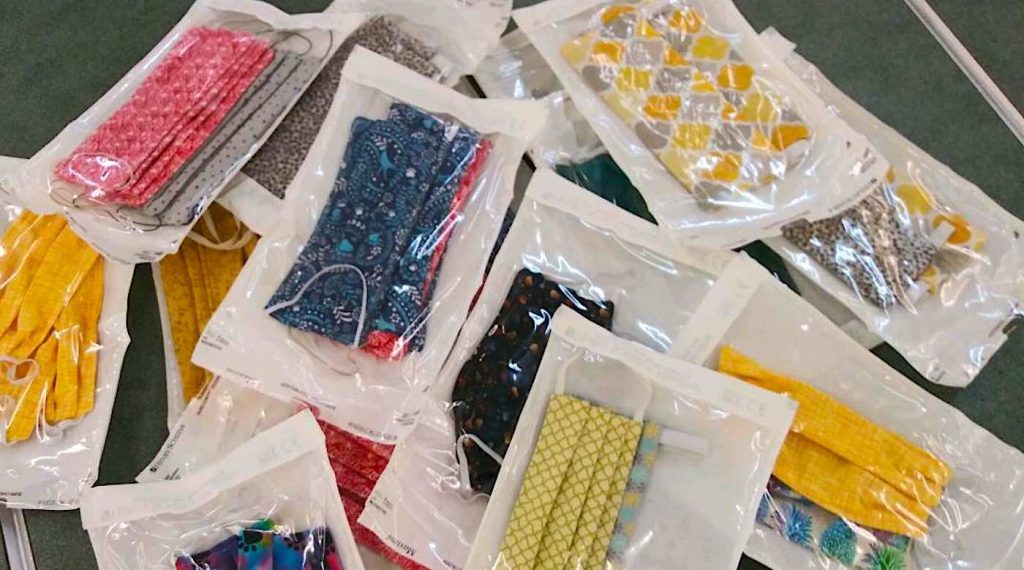
Trina began constructing and sewing cloth masks for a project in Indiana to help teenage cancer patients undergoing chemotherapy. Then, wanted to donate more masks to workers at four local chemo centers in New Jersey, spurred on by a friend of hers whose mother has cancer “and right now she’s using a bandana.”
Cloth masks are useful because they keep your hands from touching your nose and mouth (especially out in public where you don’t know if surfaces are clean). They also can contain sneezes and coughs, protecting those around you who may have vulnerable immune systems.
As Trina was running low on fabric and unable to purchase more, she asked around to see if there was anyone willing to donate to a good cause, but had no luck.
She then reached out to Good News Network on Friday, the very same dayGNN received a press release from JOANN fabric Stores announcing that the U.S. company would begin donating materials to anyone looking to sew together masks, gowns, or other essential medical equipment for healthcare workers.
After learning the JOANN Stores were launching the program on March 23, we submitted Trina’s order to the company and they said the supplies would be mailed immediately to her in Somerdale, New Jersey.
Branella was thrilled to hear about the donation program and ordered 5 yards of flannel, and a couple packets of 1/8 inch elastic.
“I just have this warm, little fuzzy going on right now,” she told GNN by phone. “I’m so happy they’re doing something. I love JOANN’s.”
Beyond just donated materials, JOANN is offering “Ship-to-Home” or “Curbside Pickup” options, so customers won’t need to come into the stores.
The chain includes 865 stores across 49 states (find your local store here)—but not all shops may be participating, so telephone the store first.
“The amazing thing about the crafting community is that, especially in difficult times, they are always looking for ways to help,” said Wade Miquelon, President & CEO of JOANN.
All open JOANN locations will serve as collection points, too, so that people sewing in their homes can drop off any items created, which will then be distributed to medical centers to help extend their dwindling supplies.
Photos by JOANN Stores
“We are seeing hospital workers, organizations and individuals coming into our stores for supplies to make these essential items, and our customers are asking us how they can help,” Miquelon added. “So many are spending their time and money to help in this tragic situation, and we want to step in to do our part to protect the amazing people who are helping the communities we serve.”
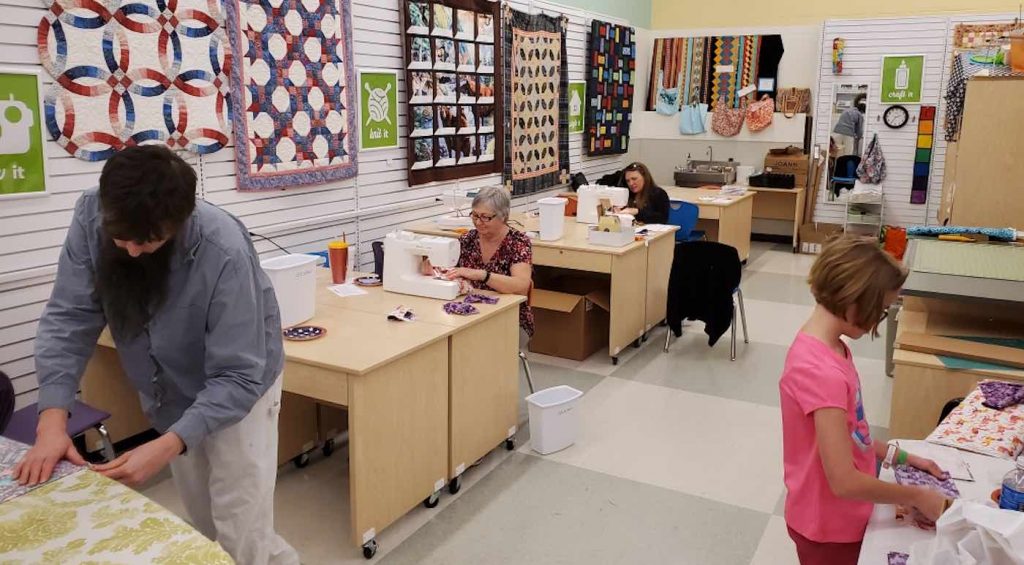
They say they will also open their classrooms—while adhering to social distancing guidelines—to any who want to help make these essential items. Participating locations will offer sewing machines, materials and guidance to help customers safely make face masks and covers, gowns and other items to donate to America’s hospitals. They have some How-to guides here.
“We have a generous community who can make a big difference as our healthcare system faces this crisis,” Miquelon said. “We’re here to support them, and all who make to give year round. We are all in this together.”
“We are the World” Blogfest” aims to spread the message of light, hope and love in today’s world. We are challenging all participants to share the positive side of humanity. This month’s co-hosts, Sylvia McGrath, Lizbeth Hartz, Shilpa Garg, Mary Giese, and Belinda Witzenhausen welcome participants and encourage all to join in during future months. #WATWB comes on the last Friday of every month. Click HERE for more information. You are always welcome to join in!You can find more stories of hope, light, and love on the WATWB Facebook Page. Click HERE to be part of the Light.
Many of us are experiencing emotional distress from the pandemic which can affect each of us in different ways, but often presents as increasing anxiety, worry, sleep disruption, feelings of helplessness, panic, and/or depression. The shrieking headlines don’t help do they? So what can we do to manage these feelings and feel stronger emotionally and […]
International Women’s Day is celebrated on the 8th March every year. http://www.internationalwomensday.com This years theme is #EachforEqual – in other words, raising awareness of a gender equal world, as well as celebrating women’s achievements around the world. ”Let’s all be each for equal”is something many women around the world challenge. Expressing their individuality, debating stereotypes […]
We live in an era when organic, biological products are highly valued. We are trying to buy organic vegetables and fruits, prefer organic supermarkets with bioproducts and increasingly enjoy bio-positive restaurants! And that’s AWESOME! After all, we are what we eat! I remember my childhood when I was sent to my grandmother in the village. […]
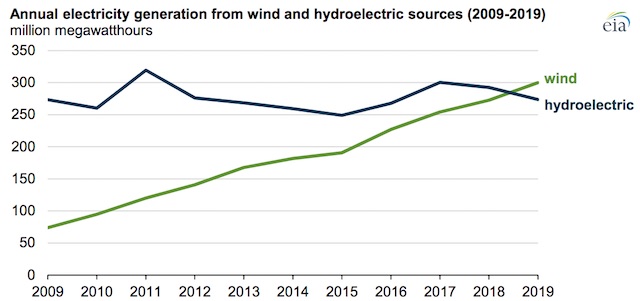
According to the U.S. Energy Information Administration’s newly-released Electric Power Monthly, the exciting milestone means that wind is now the top renewable source of electricity generation in the country—a position previously held by hydroelectricity for several decades.
Annual wind generation totaled 300 million megawatthours (MWh) in 2019, exceeding hydroelectric generation by 26 million MWh. Wind generation has increased steadily during the past decade, in part, because the Production Tax Credit (PTC)—which drove wind capacity additions—was extended. Annual hydroelectric generation has fluctuated between 250 million MWh and 320 million MWh in the past decade, reflecting a stable capacity base and variable annual precipitation.
Annual changes in hydroelectric generation are primarily the result of variations in annual precipitation patterns and water runoff. Although weather patterns also affect wind generation in different regions, capacity growth has been the predominant driver of annual changes in wind generation.
Both hydroelectric and wind generation follow seasonal patterns. Hydroelectric generation is typically greatest in the spring when precipitation and melting snowpack increase water runoff. Seasonal patterns in wind generation vary across the country, but wind generation is usually greatest in the spring and fall.
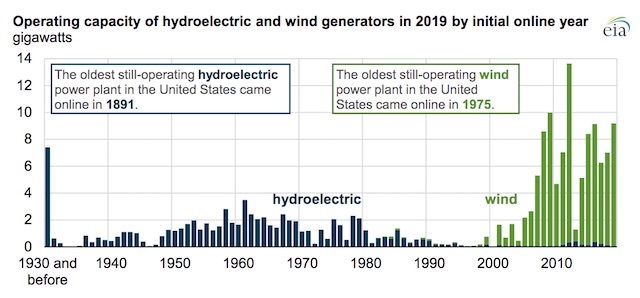
Wind capacity additions tend to come online during the fourth quarter of the year, most likely because of tax benefits. Wind capacity additions totaled 10 gigawatts in 2019 (3.8 GW installed in the fourth quarter), making 2019 the second-largest year for wind capacity additions, second only to 2012.
As of the end of 2019, the United States had 103 GW of wind capacity, nearly all of which (77%) were installed in the past decade. The United States has 80 GW of hydroelectric capacity, most of which has been operating for several decades. Only 2 GW of hydroelectric capacity has been added in the past decade, and some of those additions involved convertingpreviously non-powered dams.
Although total installed wind capacity surpassed total installed hydroelectric capacity in 2016, it wasn’t until 2019 that wind generation surpassed hydroelectric generation. The average annual capacity factors for the hydroelectric fleet between 2009 and 2019 ranged from 35% to 43%. The average annual capacity factors for the U.S. wind fleet were lower, ranging from 28% to 35%. Capacity factors are the ratio of the electrical energy produced by a generating unit for a specified period of time to the electrical energy that could have been produced at continuous full power operation during the same period.
“We are the World” Blogfest” aims to spread the message of light, hope and love in today’s world. We are challenging all participants to share the positive side of humanity. This month’s co-hosts, Sylvia McGrath, Lizbeth Hartz, Shilpa Garg, Mary Giese, and Belinda Witzenhausen welcome participants and encourage all to join in during future months. #WATWB comes on the last Friday of every month. Click HERE for more information. You are always welcome to join in!You can find more stories of hope, light, and love on the WATWB Facebook Page. Click HERE to be part of the Light.
This week marks the 7 year anniversary of my diagnosis with Lyme Disease. Before that I lived with (or rather, slowly succumbed to) this debilitating disease for 5 years. After my diagnosis, it took another 3 years of treatment before I was finally Lyme-free. Then I relapsed a year later, but beat it again after […]
As hard as I try to hold myself to high standards, I’ve discovered I’m not a machine. I still look in the mirror and find a human being looking back at me, with all of my flaws, faults and positives as well. Sometimes I expect so much from myself, when I make a mistake or […]
As a home health nurse, I have done a lot of education on fall prevention. Falls can cause serious injury and even death to Senior citizens. According to the National Council on Aging, falls are the leading cause of fatal injury and The most common cause of non-fatal trauma-related hospital admissions among older adults. There […]
In the last six weeks two new oral medications have become available for the acute treatment of migraine. Reyvow (lasmitidan) was approved by the Food and Drug Aministration (FDA) October 11, 2019, but it has only recently been made available to prescribe. Ubrelvy (ubrogepant) was approved by FDA December 23, 2019, and is also now […]
Dear friends, “Beyond Survival: Hope and Healing on Kilimanjaro” is the 11th addition to the MenHealing library of videos that feature the healing journeys of male survivors. This 22-minute video chronicles the incredible journey of Weekend Of Recovery Alumnus Jordan Masciangelo’s successful climb to the 19,341 foot summit of Africa’s Mt. Kilimanjaro In January 2019 This Expedition Climb project was a labor of love to heighten public awareness about male sexual victimization and was successful in raising nearly $9,500 for the WOR Scholarship Fund. We are deeply grateful to David James Findlay, a professional television commercial editor in Toronto, for producing this video FOR FREE as a gift to Jordan and to MenHealing. To watch the video click here.All “Beyond Survival: Voices of Healing” videos now have closed caption accessibility. Several videos are also currently available with Spanish language access; Spanish translation for all videos will be completed soon. Jim Struve Executive Director, MenHealing/Weekends of Recovery www.menhealing.org Stay connected on our social media platforms!
It doesn’t take 21 days to wire in a habit, says psychologist BJ Fogg. Sometimes, all you need is a shot of positive feeling and emotion, a dose of celebration. Celebrating is a great way to reinforce small changes — and pave the way for big successes.
Psychologist BJ Fogg is the founder and director of the Behavior Design Lab at Stanford University — he’s coached over 40,000 people in his behavior change methods and influenced countless more. His Tiny Habits method states that a new behavior happens when three elements come together: motivation, ability and a prompt.
If we really want to make lasting changes in our lives, Fogg believes we need to break them down into specific, easy behaviors (what he calls Tiny Habits), and find ways to trigger and reward them. Taking 30 seconds or less, a Tiny Habit is fast, simple and will grow For example, instead of having “get in shape” as a vague and intimidating goal, do two push-ups every time you make your morning coffee — that’s your Tiny Habit. After a while, you can increase the number of push-ups and expand into different exercises.
In working with thousands of people, Fogg has found one thing really helps fledgling habits to stick: Celebrating them. Here, he explains how the power of celebration can wire new behaviors into our lives — and make us feel great in the process.
Linda had a postcard taped on her fridge next to her kids’ finger-painted masterpieces. It was a black-and-white illustration of a 1950s housewife talking on the phone. Above the woman’s perfectly coiffed head was a talk bubble: “If the kids are alive at five o’clock, I’ve done my job.”
When Linda saw it, she laughed out loud. It made her smile, then it made her think. It represented an attitude of self-acceptance that she badly wanted but felt was too difficult to adopt.
Linda was a full-time stay-at-home mom with six kids under the age of 13. She loved being home and wouldn’t have had it any other way, yet she felt constantly underwater and overwhelmed. Unlike the woman on the postcard, Linda’s every thought at the end of the day was about all the things she didn’t get done or had done badly: the Cheerios on the back seat of the car (“I should have vacuumed it”); the dirty plates in the sink (“I should have washed them; my mom would never left them”); her son’s face falling after she snapped at him for teasing his sister (“I should be more patient”), and so on.
In my research, I’ve found that adults have many ways to tell themselves “I did a bad job” and very few ways of saying “I did a good job.” Like Linda, we rarely recognize our successes and feel good about our accomplishments. We focus only on our shortcomings as we scamper through our days and trudge through our years.
I want to show you how to gain a superpower — the ability to feel good at any given moment — and use this superpower to transform your habits and, ultimately, your life. Feeling good is a vital part of the Tiny Habits method. You can create this good feeling by using a technique I call “celebration.” When you celebrate, you create a positive feeling inside yourself on demand. This good feeling wires the new habit into your brain. Celebration is both a specific technique for behavior change and a psychological frame shift.
I discovered the power of celebration when I was trying to pick up a tooth-flossing habit. I stumbled on it at a time when I felt so much stress that I could barely get through each day. A new business I’d started was failing, and my young nephew had died tragically. Navigating the fallout of those events meant I hadn’t gotten a good night’s sleep in weeks. I was so anxious most nights that I would get up at 3 AM and do the only thing that calmed me down: watch videos of puppies on the Internet.
One early morning, after a particularly bad night, I glanced in the mirror and thought to myself, “You know, this could be the day when the wheels totally fall off.” A day of not just setbacks but paralyzing failure.
As I went about my morning routine, I picked up the floss and flossed one tooth. I thought to myself, “Well, even if everything else goes wrong today, I’m not a total failure. At least I flossed one tooth.”
I smiled in the mirror and said one word to myself: “Victory!”
Then I felt it.
Something changed. It was like a warm space had opened up in my chest where there had been a dark tightness. I felt calmer and even a little energized. And this made me want to feel that way again.
But then I worried that I was losing it. My nephew had just died, my life seemed ready to fall apart, and flossing one tooth had made me feel better? That’s nuts.
If I hadn’t been a behavior scientist and endlessly curious about human nature, I might have laughed at myself and left it alone. But I asked myself, “How did flossing that tooth make me feel better? Was it the flossing itself? Or was it saying ‘Victory!’ into the mirror? Or was it smiling?”
I tried it again that evening. I flossed one tooth, smiled at myself in the mirror, and said, “Victory!” In the days that followed, many of which were still difficult, I continued to floss and proclaim victory. No matter what else was going on, I was able to create a moment in each day when I felt good — and that was remarkable.
When I teach people about human behavior, I boil it down to three words: Emotions create habits. Not repetition. Not frequency. Not fairy dust. Emotions. When you are designing for habit formation — for yourself or for someone else — you are really designing for emotions.
Celebration is the best way to use emotions and create a positive feeling that wires in new habits. It’s free, fast, and available to people of every color, shape, size, income and personality. In addition, celebration teaches us how to be nice to ourselves — a skill that pays out the biggest dividends of all.
Celebration is habit fertilizer. Each individual celebration strengthens the roots of a specific habit, but the accumulation of celebrations over time is what fertilizes the entire habit garden. By cultivating feelings of success and confidence, we make the soil more inviting and nourishing for all the other habit seeds we want to plant.
You can adopt a new habit faster and more reliably by celebrating at three different times: the moment you remember to do the habit, when you’re doing the habit, and immediately after completing the habit. Your celebration does not have to be something you say out loud or even physically express. The only rule is that it has to be something said or done — internally or externally — that makes you feel good and creates a feeling of success. It could be a “yes!”; a fist pump; a big smile; a V with your arms. You might imagine the roar of the crowd; think to yourself “Good job” or “I got this”; or picture fireworks.
I like to call this feeling “Shine.” You know it already. You feel Shine when you ace an exam. You feel Shine when you give a great presentation and people clap at the end. You feel Shine when you smell something delicious that you cooked for the first time.
If you’re stumped on what celebration might work for you, put yourself in the following scenarios and watch how you react. This will give you a clue about your natural ways of celebrating. As you read them, don’t overthink or analyze. Just let yourself react.
Scenario #1: You apply for your dream job. You make it through the process all the way to the final interview. The hiring manager says, “We’ll send an email with our decision.” The next morning the manager’s email is waiting for you. You open it, and the first word you read is: “Congratulations!” What do you do at that moment?
Scenario #2: You’re sitting at work. You have a piece of paper to recycle, and the recycling bin is in the far corner of the room. You decide to wad up the paper and throw it; you are not sure you’ll make it. You aim carefully and toss the paper. Up it goes into an arc and it vanishes into the bin — perfect shot! What do you do at that moment?
Scenario #3: Your favorite sports team is in the championship game. The score is tied and as the time on the clock runs out, your team scores — and wins the championship. What do you do at that moment?
Suppose you have this as a proposed habit: “After I walk in the door after work, I will hang up my keys.” I encourage you to celebrate the exact moment your brain reminds you to do your new habit. Imagine you walk in the door after work, and as you’re putting down your backpack, this idea pops into your head: “Oh, now is when I said I was going to hang my keys up so I can find them tomorrow.”
Celebrate right then. You’ll feel Shine, and by feeling it, you are wiring in the habit of remembering to hang up your keys, not the habit of hanging up your keys. When you celebrate remembering to do your habit, you’ll wire in that moment of remembering. And that’s important. If you don’t remember to do a habit, you won’t do it.
Another time to celebrate is while you’re doing your new habit. Your brain will associate the behavior with Shine. A woman named Jill was trying to adopt the practice of wiping down the kitchen counter right after she used it. What most reliably prompted the feeling of Shine for her was picturing the meal that her husband would make that night and imagining him giving her a kiss and saying, “Nice work, babe.” Her celebration was her visualizing this moment. It allowed her to connect her small action with positive feelings of togetherness. This celebration wired in the remembering and increased her motivation to wipe the counter in the future. Fast-forward to today: Jill wipes the counter without even thinking about it.
I know that celebration can sometimes trip people up. They can’t get themselves to celebrate, or they’ve tried out different celebrations and still feel like a big faker. It also may not feel that compelling or comfortable. If that’s how you feel, I suggest that you try one of my favorite techniques to get a taste of the power of celebration: the Celebration Blitz.
I encourage everyone to do a Celebration Blitz when you need a score in the win column: Go to the messiest room or corner in your house or office, set a timer for three minutes, and tidy up. After every errant paper you throw away, celebrate. After every dishtowel you fold and hang back up, celebrate. After every toy you toss back into its cubbyhole — you get the idea. Say, “Good for me!” and “Wow. That looks better.” And do a fist pump or whatever works for you. Celebrate each tiny success even if you don’t feel it authentically, because as soon as that timer goes off, I want you to stop and tune into what you are feeling.
I predict that your mood will be lighter and that you will have a noticeable feeling of Shine. You will be more optimistic about your day and your tasks ahead. You may be surprised at how quickly you’ve shifted your perspective. You’ll see that you made your life better in just three minutes. Not just because the room is tidier, but because you took three minutes to practice the skills of change by exploring the effects of tiny celebrations done quickly.
BJ Fogg , PhD, is the founder and director of the Behavior Design Lab at Stanford. In addition to his research, he teaches boot camps in Behavior Design for industry innovators and also leads the Tiny Habits Academy helping people around the world.
Being part of a group of betrayed partners and spouses was nothing I envisioned in a million years. For who of us expects to be betrayed by their spouse, or expects to be married to a sex addict? It’s not the kind of thing you ever think or dream about. And it’s not the kind of thing you really want to talk about.
In fact, you think you must be starring in some other person’s life – for you simply can’t believe that this is happening to you. It’s scary, and it’s crazy, and it cuts you to the heart. And that’s why it’s so important to encounter wives like you.
A community of women who are walking this road, too. And a group of shell-shocked women who just get what you’re going through. It becomes a kind of life-line for these women understand. There is no need…
Psychologist Susan David explains why a simple switch from “I must go to the gym three times a week” to “I want to go to the gym three times a week” can put your goal within reach.
Ted was a London-based client of mine who became a good friend. He was forty pounds overweight and, because he traveled a lot for work, he found it difficult to get into a healthy routine. After a long flight, he’d show up at a hotel tired, hungry and missing his family. He’d seek out comfort in a cheeseburger and a couple of beers, then he’d graze from the minibar. His wife and doctor were after him to lose weight and exercise, but somehow, knowing what he “had to” do never got him to do it.
Ted married late in life, and he and his wife adopted a boy from Romania named Alex. Alex had been orphaned at a young age and had spent his early years in heartbreaking circumstances. He’d barely been held, touched or spoken to, and was so malnourished he developed long-term learning disabilities.
Despite these difficulties, Alex was a very talented artist. One day, when he was 10, he drew a picture of himself alone, desolate and abandoned. He titled his picture “The Orphan.” Ted was not surprised at the theme — Alex often depicted his early memories — but this time, Ted noted that the figure in the picture was a young adult. When he asked Alex about it, his son began to cry. He said he “just knew” his dad would die because of his poor health habits, leaving Alex fatherless again.
In that moment, Ted later explained to me, he went from feeling that he “had to” change his health habits to feeling that he “wanted to.” He was motivated to get healthy out of love for his child and the desire to see Alex grow up. Ted began to make small changes — ordering salad instead of fries, placing the minibar candy out of sight, and exploring cities on foot rather than by cab — and those changes added up. He lost weight and has kept it off, because he wants to.
When we’re compelled by a wagging finger instead of a willing heart, we end up in an internal tug-of-war between good intentions and less-than-stellar execution.
When we double down on discipline and willpower, this rarely leads to the best results. You may drag yourself to the gym, but how often does that lead to you sticking with an exercise routine? You may call up your relatives out of obligation, but how often do you have a meaningful conversation? When we’re compelled by a wagging finger instead of a willing heart, we end up in an internal tug-of-war between good intentions and less-than-stellar execution.
Twenty-five hundred years ago, Plato captured this inner conflict with his metaphor of a chariot being pulled by two very different horses. One horse was passion — our internal urges — and the other was intellect — our rational, moral mind. Plato understood that we are constantly pulled in two opposing directions by what we want to do and what we know we should do. It is our job, as the charioteer, to tame and guide the horses in order to end up where we want to be.
Modern neuroimaging tells us that whenever the impulsive, reward-seeking system in our brain (passion) conflicts with our rational, long-standing goals (intellect), our brain tries to — pardon the pun — rein things in. Let’s say you’re trying to eat better. You’re at a restaurant, and you spot chocolate mousse on the dessert tray. That triggers activity in your nucleus accumbens, an area of the brain associated with pleasure. You want that chocolate mousse. But, no, you remind yourself, I can’t have it. As you muster up the strength to pass on dessert, your inferior frontal gyrus, a part of the brain associated with self-control, kicks in. With both areas activated, our brain is fighting with itself while we try to decide whether to dig in or abstain.
To make matters more complicated, our baser instincts have a head start. According to brain imaging, when we’re faced with a typical choice, basic attributes like taste are processed on average about 195 milliseconds earlier than health attributes. This might explain why, in one study, 74 percent of people said they would choose fruit over chocolate “at some future date,” but when fruit and chocolate were put in front of them, 70 percent grabbed the chocolate.
Want-to goals reflect a person’s genuine interest and values, while have-to goals are imposed, often by a nagging loved one or by our own sense of obligation.
Fortunately, there is a tiny tweak we can make to help us sidestep this competition between the two horses. Like Ted, we can position our goals in terms of what we want to do, as opposed to what we have to. When we tweak our motivation in this way, we don’t have to worry about which part of us prevails — our passion or our intellect — because our whole self is working in harmony.
Want-to goals reflect a person’s genuine interest and values (their “why”). We pursue them because of personal enjoyment, because of the inherent importance of the goal, or because the goal has been assimilated into our core identity. But most important, these goals are freely chosen by us.
Have-to goals, on the other hand, are imposed, often by a nagging loved one (“You’ve gotta lose that gut!”) or by our own sense of obligation, sometimes related to avoiding shame (“Good grief! I look like the Goodyear blimp! I can’t go to the wedding looking like this!”).
You can choose to eat a more healthful diet out of feelings of fear, shame or anxiety. Or you can choose to eat well because you view good health as an important quality that helps you feel good and enjoy life. A key difference between these two kinds of reasons is that although have-to motivations will allow you to make positive changes for a while, eventually that determination is going to break down.
Studies show, for instance, that two people with the same goal of losing five pounds will see that same serving of chocolate mousse very differently depending on their motivation. The person with a want-to motivation will physically experience it as less tempting (“The dessert looks nice, but I’m just not that interested”) and will perceive fewer obstacles in sticking to the goal (“There are other, healthier options on the menu”). Once she’s tweaked her motivation, she no longer feels like she’s struggling against irresistible forces.
Want-to motivation is associated with lower automatic attraction toward the stimuli that are going to trip you up — the old flame, the martini passing by on a waiter’s tray — and instead draws you toward behaviors that can help you achieve your goals. Have-to motivation, on the other hand, actually ramps up temptation because it makes you feel constricted or deprived. In this way, pursuing a goal for have-to reasons can undermine your self-control and make you more vulnerable to doing what you don’t want to do.
I’m not suggesting we should all simply think positive and ignore real concerns. If you can’t find a want to, then that could be a sign that change is in order.
If life is a series of small moments, each of which can be adjusted ever so slightly, and all of which, in combination, can add up to significant change, imagine how much ground you could gain by employing this simple tweak and finding the want to hidden in the have to. We all fall into these subtle traps of language and think, “I have to be on dad duty today,” or “I have to attend another boring meeting.” When we do this, we forget that our current circumstances are often the result of earlier choices we made in service of our values: “I want to be a father,” or “I love the work that I do and want to excel at my job.”
To be clear, I’m not suggesting we should all simply think positive and ignore real underlying concerns. If you can’t find a want to in some particular facet of your life, then that could be a sign that change is in order. If you entered your field because you wanted to make a difference in the world but your company is focused more on the bottom line, it may be time to switch jobs. Or if you’ve come to realize that your significant other is not the person you thought he was, you might need to seek a new relationship. Finding a want to is not about forcing any particular choice; it’s about making it easier to choose things that lead to the life you want.
Susan David is a psychologist on the faculty of Harvard Medical School, cofounder and codirector of the Institute of Coaching at McLean Hospital, and CEO of Evidence Based Psychology, a business consultancy.
Had a maintenance ECT session today and it was a whopper! Dizzy and woozy all day, slept for hours and hours. Still not quite steady on my feet. It hasn’t been going very well recently, so we’re going to stick with a two week repetition for the maintenance sessions. Saw my psychologist for the last […]
From the moment I stepped into a psychiatric hospital during Christmas 2008 I knew I had a very long journey ahead of me. I had no idea the additional challenges that would unfold. I couldn’t have imagined how much my life could have been turned upside down. Untreated and under treated serious mental illness is […]
My diagnosis of fibromyalgia has been problematic. During one visit I mentioned my diagnosis of fibromyalgia and he said, and I quote “That’s not a real disease.”
It’s difficult to work if you only have part of the picture. This is so true of dyslexia. A few days back we explored how difficult it is for a child with dyslexia to answer school questions without help. A help which is often absent. Our son is dyslexic. He has found a way of […]
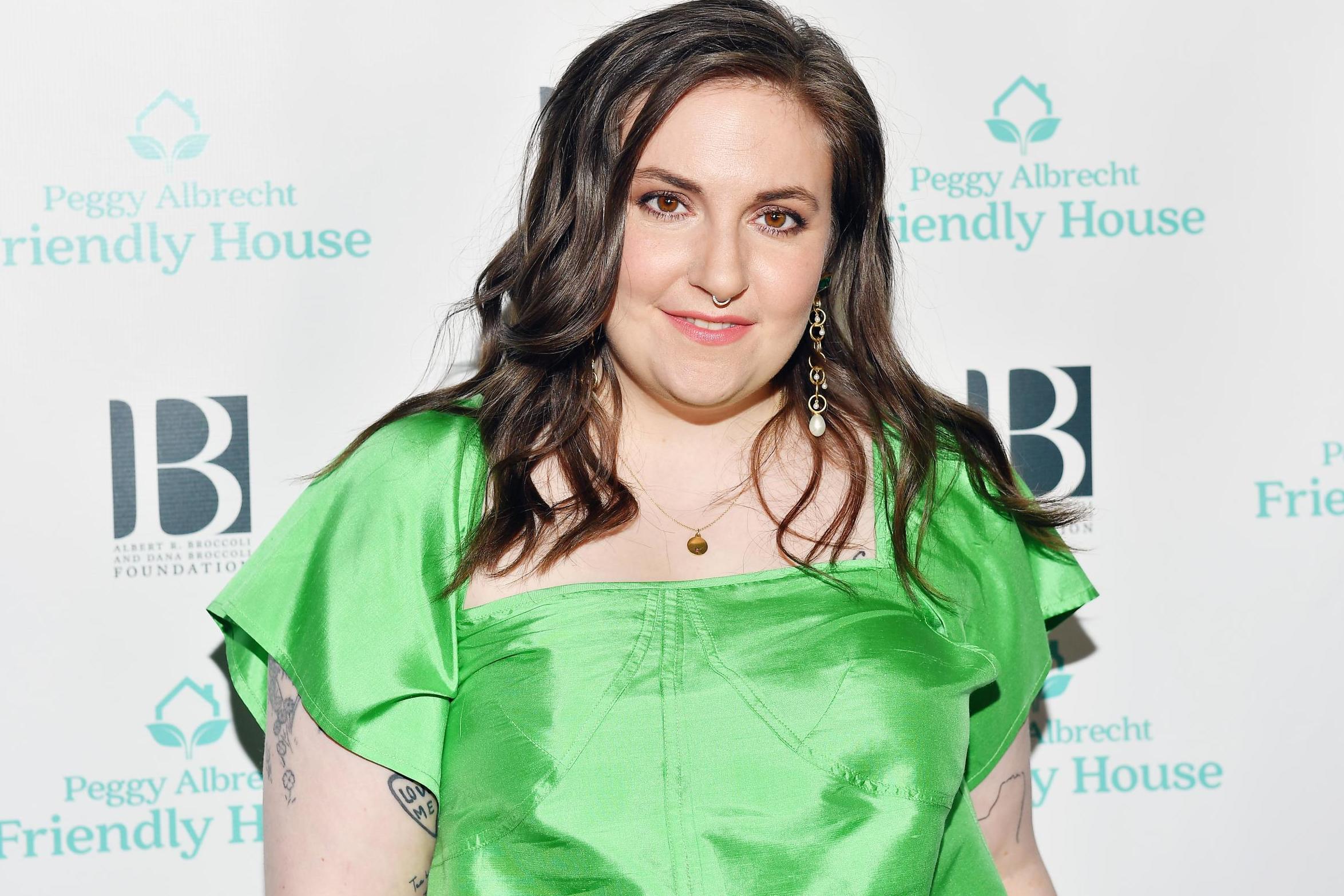
Lena Dunham attends the Friendly House 30th annual awards luncheon on 26 October, 2019 in Los Angeles, California. ( Vince Bucci/Getty Images for Friendly House )
The actor was named Woman of the Year by Friendly House, an addiction treatment facility for women in Los Angeles.
“I didn’t think that I was a drug addict,” Dunham, who has previously said she used to misuse prescription medication, said while accepting the honour at a luncheon this weekend, according to Variety.
Speaking in more detail about her former struggle around drugs, she added that “pills that I thought dulled my pain actually created it”.
Dunham, who has been sober for 18 months, first disclosed her history of drug abuse last year in a podcast with Dax Shepard.
At that time, she told the actor she had “misused [benzodiazepines]” for three years, adding: “Nobody I know who are prescribed these medications is told, ‘By the way, when you try and get off this, it’s going to be like the most hellacious acid trip you’ve ever had where you’re f****** clutching the walls and the hair is blowing off your head and you can’t believe you found yourself in this situation.”
During this weekend’s event, Dunham explained how media portrayals had skewed her perception of what addiction can look like.
“I didn’t think that I was a drug addict,” she said, deadpanning: “I thought drug addicts were depraved lunatics who wandered the streets, demanding crack from innocent children and flaunting their open wounds in public parks.
“And I was a successful, capable celebrity who wandered red carpets demanding attention and flaunting her open boobs on TV. It’s totally different.”Support free-thinking journalism and attend Independent events
The actor spoke candidly of her path to recovery, explaining: “When I was dropped off at rehab, I thought it was the end of my life.
“Seemingly overnight, I had lost almost all of what I hold dear: My relationships, my body and my career were in relative shambles.”
She made it clear that she’s now grateful for her sobriety, adding that “a woman who has overcome an addiction can do f****** anything”.
If you’ve watched daytime television you’ve heard every get rich quick scheme, start your own business and make $3,000 this month………I’m getting off track. I enjoy making money! I keep it simple by making money on purchases I’m already making. There are tons of apps that do coupons, check prices and anything imaginable if you want to be a SUPER SHOPPER.
I use two apps, Rakuten.com formerly Ebates and Honey.com. Both are installed in my browser and recognize when I shop at one of their partners. An Rakuten.com pop-up ask you to activate by clicking and it shows % of sale received on purchase.
Rakuten.com is my long-term favorite, it’s easy and they partner with all the places I shop. To date I’ve earned approximately $800.00. Rakuten.com pays out every quarter for your previous purchases. The big money days are when their partners offer double percent back and 10% days make me very happy. Small sales add up over the year.
Honey.com works based on finding coupon codes for your purchase. It runs thru a long list of coupon codes to see if one applies. You’ll see a pop up that says there are coupons codes. You click and it does it trick. I have not used Honey.com very long but received free shipping on several purchases.
*FRUGAL FIND
THREDUP.COM
ThredUp.com is a site for women’s clothing, shoes and accessesories. You can find new items with tags, almost new and used, all priced accordingly. You can also clean out your closet and send items to ThredUp to sale. They also accept some designer items for resale.
USE MY REFFERRAL LINK AND RECEIVE $20 CREDIT WITH FIRST ORDER.
If you are a Prime Member at Amazon.com you have a world of free goodies offered movies, bookes…..on and on. I rely on Amazon.com since I don’t drive and Prime Members get two-day free shipping.
The best discovery I’ve made is the Amazon Prime Member Card. It’s a credit card that can only be used at Amazon.com, it’s offered with no fees. You receive 5% back on every purchase you make on Amazon.com. WOW!!!!!
To give my husband down time on weekends, we get our groceries delivered. Prime Members get free delivery. The amount of time saved has surprised him, the money has brought a smile to my face. The grocery section is AmazonFresh, they have thousands of products including fresh bread.
Another up side to the delivery AmazonFresh uses frozen bottled water to keep items cold. Each week we receive 6-8 bottles of water free.
If you really want to save money, work all the coupon apps and be a Super Shopper. You have to be organized to handle that many coupons and will need lots of extra storage space.






 All “
All “






 lookingforthelight.blog