Health and Wellbeing · Men & Womens Health

4 Ways To Keep Your Vehicle Running Longer Than It Otherwise Might

Running a vehicle is often a large investment in time, energy, and financial prowess, and so many could be forgiven for wanting such a utility to run as long as possible. But of course, driving on the roads and driving safely on the roads are two separate habits, and will be determined in large part by the condition of the vehicle you use.

For this reason, it’s important to make sure your vehicle is not only roadworthy from a technical legal sense, but also that it’s in good condition, operates well, and that certain elements such as the brake tuning and tire pressure are properly maintained. In this post, then, we’ll discuss four different ways for keeping your vehicle running longer than it otherwise might, what that could imply, and a few tips for getting there without overdoing it.

This way, you’ll not only enjoy a better vehicle with more utility to offer, but you’ll notice yourself operating on the roads as a better, safer, more observant driver. With that in mind, let’s begin:

Photo by Tim Samuel on Pexels.com

Avoid Harsh Driving Habits

Harsh driving habits, such as constantly accelerating quickly and braking harshly, giving yourself too little room to turn with, overrevving your engine, and avoiding regular maintenance can leave a car more worn out than it may otherwise be. The opposite of these actions, then, can help you stay safer on the roads, as well as maintain your vehicle as necessary.

Calm Yourself On The Road

No matter the strain, be that a road covered in black ice, harsh drivers tailgating you or cutting you off, or passengers who may not be behaving as well as they could, keeping a calm head can help you find a safe place to park or to find an alternate route without escalating the situation. Focus behind the wheel has probably saved more lives and vehicles than anything else.

Proper & Regular Cleaning

Cleaning the interior and exterior of your car semi-regularly should be an essential practice to upkeep. No matter if you enjoy washing it by hand or visiting a professional car wash center, the more you can remove unnecessary dirt, grime, dust, and interior buildup the better, and the more capably your vehicle will perform.

Understand Its Functioning

There’s nothing better for a car’s functioning than an owner who understands how to diagnose its issues. Taking a healthy interest in car maintenance, do-it-yourself repairs, and adjacent considerations such as understanding your vehicle’s dashboard lights, when to notice it pulling from side to side, or when a tire needs replacement can help its longevity more than anything else. 

This is why investing in essential resources, like Ford F-150 factory shop manuals, can help you keep up with your maintenance to the degree that official mechanics would, too. It will also help you speak to mechanics with fluency, ensuring a perfect overall outcome.

With this advice, you’re certain to keep your vehicle running for longer than it otherwise might.

This is a collaborative post.

Melinda

Celebrate Life · Fun

Grocery Carts — Tumbleweed Connection

What is it about people who don’t put the cart back in the cart bin? Photo by Pixabay on Pexels.com Is it that they are too good to take the four or five steps to put it back? Is it that it’s someone else’s job? These are the same people who get pissed off when […]

Grocery Carts — Tumbleweed Connection
Celebrate Life · Fun

Today in History December 5, 2021

Welcome to the Weekend Edition of Today in History. I’m so glad you’re enjoying the post. Have an awesome weekend.

1945

Aircraft squadron disappears in the Bermuda Triangle

At 2:10 p.m., five U.S. Navy Avenger torpedo-bombers comprising Flight 19 take off from the Ft. Lauderdale Naval Air Station in Florida on a routine three-hour training mission. Flight 19 was scheduled to take them due east for 120 miles, north for 73 miles, and then back over a final 120-mile leg that would return them to the naval base. They never returned.

2013

South African president Nelson Mandela dies at 95

On December 5, 2013, Nelson Mandela, the former activist who overcame a nearly three-decade prison stint to become president of South Africa, passes away after years of struggling with health issues. He was 95. “Our nation has lost its greatest son. Our people have lost a …read more

1984

Eddie Murphy stars in “Beverly Hills Cop”

Eddie Murphy stars as the wisecracking Detective Axel Foley in the action-comedy Beverly Hills Cop, released in theaters on December 5, 1984. The movie marked the first major starring role for Murphy, who went on to become one of the top-grossing actors in Hollywood. Murphy was …read more

1872

The Mary Celeste, a ship whose crew mysteriously disappeared, is spotted at sea

The Dei Gratia, a small British brig under Captain David Morehouse, spots the Mary Celeste, an American vessel, sailing erratically but at full sail near the Azores Islands in the Atlantic Ocean. The ship was seaworthy, its stores and supplies were untouched, but not a soul was …read more

1964

Army Captain awarded first Medal of Honor for action in Vietnam

The first Medal of Honor awarded to a U.S. serviceman for action in Vietnam is presented to Capt. Roger Donlon of Saugerties, New York, for his heroic action earlier in the year. Captain Donlon and his Special Forces team were manning Camp Nam Dong, a mountain outpost near the …read more

Enjoy your day! 

Melinda

Health and Wellbeing · Men & Womens Health · Mental Health

How many close friends do most people have? The answer is …

IDEAS.TED.COM

Dec 2, 2021

Going through a global pandemic has brought us together in some ways, but it’s also separated many of us from our routine interactions with friends and acquaintances. And in doing so, it’s led us to look at our relationships and reflect on the ones we’d like to add to our lives — and the ones we’ve left behind. 

Voraciously curious data journalist Mona Chalabi has been thinking about her friendships too, and she recently explored this topic in her podcast Am I Normal?. Here’s an excerpt from that episode, where Chalabi speaks with renowned friendship researcher Robin Dunbar PhD, an evolutionary psychologist at Oxford University: 

Mona Chalabi: According to Dunbar, our apple basket of relationships has an average of 150 people in it. This 150 figure is referred to as “Dunbar’s number“. Now it might seem high, but what Dunbar is looking at is the number of relationships the brain can handle at one time. This includes family, best friends, acquaintances, workmates, even the bartender you know by name. So they’re friends of a wide range of types. 

Dunbar has studied social relationships since the ’70s, first in primates and then in humans. He developed the number while studying primates’ social networks. And that was when he noticed that the size of those social groups was relative to the size of the primates’ brains.

“Introverts prefer to have fewer friends,” says Dr. Dunbar. “They probably sort of hover around the 100 – 150 mark.”

Robin Dunbar: And so I just, out of idle curiosity, thought, “Well, what happens if we stick human brains into this equation?” And when we did that, it gave this figure of 150. And that number then just kept turning up all over the place. 

Chalabi: The figure popped up in surprising places — offices, communes, even Christmas card lists. 150 is also the estimated size of Neolithic farming villages in the Middle East and 11th-century Britain … Dunbar says 150 for simplicity, but really, it’s a range between 100 and 250, depending on several factors.

Dunbar: One is obviously personality. So introverts prefer to have fewer friends. They probably sort of hover around the 100 –  150 mark …

Chalabi: Another factor is age. 

Dunbar: The size of personal social networks over the lifespan increases as you grow through childhood, hits a peak somewhere in the late teens, early 20s at something approaching about 250. And then from about the 30s, surprisingly coinciding with reproduction, it drops to about 150 after which it remains very stable.

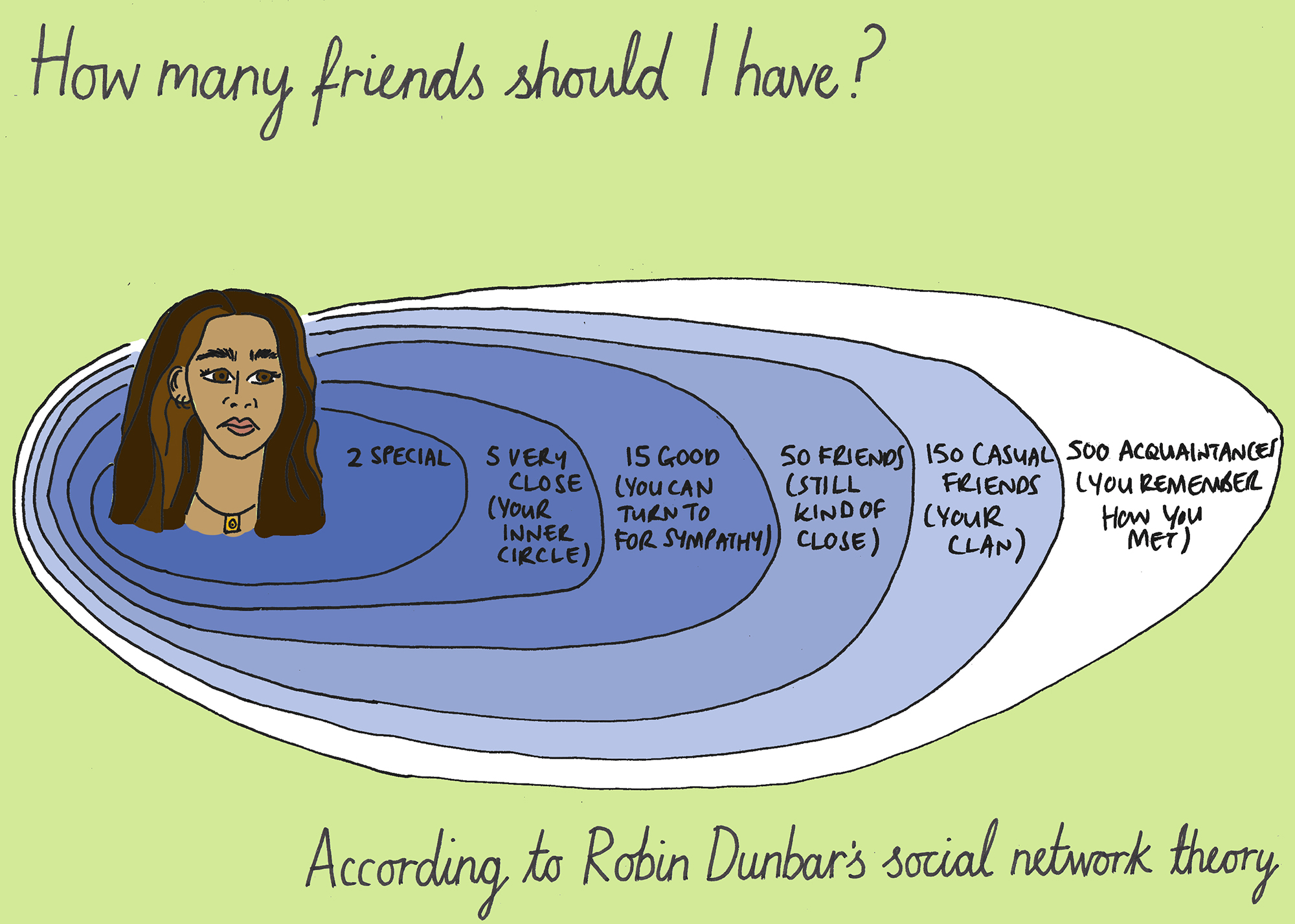
Illustration: Mona Chalabi

Chalabi: … You see, within that 100 – 250 friend range, there are layers or concentric circles. The first layer is about 1.5 people. That often represents your parents or your romantic partner.

Dunbar: Then the next layer out is somewhere around about 5 — we think of those as your intimate friends. The next layer out is 15 — those you might think of as best friends. Then there’s a layer at 50 — good friends. A layer at 150 — just friends. A layer at 500 —  which we think of as acquaintances.

Chalabi: 50 good friends! Five-zero! That feels like a whole lot of people! And I think this is the tier where I’m having the most trouble. 

… The more I think about it, part of the problem here might be that some of the people who were once part of that super-close friend group, maybe I just didn’t do enough to keep them there.

Dunbar: Certainly our research shows very clearly that if you fail to maintain that level of investment, friendships start to die slowly, but surely. Six months after you’ve not contacted them, they will have dropped down from being a good friend to maybe just a friend. And if it carries on for a couple of years, they will end up as an acquaintance.

Want to learn more? In her TED podcast Am I Normal?, data journalist, writer and illustrator Mona Chalabi dives into the numbers to get us answers to some of the most puzzling questions — like just how long does it take to get over a breakup and how bad is it to marry a cousin. But since statistics can’t tell the whole story, she also talks with experts, strangers and even her mother. Go here to listen to the irresistible episodes now. 

You can also watch this TED original video with Mona Chalabi here: 

Celebrate Life · Health and Wellbeing

How to Develop Self-Compassion — Guest Blogger Don’t Lose Hope

“This is a moment of suffering. Suffering is part of life. May I be kind to myself in this moment. May I give myself the compassion I need.” – Kristin Neff We hear a lot today about self-compassion. But how do we show compassion to ourselves? What does this look like in our everyday lives? […]

How to Develop Self-Compassion — Don’t Lose Hope
Celebrate Life · Fun · Health and Wellbeing · Men & Womens Health

Fun Facts That Will Amaze You

I’m so glad you are enjoying this weekend tradition of Fun Facts. I learn something new each week, even if it’s weird. I love hearing your comments! 

Three presidents, all Founding Fathers—John Adams, Thomas Jefferson, and James Monroe—died on July 4. Presidents Adams and Jefferson also died the same year, 1826; President Monroe died in 1831. Coincidence? You decide. (constitutioncenter.org)

The Barbie doll’s full name is Barbara Millicent Roberts, from Willows, Wisconsin. Her birthday is March 9, 1959, when she was first displayed at the New York Toy Fair. (barbiemedia.com)

There actually aren’t “57 varieties” of Heinz ketchup, and never were. Company founder H.J. Heinz thought his product should have a number, and he liked 57. Hint: Hit the glass bottle on the “57,” not the bottom, to get the ketchup to flow. (heinz.com)

 The tallest man ever recorded was American giant Robert Wadlow (1918–1940), who stood 8 feet 11 inches. Wadlow’s size was the result of abnormally enlarged pituitary gland. (guinnessworldrecords.com

The tallest living man is 37-year-old Sultan Kosen, from Turkey, who is 8 feet, 2.8 inches, who set the record in 2009. His growth is also due to a pituitary issue. (guinnessworldrecords.com)

Enjoy! 

Melinda


Health and Wellbeing · Men & Womens Health

Superfoods for winter — Guest Blogger My Name is Haifa

It is widely known that during winter season, people are in high risk of getting sick easily. What is more concerning, the number of covid19 cases has returned to increase again in some regions around the globe such as in Africa and Europe. I genuinely believe, It is preferable to adopt a healthy diet while […]

Superfoods for winter — My Name is Haifa
Health and Wellbeing · Men & Womens Health

 International Day of Persons with Disabilities

International Day of People with Disability on December 3 each year is an international observance promoted by the United Nations since 1992. 2012 marks the 20th anniversary of the International Day for People with Disabilities. The day aims to promote an understanding of people with disability and encourage support for their dignity, rights and well-being.

Photo by Porapak Apichodilok on Pexels.com


Around 15% of the world’s population, or one billion people, live with disabilities. People are often unaware of the great number of persons living with disabilities around the world and the challenges they face.

Persons with disabilities, “the world’s largest minority”, often face barriers to participation in all aspects of society. Barriers can take a variety of forms, including those relating to the physical environment or to information and communications technology (ICT), or those resulting from legislation or policy, or from societal attitudes or discrimination. The result is that persons with disabilities do not have equal access to society or services, including education, employment, health care, transportation, political participation or justice. The day aims to promote an understanding of disability issues and mobilize support for the dignity, rights and well-being of persons with disabilities. It also seeks to increase awareness of gains to be derived from the inclusion of persons with disabilities in every aspect of life.

One point I want to make is there are a large number of people with invisible disabilities. An invisible disability is one where you might say “you don’t look sick”.

Some people only think of disability applying someone in a wheelchair, or walking with a cane but there are many people who have difficulty with everyday functions who are disabled who don’t look disabled to you. 

Please be polite and patient if you see someone in handicapped parking and never take advantage of the parking space, I don’t care how sick you are. 

Enjoy the day.

Melinda

Celebrate Life · Fun

#Weekend Music Share *Hungry Like A Wolf by Duran Duran


I’m so glad you’ve joined me this week for another edition of Weekend Music Share.


Welcome back to Weekend Music Share; the place where everyone can share their favorite music.
Feel free to use the ‘Weekend Music Share‘ banner in your post, and don’t forget to use the hashtag #WeekendMusicShare on social media so other participants can find your post.

Melinda

Health and Wellbeing · Men & Womens Health · Mental Health

Book Review Adaptable by Alexa Carlin

I was kindly gifted a copy of Adaptable-How to Lead with Curiosity, Pivot with Purpose, and Thrive Through Change by Alexa Carlin from NetGalley, GracePoint Publishing, and Wex Press for a review. 


Pub Date 14 Sep 2021 
GracePoint Publishing, WEX Press

About the Author

At 17, Alexa Carlin became CEO of her first company, designing jewelry that made a difference, one bracelet at a time. But at 21, she was induced into a medical coma and given a one-percent chance to live. In Adaptable, she shares the stories of her journey, offering powerful insights into hope, courage, and life’s challenges.

Blurb

Life’s obstacles offer two distinct directions: They can push you backward or fuel you forward. The choice is up to you.

Written in a heartfelt and authentic tone, Adaptable invites readers to develop a new perspective on their past and current obstacles. The stories, lessons, and action steps that fill each chapter gently guide readers back to their true selves, allowing them to connect deeply to their inner light and shine brightly with their true purpose.

Alexa encourages and inspires readers to use their own challenges not as a reason to abandon dreams, but as a springboard from which to thrive.

Reviews

“Empowering, real, raw, and game-changing! Alexa’s stories within Adaptable will remind you of the potential you hold inside of you and the strength to push through any obstacle. An inspiring book by an inspiring woman!” – Jess Ekstrom, author of Chasing the Bright Side

Adaptable is a must read for anyone trying to silence that negative voice in their head and go after their dreams. Alexa’s voice is so real, inspiring, and motivating that you can’t help but feel empowered to live your best life.” – Rachel DeAlto, author of relatable, Relationship Expert, and television personality

My Thoughts

Adaptable is a story about overcoming insurmountable odds and taking the bull by the horns. Alexa inspires you to stay focused on your dreams and to chart a course for success by using your own obstacles as a learning experience for achieving each and every goal you set.

Alexa takes the obstacles in her young life and turns them into the motivation she needs to chart her own course.  

“This book is meant to be consumed in two ways. First, read it from front to back. Second, use it as a tool to help you find hope when it may be lost, to help you through times of self-doubt when pursuing your dreams, or for a beacon of light during some difficult times. Keep it near and anytime you feel you need a reminder, randomly flip open to a new chapter while asking for the answer you’re looking for, and read whatever chapter opens up.” I think this is the best way to read the book, it’s a story and a handbook to reflect on. 

Adaptable is a great book for everyone, from college students, just started out to professionals on the way up the ladder. 

Enjoy Reading!

Melinda

Looking for the Light

@lookinglight

Celebrate Life · Health and Wellbeing · Men & Womens Health · Mental Health

Daily Quote

Happy Thursday!

Photo by Samuel Theo Manat Silitonga on Pexels.com

“I’ll never be content to stay forever in one place. I’m too madly in love with all the places I haven’t been, the people I haven’t met, the food I haven’t tried on the streets I haven’t danced on.”

Brook Hampton

Have a great day.

Melinda

Celebrate Life · Fun · Health and Wellbeing · Men & Womens Health · Mental Health

Everyday Magic


Bella and Grace by Stampington

It is not often that we find ourselves in awe of something, but’s an incredible feeling. When was the last time you saw something so beautiful it took your breath away?


Enjoy your day! 

 Melinda

Celebrate Life · Health and Wellbeing · Men & Womens Health · Mental Illness

Book Review Manic Man by Jason Wegner and Dr. Kerry Bernes

I was kindly gifted a copy of Manic Man, How to Live a Successfully with a Severe Mental Illness by Jason Wegner and Dr. Kerry Bernes from Soraya Nair, Managing Editor at Cherish Editions for a review. Thank you, Manic Man was another great read from Cherish Editions. 

 Because this review was done many years ago I’m not able to make the changes to the layout that I would like to.


Manic Man: How to Live Successfully with a Severe Mental Illness by [Jason Wegner, Dr. Kerry Bernes]


Published 2021

Cherish Editions

About the Authors

Jason Wegner

Lives with a severe mental illness, Bipolar Disorder 1.


Dr. Kerry Bernes
B.Ed., M.Sc., Ph.D., R.Psych., ABPP
Board Certified in Clinical Psychology (American Board of Professional Psychology)

Blurb


His courageous story begins with a glimpse of Jason’s normal life before the hypomanic stage of his illness kicks in. The mania starts when he tries the dangerous psychedelic drug LSD and takes off a few weeks later in Tanzania. He is in a full-blown manic episode while in Africa, and his behaviours and journaled thoughts demonstrate this. Weeks of mania continue after he returns from Africa until he is tricked into an ambulance and taken to the hospital’s emergency wing. He would be hospitalized in the acute psychiatry ward for 57 days, but his journey to improved mental health had just begun.


To lift Jason out of his severe depression, his psychologist Dr. Kerry Bernes developed “The Octagon of Life,” which represents the eight areas that Jason needed to focus on to rebuild his life. He shares this model in Manic Man, too.

Reviews:


“Jason gives an inside look into his brain during his mania, depression and recovery. It helped me to learn more about the bipolar disorder, as well as mental health in general. Thank you for sharing your story and breaking the stigma surrounding an invisible illness.”


“A must read for anyone who knows anyone going through a mental health crisis. Very well written. Thank you for writing this book.”

My Thoughts

I completely understand where Jason is coming from because I was diagnosed with Bipolar Disorder 1 at 19 years old. Being in a Manic in a state is hard to describe. You have firm beliefs that are not reality, they are grandiose, supernatural, and intoxicating. So intoxicating you don’t want the feelings to stop even when you realize how sick you are. 

Jason was like a train going full steam with no brakes, ideas and thoughts coming at him like the changing of slides in a hand projector. They say is the higher you are the harder you fall and Jason fell hard. 

He spent 57 days in a Phsychaitrict hospital after his parents intervened on his behalf when his behavior became so erratic they grew concerned for his wellbeing. 

During his stay in the hospital, Jason learned about this illness, began to come to terms with his behavior, and started medication which is essential for Bipolar Disorder patients. 

I highly recommend this book to anyone who has a friend or loved one with Bipolar Disorder, it will give you first-hand insight and you can’t get anywhere else. If you think someone has Bipolar Disorder this is a good book to help you better understand the signs and symptoms. 

Cherish Editions

Cherish Editions is the self-publishing division of Trigger Publishing, the UK’s leading independent mental health and wellbeing publisher.

We are experienced in creating and selling positive, responsible, important and inspirational books, which work to de-stigmatise the issues around mental health, as well as helping people who read them to maintain and improve their mental health and wellbeing. By choosing to publish through Cherish Editions, you will get the expertise of the dedicated Trigger Team at every step of the process.

We are proud of what we do, and passionate about the books that we publish. We want to do the very best for you and your book, holding your hand every step of the way.

Enjoy Reading

Melinda

Looking for the Light

Health and Wellbeing · Men & Womens Health

Are you mentorable?

IDEAS.TED.COM

May 2, 2019 / Lenora E. Houseworth

Are you open about the areas where you want help? Respectful of your mentor’s time and advice? Here are the characteristics that can make you someone whom other people would like to guide, from mentoring researcher Victoria Black.

This post is part of TED’s “How to Be a Better Human” series, each of which contains a piece of helpful advice from someone in the TED community; browse through all the posts here.

Finding the right mentor (or mentors) can change the trajectory of your life. Many people in the working world have one, or if we don’t, we’ve looked, wondering, “Would so-and-so make a good mentor?” But when was the last time you asked yourself, “Am I a good mentee?”

If you haven’t, that’s normal. Organizations typically place much greater emphasis on mentors than on mentees, says Victoria Black, director of a peer-mentoring and coaching program at Texas State University. At the program, she saw some pairings soar and others slump, and she wondered about the different outcomes. One day she heard education professor Richard Reddick use the word “mentorability” to refer to the ability of mentees to benefit from mentoring. A lightbulb went off.

She recalls, “I thought, ‘Gosh, we’re not doing a job of putting ownership back on the mentee or, at least, not talking to them about what it means to be mentorable. Often, you just assign a mentor to a mentee and let them go. I put a lot of effort and time into training the mentor and not the same into training the mentee.” A 2017 study coauthored by Black looked at postsecondary mentoring programs at public, four-year educational institutions in her state and found that programs were four times more likely to address mentors than mentees.

The key to mentorability is an open and reciprocal partnership between mentor and mentee. Think of it as being on a long car ride together, Black says: “The mentee is the driver, and the mentor is the copilot, helping them get to their destination.” Even though they may receive a lot of input, the mentee is the person in control, and they must respond to the mentor’s advice and give continual feedback about their needs. For mentees, she says, “Success is not just having a mentor tell you or show you what to do. It’s a two-way relationship.”

Are you a good mentee? Black shares the principal characteristics of mentorability.

1. You understand the value of their time.

Your mentor is giving you that most precious and rare of commodities: their time. Show them you appreciate it by arriving on time or early to see them and not cancelling at the last minute unless there’s an emergency. Prep for your meetings, and come with questions, comments or articles to share. Then, when the two of you are together, give your mentor your complete attention. If she sends you a text or email that requires a reply, try to respond within 24 hours; if you can’t, explain why. While this may sound incredibly basic, Black says carelessness about mentors’ time has been a common complaint in pairings that have faltered.

2. You’re clear about what you’re looking for from a mentor.

People seek out mentors for different reasons. Do you want overall career guidance, or do you have a specific goal — such as finding a new job or achieving a promotion — in mind? Are you looking for a more senior colleague who will actively champion you within your organization? Or do you want general life advice? Are you someone from an underrepresented group who wants a role model from a similar background to tell you how to navigate particular obstacles? The more specifically you can articulate your expectations and objectives, the more likely you are to receive the guidance you’d like.

Many of us feel like we want to show only our best face to prospective mentors, but you may need to expose your problems and limitations. One of Black’s most rewarding mentees was a student who was in danger of failing out of school. He showed up at her office and, she says, “admitted he was struggling in college and said he wanted to change.” After three semesters of weekly meetings with her and adhering to her schedules and timelines, he was able to get off academic probation and has gone on to succeed.

Showing vulnerability is equally important in your ongoing partnership. When she asked a group of mentors about mentees, she says, “They wanted somebody to be realistic, to be real with them and not sugar-coat their experiences but talk about their flaws in ways that helped them grow.”

3. You can accept input, advice and — sometimes — criticism.

You’ve turned to a mentor because they have knowledge or experience that you don’t possess. However, cautions Black, “you may not like what you hear all the time. Be ready to receive their feedback, and then decide whether or not you want to take it.”

If you disagree with them, examine your attitude. Remember, their advice most likely comes from a positive impulse: their desire to help you grow. Black says, “Ask yourself, Why do I not agree? Why does this make me feel uncomfortable? Is this pushing me past my boundaries?” Your reluctance may have more to do with a fear of leaving your comfort zone or an unwillingness to change than the quality of their instructions. It’s also possible that their suggestions may not fit your larger objective, so if this is the case, let them know.

If you decide not to follow their guidance, it’s still important to express your gratitude. After all, they’ve put time and thought into what they told you. Black has seen some mentees simply ignore input they don’t like. Social media has affected our behavior, she explains, “that if we don’t like what somebody has to say, we don’t think we need to respond.”

Instead, be your best self. In person or over email or text, say a simple “thank you”and briefly and politely explain your decision. As in any healthy partnership, communication is critical. Your feedback will enable your mentor to learn how they can best coach you. “With the best intentions, mentors might give you advice that works for them, but it doesn’t necessarily mean it’s going to work for you,” says Black. “Finding the best way for the mentee to thrive on their own and helping them make their own decisions is what good mentoring partnerships are about.”

4. For the lifespan of your relationship, you keep asking, “Am I a good mentee?” 

Periodic reassessment is an important part of the process, according to Black. Two other questions to reflect on: “Am I committed to this partnership?” and “How can I be a a better mentee?”

5. You’re open to whatever you can learn from your mentor. 

While you may not get what you want or expect from your partnership, it can still be immensely valuable. “Not all relationships are meant to be fruitful,” says Black. “That doesn’t mean they can’t help you develop.” Maybe you’ll come out of it with new information, a new skill, a new perspective, or a new friendship.

Watch her TEDxTexasStateUniversity talk now:https://www.youtube.com/embed/JzqyKn0IFO0?version=3&rel=1&showsearch=0&showinfo=1&iv_load_policy=1&fs=1&hl=en-US&autohide=2&wmode=transparent

ABOUT THE AUTHOR

Lenora E. Houseworth is a social media strategist and writer with a passion for communication and culture, and she is based in the New York City area.


Health and Wellbeing · Men & Womens Health

3 Rules For Better Work-Life Balance