Over the years, you might have heard the term ‘superfood’ used increasingly. But what really does it mean? Well, in simple terms, these are foods that are packed with nutrients such as minerals, vitamins, and antioxidants, and so are associated with positive impacts on your health. But how do you know what superfoods to eat then?
The thing is, you may currently include a good number of superfoods in your diet without even knowing, so this list of the 10 most popular superfoods has been put together so that you are made away of well-known superfoods, as well as to inform you about some superfoods that you may not be familiar with.
Eggs
Eggs are one of those foods that have stood the test of both time and criticism. No doubt, they are pretty healthy and come loaded with very high-quality proteins. More than that, eggs contain a plethora of minerals and vitamins, some of which include vitamin A, B vitamins, choline, and iron. They also contain two very powerful antioxidants, namely zeaxanthin and lutein, which are known for protecting vision and boosting eyesight. That being said, if you are having issues with your vision, don’t hesitate to visit https://eyeglasses.com for some more information.
Dark leafy greens
A lot of people aren’t fans of dark leafy greens, but they’re one of the best superfoods to exist. These types of greens contain several nutrients that the body needs to heal, including zinc, iron, magnesium, fiber, and vitamin C. More so, dark leafy greens have earned their place in the superfoods hall of fame. They might also help reduce your risks of suffering from chronic illnesses such as heart disease and type 2 diabetes. Some examples of these dark leafy greens are kale, spinach, collard greens, and Swiss chard which can be incorporated into your diet via smoothies, soups, and salads.
Berries
Many of us who love berries are unaware of the amazing effects that eating them has on the body. For one, berries are very rich in vitamins and minerals as well as certain antioxidants. In fact, berries are particularly effective when it comes to treating digestive issues and are often used in modern medical therapies. Examples of these fruits include blueberries, blackberries, strawberries, and raspberries. You can eat them as they are, or add them to smoothies and desserts.
Avocado
Simply put, avocados are great. Yes, they’re good for guacamole, but more than that, this superfood is very rich in healthy fats that keep you feeling full for longer. It also comes packed with antioxidants and fiber that all work to protect against heart diseases. Additionally, this food is can be eaten even on a diet and is even recommended on the Keto diet. Delicious ways to incorporate avocado in your diet include serving it on your morning toast to adding it as an essential ingredient to smoothies and salads.
Chia seeds
Chia seeds are tiny, black seeds that have taken the health industry by storm over the past few years. No doubt, these seeds pack a powerful punch when it comes to nutrition. Firstly, they contain pretty much all the essential minerals including calcium, manganese, magnesium, and phosphorus. In addition, vitamins B1, B2, and B3 are also available in abundance. More so, 28 grams of chia seeds contain 11 grams of fiber and just one gram of digestible carbohydrates, making it one of the most suitable foods out there for a low-carb diet.
Coconut
When it comes to versatile foods, coconuts are out there at the top. They can be consumed as coconut water, coconut oil, coconut flour, coconut flakes, and even just coconut meat. More so, this superfood can easily be incorporated into your diet without any headache.
That said, in terms of what makes it so ‘super’ coconut oil especially contains medium-chain triglycerides, which are used as a source of energy once in the body. Furthermore, coconut water is high in vitamins and minerals including potassium, magnesium, sodium, and vitamin C. On top of this, coconut flour is low in gluten and carbs and can be used for baking and desserts.
Flax seeds
Flax seeds are one of those foods that didn’t become popular until recently. These seeds contribute towards a healthy heart as they come packed with omega 3 fatty acids that work as anti-inflammatory agents. More som flax seeds can be added to your salads and smoothies by grinding them into a semi-fine powder. That being said, they do have other uses apart from consumption. In fact, flax seeds also come in handy as a home remedy for hair growth.
Hemp seeds
Yet another super seed is hemp seed. This is a great source of healthy proteins and contains omega 3 and omega 3 fats; both of which work together to reduce the risk of cardiovascular diseases in the body. More recent studies also associate hemp seeds with relieving the symptoms of menopause in women. For consumption, these seeds are typically toasted lightly and then added to foods like salads, oatmeal, and cereal.
Salmon
When next you go grocery shopping, be sure to pick up some salmon. This fish is rich in healthy oils that are a great source of energy and contains inflammation-reducing omega 3 fats. More so, this fish is packed with wildly sourced protein that can provide you with almost 60 percent of your daily recommended protein intake. It also contains vitamin D as well as bioactive peptides that help in collagen production.
Cocoa nibs
Cocoa nibs are essentially just healthier chocolates. These foods range from really sweet to very bitter, so you get to choose just how you like them. More so, it is a great source of fiber and it also contains a good amount of iron and magnesium. More than that, research has shown that eating cocoa nibs can help elevate your mood and brain activity. As for preparation, they can be used in desserts, smoothie bowls, or just on their own as a nice snack.
Procrastination isn’t shameful or a character flaw. Instead it’s rooted in a very human need: the need to feel competent and worthy, says educator Nic Voge.
This post is part of TED’s “How to Be a Better Human” series, each of which contains a piece of helpful advice from someone in the TED community; browse through all the posts here.
“It’s 11 o’clock. You’re in your dorm room, and you have a paper due in a day or so. You sit down at your desk, you open up your laptop to get started, and then you think, ‘I’m gonna check my email just for a minute; get that out of the way.’ Forty-five minutes later, you’ve checked a lot of email,” says Nic Voge, senior associate director of Princeton University’s McGraw Center for Teaching and Learning in New Jersey, in a TEDxPrinceton talk. “You’ve done a really good job of that, but now you realize, ‘You know what? I’m pretty tired. I’m kind of exhausted, and that’s not conducive to writing a good paper. What do I need? I need to go to sleep.” And you do — only to wake up and go through the whole cycle of delays-and-excuses the next day.
Is this you? Rather than a college paper, maybe it was a report for work, graduate program application, peer review, or some other important thing that you kept kicking down the road until the road ran out and you had to deliver.
You probably scolded yourself for your behavior. And wondered, “Why am I so lazy /weak-willed /disorganized /unmotivated /hopeless /[fill in other belittling adjective]?”
Well, Voge has good news for you. “Procrastination isn’t shameful. It’s not a sign of weakness. It’s not a flaw,” he says. “It’s actually pretty predictable; it’s something we can really expect if we understand the dynamics of motivation,” At Princeton, Voge develops, designs and directs academic support programs for undergraduates. He’s seen procrastination in all its forms, and he has also, he confesses, “mastered the craft and art of procrastination — the mind games, the rationalizations, the justifications.”
There are many theories about why we procrastinate. Some have said it’s about the inability to cope with difficult emotions; others, that it’s connected to faulty time management or perfectionism. Voge, however, believes it is rooted in our self-worth. He explains, “The paramount psychological need that all of us have is to be seen by ourselves and others as capable and competent and able … and we will actually sacrifice or trade off other needs to meet that need.”
To be clear, the need to be seen as worthy or worthwhile is not the problem. Where things go wrong is that some of us depend heavily on external feedback — in the form of good grades, praise from bosses, parents, in-laws or other authority figures, or the acceptance of prestigious organizations — for those feelings of worthiness. Voge says, “People who procrastinate a lot have a kind of simplistic equation in their mind: their performance is equal or equivalent to their ability, which is equal or equivalent to their self-worth as a person.” Or, as he puts it: performance = ability = self-worth. The reason we’re so terrified about performing poorly on that paper, application, analysis, etc. is because we feel our ability rests on it — and our value as a person.
In the performance = ability = self-worth equation, the only variable we can control is how much effort we put into our performance. When we procrastinate and put in less effort, we’re doing it as a form of self-protection, according to Voge. That way, if we earn a bad result, it doesn’t mean we’re not talented, able or worthy; we were just too busy or distracted to do our best.
Think about the murmurs you inevitably heard before exams in high school or college. Voge asks, “What are people saying? ‘I only studied three hours.’ ‘I only studied two hours; my computer froze.’ Everyone’s explaining how they’re not ready. Why? Because if they don’t achieve, then they have this built-in excuse not only for themselves but for others.”
Anyone who has ever procrastinated has experienced that feeling of stuckness. “Many people describe procrastination as being stuck at or against a wall or an obstacle they can’t get over,” says Voge. “We are often agitated, we can’t sleep — but we [also] can’t work.” At those times, we find ourselves pulled between two equally strong and compelling forces: the drive to achieve and the fear of failure. We come unstuck only when the fear of not getting things done overrides our fear of failure.
How do we break the cycle? Voge highlights three strategies:
1. Be aware of what you’re doing and why.
“We know from the research on procrastination and overcoming it that gaining knowledge and being aware of self-worth theory in these dynamics helps people over these things,” says Voge. “To understand the roots of procrastination helps us weaken it.” Your procrastination is probably not coming from a place of self-loathing or self-sabotage but from a need to protect yourself.
Know when you’re procrastinating. Sometimes it’s obvious; there is absolutely no reason for us to do the laundry before we write that grant application. At other times, it’s more subtle, so you may need to check in with yourself: “Yes, removing old files from my computer desktop will give me a less distracting workspace, but is it essential that I do it right now? Or am I just postponing writing the application?” Pro-tip: If you have to ask yourself whether you’re procrastinating or not, chances are you are.
Get familiar with your “greatest hits” of wasting time. Most of us have specific fall-back activities that we do when we’re playing the delaying game. What’s yours — house-cleaning, napping, shopping, reading email, catching up on Netflix? Learn to recognize it so you can nip it in the bud; it’s much easier to prevent falling down the cleaning /napping /shopping rabbit hole rather than pulling yourself out. Voge says, “The greater awareness we have of our tendencies and our motivations, we’re more likely to overcome them.”
2. Tip the balance.
Our progress towards completing any activity is affected by “approach” motives (reasons why we want to do this thing) and “avoid” motives (reasons we don’t want to do this thing). With activities that we have no hesitations doing — let’s say, eating something that’s delicious and healthy — it’s because we have many “approach” motives and very few “avoid” motives.
Many procrastinators have the mistaken belief that the reason they’re putting off a task is because there’s an underlying reason they don’t want to do it. “Often, that’s not the case. It’s simply that their fears dominate or overwhelm their ‘approach’ motives,” says Voge. When you’re playing solitaire instead of performing a competitive market analysis for your boss, it could be because your “avoid” motives — in particular, you’re avoiding the project because you’re terrified you’ll fail — outweigh your “approach” motives.
When this happens, think of all the reasons why you want to do this activity. It might help to remind yourself of how completing it fits into your larger goals, objectives or mission. Then, if it seems especially big or intimidating, break it down into manageable pieces. When Voge found himself procrastinating writing his TEDx talk because it seemed so daunting, he decided to create an outline so he could write his script section by section. Warning: Just resist turning that outline or to-do list into an invitation to procrastinate further.
3. Challenge your beliefs.
We need to undermine the ideas that brought us to procrastinate in the first place, says Voge. “The equation that we carry around in our head is flawed … your ability is not equivalent to your worth.” He adds, “Our worth derives from our human qualities of kindness and thoughtfulness and our vulnerabilities.”
Some people love working from home, and they can’t imagine anything better than a day with their laptop clad in pajama pants. Others miss the structure and the casual chats with coworkers that happen at their offices. Whether you love it or hate it, working remote — for those who can do it; not every job lends itself to this kind flexibility — is going to be common for many of us in the near future due to the pandemic.
For those of you new to working from home, there’s lots of advice out there about how to deal with the pitfalls and stay productive and sane (“Take a shower!” “Don’t spend too much time on social media!”). But from my own experience, working from home can be a real delight if you let it. So I’d like to share a few ideas for creating a workspace and routines that will make working from home a joyful, sustainable experience. And who knows? You might not even want to go back to the office!
1. Take care of your body
In her book Proposals for the Feminine Economy, Jenn Armbrust offers a series of principles, the first one being: “You have a body.” Sounds simple, but working from home can make it easy to forget about your body’s basic needs. At your office, you probably had an ergonomic desk chair or an adjustable workstation. However, unless you work from home regularly, your workspace may consist of a kitchen table and basic chair.
You don’t need to invest in a whole home-office setup, but rather pay attention to how your body feels as you work from home. One advantage to working from home — as opposed to being in an office — is that you can change positions frequently. Try out lots of postures, whether that’s sitting in a chair, standing at your kitchen counter, relaxing on the sofa, or sitting on a yoga block on the floor with your coffee table as a desk. It took me a long time (and some serious shoulder pain) to realize that the best position for long writing stretches for me is sitting on a backless bench at my dining table. Testing different positions can help you find physical ease faster.
Another thing to pay attention to is movement. You likely do some walking in the course of an office workday — to the office from the train or bus or parking lot, between meetings, to the café for more coffee — and these movement breaks disappear when everything you need is within a couple of rooms in your home. When I first started working from home, I was surprised to find that I sometimes got in fewer than 1,000 steps in a day!
The flexibility of home work means, though, that you can largely move when you want to. Try setting a timer for a yoga or workout to break up a long email session. While writing my book Joyful, I took impromptu dance breaks whenever I was stuck on a section, which cleared my head but would’ve been hard to do in the office. I also started to take a long walk in the park at the end of every day. In the summer, I’d print out the latest draft and take it with me and sit in the shade while marking it up. In the winter, I’d do this at the kitchen island after coming home.
2. Use your commute
How long was your pre-pandemic daily commute? For many people, it can range between 30 minutes to 2 hours (or more), round trip every day. It also really adds up. Even at the short end, that 30 minutes per day adds up to two and a half hours that you’ve now gained per week!
The key is being intentional about how you use that time. Schedule it in your calendar — it doesn’t have to be at the same time as your commute — just as you would a meeting.
You can also block that time out for free, unstructured time, something most adults don’t get enough of. But then make sure to put tools down when the calendar alert goes off and give yourself space to enjoy it.
3. Create a sensory landscape
With their dull color palettes, synthetic carpets and humming HVAC systems, most workplaces have a joyless sensory landscape. Add in the noise from open-plan seating, and the fact that many spaces are often too cold or hot, and the typical office can be deeply unpleasant to spend time in, much less get focused work done.
While many of us often see the problem as overstimulation, in fact offices are just as likely to be understimulating. Workspaces have traditionally been designed based on the belief that to maximize productivity you need to minimize distraction, leading to bland, featureless spaces. But research shows that when people in these “lean” workspaces are compared to people working in “enriched” spaces that have art, plants, and more sensorial stimulation, the workers in the enriched spaces are 15 percent more productive. And if the workers have control over the placement of things in their workspace? They’re 32 percent more productive.
When you work from home, you can be like those workers in the study who controlled their own workspace — and create a sensory landscape that works for you. Part of this may mean eliminating unpleasant sensations, by getting noise-cancelling headphones to tune out distracting noises or adjusting the temperature so that it’s comfortable for you.
Also, look for ways to add pleasant sensations into your workspace. Hang up an image that gives your gaze something to rest on while you glance away from your screen. Play nature sounds. Choose a brightly colored mug for your morning coffee.
The senses of touch and smell are particularly understimulated during the hours we’re tapping away at a keyboard, so look for ways to appeal to them. For example, I cover the bench I sit on when writing with a sheepskin, which has a decidedly unofficelike soft texture. I keep a bottle of essential oils on my desk, and sometimes use a diffuser to scent the air.
4. Get some sunshine
One poorly designed aspect of many traditional offices is how little daylight exposure is available in workspaces. For most workers, the only light during the day comes from the dull fluorescents overhead. Yet research shows that workers who get more exposure to daylight sleep better (up to 46 minutes more per night), are less stressed, and are more active during the day. Light regulates key hormones and neurotransmitters, influencing everything from our alertness to stress levels, our immune system to our moods.
In your home, you have more control over where you choose to work, so if possible, choose a space near a window. And if you don’t have much natural light in your space, use lamps to boost the brightness. Just as too much blue light from our screens can keep us up at night, a healthy dose of bright artificial light during the day can also help keep our 24-hour internal clock in sync.
Also, when you used to commute to work, you likely got at least a little sunlight on the way, which you lose if now you jump straight into work first thing. Light has the greatest impact on our circadian rhythms in the morning, so try to go outside for a brief walk before you sit down.
5. Green your workspace
One simple thing to do to make your workspace more joyful is to add greenery. Plants that might struggle in the dim light of an office can thrive in your home, and you gain the extra benefit of getting to enjoy them when you’re not working as well. You don’t have to have as many plants as Summer Rayne Oakes does in her home workspace, but even just adding a few has been shown to reduce stress and restore your ability to concentrate.
6. Make a “get to work” playlist
One challenge I’ve found in working from home is transitions. It can be hard to stop doing all those home things (emptying the dishwasher, folding laundry, etc.) and get down to work, especially if there’s work you’re avoiding. In fact, many writers joke that their home is never tidier than when they’re working on a book.
One thing that helps is having some sort of ritual that marks a transition into a work session. I have a couple of “Get to Work” playlists that help with this: one for writing, one for email. The playlists always start with the same song, so it becomes like a sonic trigger that primes me to focus.
Other transition ideas might be pouring a fresh cup of tea or coffee, doing a quick stretch, or setting a focus timer (I use the Tide app on my phone).
7. Make snack time special
A lot of work-from-home guides advise you to take a real lunch, but I confess that when I’m in flow, I much prefer to eat at my desk. This doesn’t mean that I don’t believe in taking breaks, though. As I mentioned above, the most important features of breaks for me are to get outside and to incorporate movement into my day.
I also love a good snack break. We often think of snacks as fuel, but for me, they’re more of a treat. And, as writer Gretchen Rubin has pointed out, treats can help make us feel cared for, energized and motivated. Having access to your own kitchen means that you don’t have to rely on the processed foods that constitute a snack in most offices, nor do you have to eat it out of a bag.
I’m a big fan of cutting up fruit and arranging it in a wheel around my plate, or making little sampler plates from the fridge of pickles, olives and other nibbles. I also make energy balls or banana bread and freeze some so I can have it for a mid-week treat. You’re your own office manager now, so think about what would make you feel cared for and create space for it in your daily routine.
8. Be playful
Offices have been designed with work in mind, and the prevailing view is that work is somehow the opposite of play. But, as play researcher Brian Sutton-Smith says, “The opposite of play is not work. It’s depression.” Bringing your work home gives you a chance to invite more play into your workflow. And this can start with your workspace.
A playful workspace creates more opportunities for play in your day. These can be small, like the miniature spinning tops I keep on my desk to spin when I get stuck on an idea, or they can be larger, like having a trampoline to bounce on or a hula hoop to play with. Changing out a desk chair for an exercise ball can also bring a sense of play. A giant bowl of Legos or a big puzzle can keep hands busy while your mind is working through ideas.
You can also experiment with adding playful forms of decor, like children’s drawings on the wall, or cute objects for your desk. I put googly eyes on my stapler, for instance. Cute things may even benefit our productivity, according to research out of Japan, by enhancing our ability to focus.
Imagine: If you’d never been to an office before, what would you want it to look like? When you work from home, there’s no reason not to create a space that lets your imagination run free.
9. Pack it up and put it away
Perhaps the worst thing about working from home is that it’s hard to know when the workday ends. Writer Kevin Roose has found, for example, that remote workers take shorter breaks and fewer sick days, suggesting that boundaries can be an issue. This is even more challenging if you don’t have a dedicated home office space. When your laptop sits on the dining table or your coffee table is covered in stacks of folders, it’s hard to fully feel like you’ve turned off.
This is one reason why I insisted on building in two tiny home offices in our current renovation. I still will probably spend time working at the dining table, but I wanted a place to put everything at night so that I can close the door on it and not be distracted by the things I didn’t get done.
You don’t need a spare room to do this, though. Simply having a basket or closet to tuck your laptop and papers into at night will do the trick. Creating a physical boundary will help you reset your mind and reclaim your home as your home.
Ingrid Fetell Lee is the founder of the blog The Aesthetics of Joy and was formerly design director at the global innovation firm IDEO.
Another thought
It’s not just creating a playful space that you should think about, it’s being more playful in how you work. One simple idea is to stop communicating via emails and start video or voice calling people. If you visit this website, you will learn how to start using Microsoft Teams, meaning you can have long chats with clients, coworkers, or employees. Adding a more visual element to working from home helps you stay more connected to people, and it also makes life more playful and joyous. Instead of staring at words on a screen, you can see the people you’re talking to!
When I first began working at home, I couldn’t believe I was getting away with such a racket.
No one told me what to do or where to be! I could work in my bed, go to the grocery store in the middle of the day, and my clients were none the wiser. Even though I was a freelancer, I was constantly looking over my shoulder and expecting to be reprimanded by someone.
But my elation wore away when I realized I wasn’t quite alone at home: My anxiety was there, too.
Now, I’m an anxious person, even in the best of times. But these days, it seems like we’re all anxious. And anxiety is another ingredient — like Zoom calls, overloaded wifi or howling children or pets — that needs to be factored into your days, your productivity and your time management.
Some days my anxiety drives me to perform at an Olympic level, with no task undone and no email unanswered even if I have to work until midnight. That is overwork — a common way that many of us anxious people deal with our feelings — and I’ll return to it later.
Other days, anxiety creates a background buzz in the form of intrusive thoughts and fears about the future. It can also make us distracted and unable to focus, so another common way of dealing with anxiety is avoidance (more later on this one too). For example, while I was writing this piece, I baked banana bread, made a half-hearted attempt at the exercise bike, fed the cats their pre-lunch snack and wandered around my house looking for things that needed my attention.
Working from home can be wonderful, but when you’re anxious, it can be difficult to concentrate and stay on task. How do you stay accountable to yourself and get work done without driving yourself to exhaustion?
Here are some tips based on what I have learned from 15 years of managing my anxiety while also working from home:
1. Call off the mental fire drill that occurs whenever you get a Slack or email notification
I know I’m not the only one whose heart rate accelerates when I see a new email in my inbox (or a Slack message). It could be a client, a staffer, my accountant or my mother. My anxiety drives me to want to quickly fix what they’re writing me about so I’ll feel better. But before I do, I often spend time worrying and trying to suss out the “true” meaning of their message (a fool’s errand, since emotional nuance is lost in almost any digital communication). Then I’ll force myself to respond no matter what — even if I’m finally eating lunch at 3PM or doing time-sensitive work.
Don’t blame yourself for leaping to reply to every message — much of modern knowledge work is built on this Pavlovian system of instant feedback and urgent response. With so many of us working from home and without the normal in-person interaction, this past year we’ve gotten trained to crave the feedback of a “ping” or a visual notification.
To start to de-program ourselves from the need to always be on, we need to practice being disconnected for small amounts of time. Begin with a time limit. Pick an after-hours moment when you don’t need to be online, and then turn off or hide your devices for an hour. Gradually work towards doing this during a workday. For that, select an hour when you can purposefully avoid checking updates (set up an “away” or “in a meeting” notification so people won’t wonder why you’re not getting back to them).
See how you feel when you can take a break from checking. When I avoid my phone for an hour, I notice that my neck is looser and so are my shoulders! Immediate benefit.
2. Stop waiting to get permission to log off
When work isn’t a place you leave at the end of the day, it can be incredibly difficult to stop. And let’s face it, when the option is to keep working and feel in control or spend more time on the sofa doom-scrolling or with whining kids, overworking might seem even more attractive. But learning to stop work is a discipline that creates good habits and a necessary step to keeping your energy tank filled.
I am an accomplished professional, but unconsciously I still want someone to tell me, “You did a good job today — you’re done.” Well, you need to learn to give yourself that permission.
Psychologist Alice Boyes changed my life when she suggested setting concrete limits around the amount of time I spend on the tasks that make me anxious and tend to overdo. Such shortcuts and hacks that help calm anxiety are called heuristics.
Here’s how you could come up with a heuristic to set boundaries on your work hours. At the beginning of your day (or the day before), create a reasonable to-do list. The key word is reasonable — no writing up a list based upon an imaginary 240-hour day — and based on experience, you’ll probably know how long most of your tasks will take. And if you have to guess time for any, guess upwards. Structure your day based around this list, and when you’re finished, close your computer. You did good.
3. When you get stuck in a worry spiral, ask: “What’s making me anxious right now?”
The flip side of overwork is avoidance — avoiding deadlines and tasks because you’re anxious. Everyone has their greatest hits of coping mechanisms, from trying to worry the fear away to working it away to diving into a bag of cheese doodles. Our brain does this because it’s trying to help us avoid our bad feelings. To understand the motivations and causes behind your anxiety, it helps to take a pause to feel your feelings and monitor how you react to those feelings.
Start by looking at what’s making you anxious right now and how the anxiety is making you react. Here’s an example from my life. Thinking about money makes me anxious. When the economic news is frightening, I might act out when I’m faced with a work task that has anything to do with money. So if I need to prepare a financial report for my small business, I assume it’s going to reveal negative results, which sends me into a spiral of fear. Cognitive behavioral therapists call this kind of reaction an anxious automatic thought. Consequently, instead of facing the spreadsheet and doing my work, I might avoid it entirely. I might eat that bag of cheese doodles or buy something online that makes me feel good. I’m reacting to my anxiety.
It’s better if I can learn to move from reacting on auto-pilot to knowing what sets me off and then managing how I will respond. I can say to myself: “Looking at my company’s finances is going to set me off right now. Maybe I should ask my business partner to do it. Or maybe I should build in a reward if I face the challenge head on? I could let myself have an extra hour of Netflix if I complete the spreadsheet.” I find that most of the time, doing the work doesn’t feel nearly as bad as what my anxiety anticipates.
4. Follow it up by finding a super-achievable work task and doing it
As you can see from my example above, when you feel anxious, it’s easy to turn a relatively straightforward task into an overwhelming thought exercise that sends your brain into catastrophe mode. When you are mired in anxiety and avoiding your work, the important thing is to do something. Jonathan Baxter, a family therapist, gave me this advice:
“The experience of stress has to do with your body wanting to take action. If there are actions you can take — whether getting some exercise or cleaning the bathroom or teaching your kids something — go ahead and take them. When you take action, give yourself a moment to let yourself feel good about taking a step. Use your mind to give your body the signal that you have agency and are doing what you can. (“There, I did it!”) The goal is to feel active and effective rather than scrambling from one thing to the next.”
I like to take a page from positive psychology and choose a small, meaningful action that will build my motivation for work and to tackle bigger tasks ahead. Have you ever organized a messy spreadsheet and just felt so good? Pick an activity that connects you to your larger purpose and allows you to see yourself as an effective and competent individual, which will ultimately help you move towards doing the thing you’re avoiding.
5. If that seems impossible, pick a non-work task
If tackling work just feels like too much when you’re toiling from home and staring at a messy house or out-of-control kids, pick a non-work action that’s physical and helpful. Since I hunch and clench in my desk chair when I’m stuck, I like to pick a task that gets my body moving and my shoulders open. I might pick a household chore (I like to scrub the bathtub because it’s quick but physically demanding), cook, do some yard work or even run up my stairs a few times. I find that it helps me to get off my screen and into motion.
Notice how you feel after you do your tiny non-work task and whether you’re able to begin the thing you have been avoiding. Then notice: How long can you continue until anxiety hits again? Is there a specific activity that almost always gets you in the mood to tackle a task?
6. Keep adding to your anxiety-taming bag of tricks
Anxiety feels different for everyone. We all have different triggers, and we all react differently. Money, as I mentioned before, is a big anxiety trap for me. When I get unwelcome financial news, my brain immediately goes to a gloomy place: My business will fail, we will go broke, we will lose everything.
As you continue in your career, it’s crucial that you understand specifically what sets you off and how it affects your workday. Once you understand that, you can try to avoid these triggers and — when you can’t avoid them — use specific strategies or tools that can help you move out of anxiety.
Many people I talk to for my podcast “The Anxious Achiever” tell me that they find making to-do lists and detailed schedules helpful, because they help them cut down on ruminating and overwork. Others know that they need to sweat, get outside or run around with their dog to dissolve that knot of anxiety. I like to cook. When I’m anxious and unfocused, I make giant stockpots of broth or chili. Hey … it works for me.
It’s possible for you to create a remote workday that minimizes your anxiety, creates real connection and engagement with your coworkers, allows you to get your work done, and lets you feel OK about unplugging at night. But like all skills, learning how to manage your workday anxiety takes practice, time, and above all compassion for yourself. We all succumb to the cheese doodles at times, and that’s OK too.
Morra Aarons-Mele is a (mostly) happy, successful person. She also identifies as an extremely anxious overachiever. To normalize anxiety and help others manage theirs, Aarons-Mele launched and hosts The Anxious Achiever podcast for HBR Presents, which was a 2020 Webby Awards Honoree and is a top 10 management podcast. She’s passionate about helping people rethink the relationship between their mental health and their leadership. Aarons-Mele is also the founder of the award-winning social impact agency Women Online, which created a database of female influencers, the Mission List. She was named 2020 Entrepreneur of the Year at the Iris Awards, recognizing excellence in digital parenting media. Aarons-Mele is also a prolific writer. Since 2004 she has covered the campaign trail, the White House, the lactation room and the office cubicle. Her book, Hiding in the Bathroom: How To Get Out There (When You’d Rather Stay Home), was published in 2017, and she has written for the New York Times, Entrepreneur, Fast Company, Slate, InStyle, O, the Wall Street Journal, Forbes and the Guardian.
By examining our actions and attitude, we can start to break the cycle, says psychology researcher Raquel Peel.
This post is part of TED’s “How to Be a Better Human” series, each of which contains a piece of helpful advice from someone in the TED community; browse through all the posts here.
Before she met the love of her life, psychology researcher Raquel Peel says that she was a “romantic self-saboteur.” Her early experiences had affected her attitude and behavior towards love. In her TEDxJCUCairns talk, she recalls, “I assumed that people in my relationships would eventually leave me; I also assumed that all my relationships would fail.” Driven by these feelings of impending doom, Peel — a graduate student at James Cook University in Australia — would invariably “pull the plug” on romances whenever things got the least bit difficult.
Sound familiar?
She knew many other people who acted in deliberately self-destructive ways in relationships, so she decided to learn more about this behavior.She did it in two ways: by interviewing Australian psychologists who specialize in relationship counseling “to understand what self-sabotage looks like in practice” and by surveying more than 600 self-confessed saboteurs worldwide to find out what they did and why they did it.
“My participants varied in age, cultural background, and sexual orientation,” Peel says, “Yet they answered in very similar ways.” They exhibited one or more of what US psychologist and researcher John Gottman (watch his TEDx talk) calls “the four horsemen of the apocalypse,” or what he has identified as the primary behaviors that can lead to the end of a relationship: criticism, defensiveness, contempt and stonewalling. And while the particular form that these take are as unique as the people surveyed, the people surveyed, according to Peel, “sabotage relationships for one main reason: to protect themselves.”
Of course, while self-protection is the reason given by most of her participants, the actual causes of sabotaging behaviors are complex, varied and deep-rooted. Still, Peel has this advice to share with any self-identified romantic saboteurs out there:
Stop entering relationships that you know are doomed.
One form of romantic self-sabotage is choosing partners that are just plain wrong for you. “We should not be pursuing every relationship that comes our way,” says Peel. “Pursue those relationships that have the potential to work.”
Get curious about how you act when you’re in a relationship.
Peel suggests: “Take a really good look at yourself and your behaviors in relationships and ask yourself, Are you someone who needs a lot of reassurance from your partner? Are you someone who gets nervous when things get too close?”
Think about those four horsemen — criticism, defensiveness, contempt and stonewalling. How often do you exhibit any of them? Which are your go-tos? And what are the beliefs you hold about yourself or your partner when you act in these ways? Try to observe your actions — or think back to what you’ve done in the past — and strive to understand the reasons behind them.
View your relationship as a partnership.
“We need to figure out how to collaborate with our partners, and how, even, to be vulnerable together,” says Peel. “Are you and your partner on the same team? Do you talk to your partner about your relationship goals?”
Obviously, this isn’t appropriate in the early days when you’re getting to know each other. But when you’re in a committed relationship, writer Mandy Len Catron (watch her TED talk about the reality of love) says — borrowing from linguists Mark Johnson and George Lakoff — it helps to view it as a “work of art” that you two are co-creating together, in real time. Adopting this attitude can make you more excited about the future you’re both building, rather than seeing love, and therefore your relationship, as something that is happening to you beyond your control or input and likely to end in heartbreak.
Many romantic saboteurs mention the dispiriting sensation they have when they’re in a relationship knowing it’s just a matter of time before it will end. As Peel puts it, “it’s like staring into a crystal ball knowing exactly what’s going to happen.” However, the work-of-art mindset can help counter that pessimistic self-narrative. Instead, “you get to stop thinking about yourself and what you’re gaining or losing in your relationship, and you get to start thinking about what you have to offer,” says Catron.
Be kind to yourself.
Your reasons for developing self-sabotaging behaviors most likely spring from an understandable and human place. “It’s natural to want to protect yourself,” says Peel, “but the way out of it is to have insight into who you are in a relationship … and how best to collaborate with them. After all, if you know who you are in a relationship, your partner will also have a chance to get to know you, and together you can break the pattern to sabotage.” She adds, “Love will never be easy, but without self-sabotage, it is a lot more reachable.”
ABOUT THE AUTHOR
Daniella Balarezo is a Media Fellow at TEDx. She is also a writer and comedian based in NYC.
Sheryl Chan at A Chronic Voice has been hosting the monthly Link Up Parties since 2017, that’s a lot of sharing and learning from people with chronic illnesses, please check out her website, the archives are extensive. Each month she provides five word prompts, do all five or at least three. This month I picked three, Breathing, Smiling, and Relishing.
This month I’m talking about what I do to survive and how looking honestly at our circumstances shapes the outcome. I’m inspired by people who have so much going on with their health/life and still smile, they want to know how others are doing, and they move forward with their life.
Breathing
I am breathing a huge sigh of relief! We were spared the damage so many others suffered from the storm. We had a massive Winter storm, the worst in 70 years for our state and it almost brought down the power grid. Our houses are not built to withstand weather below 24 degrees for an extended period of time and certainly not for lower temperatures. It was far below freezing for over 100 hours. People’s pipes were bursting, flooding their houses and apartments. You could see water raining down from the apartment above and destroying all the furniture in the apartment below. Many people lost power in the freezing tempters and the broken pipe caused many to have to shut the water off. We had several pipes break and we did have to turn our water off for three days. It’s heartbreaking to watch people go without water and electricity but it’s more painful when you know they are elderly or chronically ill. Reality hits you hard when you hear a story about a woman who has a stoma and her water is shut off. She gets so much water per day and she has to decide between washing her dishes and flushing the toilet. Hardcore reality.
Smiling
I do believe there are studies that show smiling makes you feel better. Something about sending signals to the brain. I feel happy most of the time but I don’t catch myself smiling a lot. March is a good time to pay attention to how I feel and making sure it’s showing on my face. I have to think about my husband and those around me, if I’m never smiling how will they know how happy I am. I’ve received some devastating health news this month, post about it to come. I have to remember that my health does not drive my happiness, I’m in charge of that. I can choose to be happy in spite of the circumstances.
Relishing
I received devastating news this month about my Immune Deficiency Disorder, Hypogammaglobulinemia. My immune system is in such bad shape that I need Plasma Infusion Therapy. There are a couple of issues right up front, one I feel pretty good, noting like my lab work suggests and I don’t like being dependant on others to give blood for me to get Plasma. To put my illness at the basic level it’s like there are so many players required on the field to win a game but I have a fraction of the players. I can catch almost anything I’m exposed to. That’s a hell of a position to be in. I’m relishing the time I have before my treatments began. I don’t have the complete treatment plan yet so I don’t know if I’ll be having monthly Infusion treatments or what the schedule is. It’s similar to the Antibiotic Infusion Treatments I received for Lyme Disease. Similar in that you sit in a reclining chair with an IV hooked up to your arm for several hours while the Infusion takes place.
I was diagnosed with Lyme Disease in 2013 and almost died, I had 18 months of Antibiotic Infusion Treatments and took more prescriptions and supplements than I can count. I’ve been what I consider my normal healthy for years now.
The thing is, the Lyme virus went to my brain and continues to do damage albeit at a slower rate. There is no cure for Lyme Disease and you just have to deal with the relapses as they come. My biggest health problem has been cognitive, I have early onset Dementia and it’s a bitch! I have lost a great deal of my memory and can only drive within a few blocks of the house.
Why am I writing this post? When diagnosed I was told that I would continue to have complications with my immune system for years to come without a clear link to Lyme Disease.
Here we are in 2021and I’ve been diagnosed with a serious Immune Diffecency Disorder. Are they related? No-one will ever know but I have to ask.
I received devastating news this month about my Immune Deficiency Disorder, Hypogammaglobulinemia. My immune system is in such bad shape that I need Plasma Infusion Therapy. There are a couple of issues right up front, one I feel pretty good, noting like my lab work suggests and I don’t like being dependant on others to give blood for me to get Plasma. To put my illness at the basic level it’s like there are so many players required on the field to win a game but I have a fraction of the players. I can catch almost anything I’m exposed to. That’s a hell of a position to be in. I’m relishing the time I have before my treatments began. I don’t have the complete treatment plan yet so I don’t know if I’ll be having monthly Infusion treatments or what the schedule is. It’s similar to the Antibiotic Infusion Treatments I received for Lyme Disease. Similar in that you sit in a reclining chair with an IV hooked up to your arm for several hours while the Infusion takes place.
If you’ve been diagnosed with Lyme Diseases and find yourself battling unseeing unrelated illness, you’re not alone. The solace in that is you’re not alone with these challenges, the hurdles trying to get a doctor to understand and you’re not alone, period. One thing I’ve learned since my diagnosis is that there is a large Lyme community willing to listen and help any way they can.
You’re not crazy, it’s the illness that can make you feel that way.
It’s late morning and the teenagers in the house are still fast asleep long after you’ve got up. Should you rush upstairs and pull them out of bed by their feet? It may be tempting, but the answer is probably no. The evidence is mounting that sleep in adolescence is important for current and future mental health.
It should come as no surprise that a serious lack of sleep, or seriously disturbed sleep, is one of the most common symptoms of depression among adolescents. After all, however tired you might feel, it’s hard to drop off if you’re wracked with doubts or worries. This is true for adults too, with 92% of people with depression complaining of sleep difficulties.
What is perhaps less intuitive is that, for some, problems with sleeping might start before the depression, raising the risk of mental health problems in the future. Does this mean that sleep in teenagers should be taken more seriously? And can it lower the risk of depression later?
You might also be interested in:
The sleep illness that can be fatal Why science says you need a nap Why students need to get more sleep In a study published in 2020, Faith Orchard, a psychologist at the University of Sussex, examined the data from a large group of teenagers followed from the age of 15 to 24. Those who reported sleeping badly at the age of 15, but didn’t have depression or anxiety at the time, were more likely than their peers to be experiencing anxiety or depression when they reached 17, 21 or 24 years of age.
With adults too, sleep problems can be a predictor of future depression. A meta-analysis of 34 studies, which between them followed 150,000 people over a period of between three months and 34 years, found that if people had sleep problems, their relative risk of suffering depression later in life doubled. Of course, it doesn’t follow that everyone with insomnia is going to develop depression later on. Most people won’t. The last thing that people with insomnia need of course, is the worry about what might happen to them in the future.
But you can see why in some cases poor sleep might contribute to poor mental health. A deficit of sleep has well-established negative effects on us, including a tendency to withdraw from friends and family, a lack of motivation and increased irritability, all of which can affect the quality of a person’s relationships, putting them at greater risk of depression. On top of that there are biological factors to consider. A lack of sleep can lead to increased inflammation in the body, which has been implicated in mental health difficulties.
Researchers are now examining the relationship between sleep disorders and other mental health conditions. The eminent Oxford University neuroscientist Russell Foster has found that this link doesn’t only occur in depression. Disruption to circadian rhythms – the natural sleep-wake cycle – is not uncommon among people with bipolar disorder or schizophrenia. In some cases, the body clock can become so out of sync that people find themselves awake all night and asleep during the day.
Even when mental health problems precede disrupted sleep, the lack of sleep might exacerbate a person’s difficulties
His colleague, the clinical psychologist Daniel Freeman, has called for sleep problems to be given a higher priority within mental health care. Because they are common across different diagnoses, they don’t tend to be viewed as central to a particular condition. He feels they are sometimes neglected, when they could be tackled.
Even when mental health problems precede disrupted sleep, the lack of sleep might exacerbate a person’s difficulties. After all, just one night of sleep deprivation has a well-established negative impact on mood and thinking.
The complex relationship between sleep and mental health is further reinforced by the finding that if you treat depression, the problems with sleep don’t all disappear. It’s easy to see how psychological treatments which help people reduce ruminating over negative thoughts could also result in them falling asleep more easily. But in 2020 Shirley Reynolds, a clinical psychologist at Reading University, and her team trialled three different psychological treatments for depression. They worked equally well in reducing depression, but only sorted out the sleep problems for half of the participants. For the other half, the insomnia persisted, suggesting it was independent of their depression and needed to be addressed separately.
That said, problems sleeping and mental health difficulties can stem from the same causes. Traumatic or negative events, for example. Or excessive rumination or various genetic factors. Genes involved in serotonin pathways and dopamine functioning have been shown to be factors in both poor sleep and depression, as have the genes which influence a person’s circadian clock.
And, as we’ve already seen, it’s likely that insomnia and mental health issues exacerbate each other, making both issues worse. You’re distressed so you can’t sleep; you can’t sleep so you are more distressed – and so on, and so on, in an escalating cycle.
It’s also possible that a lack of sleep is not so much a cause of later depression, but more of an early warning signal. The worrying that stops you dropping off can in some cases be a first symptom of more serious mental health issues to come.
So perhaps persistent issues with sleep need to be taken more seriously in teenagers and adults
Foster is convinced that from a biological perspective, the best way to disentangle the web of correlation and causation is by studying the impact that disruption of circadian rhythms could be having on the brain. He says we need to look at the complex interactions between multiple genes, brain regions and neurotransmitters to understand what’s happening.
So perhaps persistent issues with sleep need to be taken more seriously in teenagers and adults. Sleep interventions are straightforward, and in some cases successful. What is already clear, from a meta-analysis of 49 studies, is that tackling poor sleep among those with insomnia, who are already experiencing symptoms of depression, not only helps them sleep better but also reduces the depression.
The large Oasis trial led by Daniel Freeman across 26 universities in the UK found that digital cognitive behavioural therapy for students with insomnia, not only helped them to sleep, but reduced the occurrence of hallucinations and paranoia, symptoms of psychosis.
The million-dollar question is whether sleep interventions could even prevent mental health problems down the line. To answer this, large-scale, long-term trials would be needed. One advantage of earlier and better interventions to prevent poor sleep – both for itself and to potentially reduce wider mental health problems – is that there is less stigma surrounding insomnia, so it might prove easier to persuade people to come forward for treatment.
Getting better sleep won’t on its own solve the mental health crisis, of course
In the meantime, anyone who has trouble sleeping can try the techniques shown to be most effective: ensuring you get enough light during the day (in the morning for most people); not napping for longer than 20 minutes; not eating or exercising or drinking caffeine late in the evening; avoid reading your emails or discussing stressful topics in bed; keeping the bedroom cool, quiet and dark; and trying to get up and go to bed at the same time each day.
Getting better sleep won’t on its own solve the mental health crisis, of course. But could it make a difference in the long run? Even if it doesn’t, as sleepy teenagers know, even for its own sake, there’s nothing better a good night’s sleep.
If you liked this story, sign up for the weekly bbc.com features newsletter, called “The Essential List”. A handpicked selection of stories from BBC Future, Culture, Worklife, and Travel, delivered to your inbox every Friday.
A new study recently publishedTrusted Source in JAMA Psychiatry found that a layperson-delivered phone call program could reduce feelings of loneliness, depression, and anxiety.
These calls also improved the general mental health of study participants within 4 weeks.
Each caller contacted between 6 and 9 participants daily for the first 5 days.
Over the past year, many of us have struggled through feelings of isolation and loneliness because of COVID-19 restrictions and enforced physical distancing to prevent virus transmission.
This has resulted in accompanying feelings of loneliness and anxiety for many.
A new study recently publishedTrusted Source in JAMA Psychiatry found that a layperson-delivered, empathy-oriented telephone call program could reduce feelings of depression, and anxiety, while improving the general mental health of study participants, within 4 weeks.
“We were partnering with Meals on Wheels of Central Texas already, and when COVID-19 struck we realized the increased mental health concerns of their members,” corresponding author Maninder K. Kahlon, PhD, associate professor in the department of population health at the University of Texas at Austin, told Healthline.
Kahlon said her team quickly designed a program and tested it rigorously to confirm that they could see improvements on “clinically-relevant scales.”
“We needed to prove to ourselves that the intervention had the effects we hypothesized,” she emphasized.
From July 6 to September 24, 2020, researchers recruited and followed up with 240 adults assigned to receive calls or no calls (the control group). They were between ages 27 to 101, with more than half 65 years or older.
Loneliness, depression, and anxiety were measured at the beginning of the study and then after 4 weeks.
Intention-to-treat analyses were conducted. Participants received calls in their homes or wherever they might be when the call was made.
The study included Meals on Wheels clients in Central Texas who matched their service criteria, which included being homebound and expressing a need for food.
The callers were between 17 and 23 years old and trained in empathetic conversational techniques prior to the study.
Each caller contacted between 6 and 8 participants daily for the first 5 days, after which participants could choose to reduce the frequency, but to no fewer than 2 calls per week.
Known as “Sunshine Calls,” the program was a randomized control trial (RCT) developed by Factor Health, a collaborative initiative at the University of Texas at Austin.
About half of participants lived alone, and all reported having one or more chronic health conditions.
According to the findings, compared to those who weren’t called, call recipients reported average improvements of over 1 point on a 7-point standard scale in feelings of loneliness, for a 16 percent difference.
The number of participants who felt at least mildly anxious at the beginning of the study also dropped 37 percent by the end of the study, and those at least mildly depressed dropped by 25 percent.
“We trained callers to prioritize the person at the other end of the phone call. Listen to them, and to listen to the clues they provided in their conversation about their interests,” Kahlon said. “If the person mentioned their aunt in passing, the caller would go back to that and pull on the thread, and usually there’s a story there that they’re just waiting to share!”
Kahlon said she was surprised by the study’s findings.
“We hypothesized we’d affect loneliness by having people connect, meaningfully, to participants. We were pleased by the degree of improvement,” she said.
“But what we were surprised by were the significant effects on depression and anxiety,” she added.
Kahlon explained that these are two major health concerns, especially considering the effects that both mental states have on “broader mental health scales.”
She also believes this program is a particularly promising way to improve health across the board.
However, according to the study, a major limitation of this research is that it’s unclear whether benefits can be sustained for longer than 4 weeks.
The study also noted that future work should address whether improvements are not only sustainable, but also enhanced with longer implementation.
“I think the relationship between loneliness and health — I think it’s a very complicated relationship and any number of factors… could be involved,” said Dr. David Roane, chair of psychiatry at Lenox Hill Hospital in New York.
He pointed out that people who aren’t attached to others have less motivation to take care of themselves, have no one to assist them or look after them to make sure they’re eating or sleeping properly, and “don’t necessarily have standardized routines.”
Roane explained that isolation itself can have a direct effect on physiology, and can affect aspects of medical health directly.
Kahlon thinks programs like ‘Sunshine Calls’ can remedy a shortage of mental health professionals.
“We can address mental health, at scale,” she said. “Loneliness need not remain unaddressed, and depression and anxiety can be tackled without being constrained by our lack of mental health professionals.”
She concluded that, “The health system should pay for whatever delivers results, including programs such as this one.”
“Well, I think the study here is really focused on some interesting ideas,” said Roane. “The focus on reaching out to people through technology through the phone, through Zoom, and reuniting with friends and relatives that you haven’t been in touch with recently.”
He emphasized that people are very open to hearing from others, “so reaching out can often be very rewarding.”
Roane added that long distance contact must be regular for the most benefit.
“So if you have a friend or relative who is particularly isolated it might actually be a great idea to have a regular scheduled call,” he said. “That might not be every single day, it might be on a Saturday or Sunday or whatever works for the person who’s trying to reach out.”
According to Roane, setting and maintaining a routine of scheduled calls is key.
“I think that for the isolated individual to know that they can expect social contact could be very helpful,” he said.
New research finds that making regularly scheduled ‘empathetic calls’ to isolated individuals can significantly reduce loneliness and anxiety — and possibly improve overall health.
Experts agree that reaching out electronically to friends and relatives isolated by physical distancing measures is a good idea, but contact should be regular for the greatest benefit.
Experts also say that calling programs can help address a shortage of mental health providers to help people experiencing loneliness and anxiety in their homes.
Former America’s Got Talent judge Gabrielle Union opened up about her mental health struggles during an interview with Gwyneth Paltrow at the In Goop Health virtual summit on Sunday. The 48-year-old said she has faced “so many rock bottom moments” throughout her life, from her experience with sexual assault to divorce to career setbacks. She felt like she was “losing my mind” at one point last fall and has short “depressive episodes.” She also discussed a shocking moment when she considered suicide.
“I’ve had so many rock bottom moments as an adult, starting with being raped at 19 at gunpoint at my job,” the Bring It On star told Paltrow via video conferencing, reports E! News. “It just felt like every so many years, there was some major catastrophic event that was happening in my life. You know, divorce, career setbacks, relationship issues. There’s always something that just lands you on your a— and you’re like ‘There’s no way I can move on from this, I’ll never recover, I’ll never be the same.'”
Union said each challenge she faced has helped her grow as a person. She called them “mini deaths” and you have to “grieve the person” you were before each of them. “There have been times I’ve felt like I had to be reborn out of success because that comes with its own challenges,” she said. The L.A.’s Finest star then explained her latest challenge, perimenopause. This marks the end of a woman’s reproductive years before menopause. The symptoms “reached a fever pitch” in September 2020, she said.
“I thought I was losing my mind,” Union said. “I thought I had early-onset dementia, Alzheimer’s. I gained 20 pounds overnight of water retention, inflammation, bizarre. I couldn’t think. Now, when I have to public speak in the last few months, I’m so anxious, because I’m like, ‘Am I going to remember words?'” The scariest symptom was a suicidal thought that came during a “stupid argument” with her husband, retired NBA star, Dwyane Wade. “Only because I’ve been in therapy for half my life that I was like ‘No, I don’t know who is talking now, it’s not my intuition,'” she said, adding that the thought was “fleeting.”
“I was able to get through it with talk therapy and diving into how I can regulate my hormones,” Union said. “Luckily I was at home and I alerted everyone.” She later added, “Separating the symptoms from who you really are…to say that it’s a challenge, I don’t think I really have the words, or I lost them, to describe what these last few months have been.”0COMMENTS
Union has spoken out about her mental health in the past. In 2018, she said she was diagnosed with PTSD after she was raped as a teenager. “I’m here to tell you that I am PTSD survivor, thriver, bada— motherf— I was diagnosed with PTSD at 19 after I was raped at gunpoint — and I didn’t let it stop me,” Union said in a video for The Child Mind Institute, reports PEOPLE. “I didn’t want it to define my whole life, and it doesn’t have to. Asking for help, needing help doesn’t make you weak or less worthy of love or support or success.”
If you or someone you know are in crisis, please call the National Suicide Prevention Lifeline at 1-800-273-TALK (8255) or contact the Crisis Text Line by texting TALK to 741-741.
There’s a lot you can do, in the day-to-day alone, to try and make yourself feel better. For both your mental and physical health’s sake, knowing you can keep your house clean and tidy is a big thing. As a result, you can feel happier, and you can feel healthier (or even alleviate your pain symptoms), and that can really improve your quality of life. But why does a clean house make you feel so much better? Well, here are the main reasons.
Cleaning can help to keep you on your feet, and make sure you’re moving on a daily basis – even if you don’t consider it a form of exercise, it’s definitely a good way to keep your legs and arms moving, and your muscles supple, if you’re someone who can’t exercise in a traditional manner.
Being active in a manner like this is also very productive; you’ll be killing two birds with one stone! You could burn almost 200 calories per hour while cleaning, and also make your space look a lot more organized, which is good for your mental health too.
Better Air Quality
The air quality in your home needs to be of good quality, to make sure you’re not coughing on a daily basis, and you’re not feeling stuffy in your nose or your throat. Poor air quality can make any and all chronic conditions you’re already living with worse, especially if you have a respiratory issue.
When the house is clean and tidy, there are far fewer dust particles in the air. Even getting a proper airflow through your home, by opening windows and turning on the AC, is a great idea. Fresh air is very good for you!
Indeed, if your central air and heating systems don’t seem to be able to crank it up to high enough levels, it’s a good idea to look into HVAC Repair for your home. There’s a good chance you have a blockage or a breakage somewhere, and that’s going to be hard to fix on your own.
You’ll Sleep Much Better
For anyone who lives with insomnia, or has a lot of trouble falling asleep thanks to chronic pain, even just making your bed in the morning can mean you get some much better sleep during the night.
Regularly changing your bedding, and making sure you have a new mattress every 8 years at the least, can help to lower your pain levels and make you feel more comfortable when you climb into bed at night.
And sleeping better makes taking care of yourself a lot easier too. If you’re rested, and you’re not feeling tired on a permanent basis, you’ll feel a lot more secure and comfortable in yourself. Getting more, better sleep really is a life-changer, and a lot of it is due to a clean house.
A clean house really can make you feel better, in a variety of ways!
Topics will include:Sex traffickingTransactional nature of sexual abuse and exploitation Elevating male survivor voicesHow recovery efforts are blocked by unenlightened/flawed perceptions of masculinityPanelists:Nola Brantley, nationally acclaimed advocate who focuses on Domestic Minor Sex Trafficking / Commercial Sexual Exploitation of ChildrenNicole Klasey, Psy.D., clinical psychologist who currently consults on programming for commercially/sexually exploited youth, vicarious trauma, and leadership developmentHost:Lee Friedman, vice president, MaleSurvivor Board of DirectorsHere is the webinar Zoom link—Live on Tuesday March 16 at 8:30 PM EST:MaleSurvivor WebinarTake time to review ourWebinars of RecoveryYou can view current recordings of these past events at:MaleSurvivor YouTube ChannelDonations of any amount are welcomed and highly valued:MaleSurvivor Donation
I wish you could see the happy dance I’m doing right now after receiving my first COVID vaccine today. I’m so impressed with the University of Texas Southwestern for the professionalism and getting me out at rapid speed, under thirty.
I packed a tote think I would have to wait for at least 30 iTunes, I didn’t sit still until in the observation room, and then for only 15 minutes.
I know you are counting the days until you get your vaccine and soon we’ll all have a chance.
I was kindly gifted The Joy of Selfish by Michelle Elman from WelBeck Publishing Group for an honest review. The book was released earlier this month and the timing is perfect. This is a must-read for everyone.
When I saw the press release for the book I knew this book was going to be a great seller. Most people know that taking care of themselves is important but they don’t look at it as critical to their health. Well, it is. If you keep putting yourself behind others and the daily task you have, you’ll never get around to yourself. You have to plan and make yourself a priority, and most importantly is you have to buy in100%.
It doesn’t matter if you’re chronically ill, a mother of five, just retired or a college student you need this book. It’s never too late to set boudoirs for your life and create the life you want and envision.
About the Author
Michelle Elman is a five-board accredited life coach, award-winning activist, author and podcaster. In 2020 she was named one of the Top 50 most inspirational women in the UK and is respected globally for her work as a body positivity influencer, best known for her ‘Scarred not Scared’ campaign.
Michelle has over 300k followers across Instagram and Tik Tok and has been a guest on media outlets including Sky News, Channel 5 News, Loose Women and BBC Radio London. She’s written for publications including HuffPost, Grazia, Metro and Stylist. Recently she coached Emily Atack on her series ‘Adulting’ and appeared on Geordie OGs to discuss online bullying and its impact on mental health. She also featured in the BBC3 documentary Being East Asian which aired earlier this year. Michelle’s podcast, In All Honesty, is available on Acast. Her first book, Am I Ugly?, was published in 2018.
Blurb
The Joy of Being Selfish redefines selfishness as a positive act, allowing us to love ourselves and those around us authentically without apology, It explores the different types of boundaries, offers tip on how to start setting them, and helps with the quilt of felt after boundaries are put into place.
Learn how to deal with her of being disliked, common responses to boundaries, dealing invitations, block/mute/delete-how to limit information, learning to express yourself-and most importantly using you inane power to start a new life.
My Thoughts
The idea of taking care of ourselves is being selfish is outdated and ridiculous. If we do nothing but give until we are depleted who is going to take care of us let alone our loved ones. I can’t agree with Michelle more on this message. Self-care is not selfish and if so then get selfish.
In 2015 Michelle was a Life Coach at crossroads in the direction of her career focus. She decided to see a Business Coach. Little did she know this chance meeting would make her future very clear and she set out on a mission to accomplish her new goals.
The Joy of Selfish is a tool for anyone who needs guidance in setting boundaries. dealing with guilt, self-sabotage, and help with dealing with the outside influences that try to throw you off track.
The Joy of Selfish is a book for everyone, every age, every gender. We can’t be our best selves for others if we don’t take care of ourselves first.
WelBeck Publishing Group
We are Welbeck Publishing Group – a globally recognized, independent publisher based in London. Our mission is to deliver talent-driven publishing with leading authors and brands worldwide. Our books and products span a variety of categories including, fiction, non-fiction and stationery and gift. We are renowned for our innovative ideas, production values, and developing long-lasting content.
Welbeck’s amazing product comes to life for adults, children, and families in over 30 languages in more than 60 countries around the world. We have collaborated with many of the world’s leading institutions and licensors including – Disney, Universal, Paramount, HBO, Queen Productions, FIFA, International Mensa, Roald Dahl Literary Estate, the Science, Natural History and Imperial War Museums, and Royal Botanic Gardens, Kew.
The facility close by has finally received vaccines and I have an appointment on Thursday for my first dose! I can’t tell you how happy I am. I had no idea when my time would arrive and was so shocked when I found out today.
Keep your chin up your day will soon arrive and you too can get protection for this killer virus.
By JUWON PARK, Associated PressPublished: February 16, 2021, 6:11am
They work to raise awareness about mental health issues
SEOUL — K-pop star Eric Nam was having a meeting in New York when he suddenly felt a pain in his chest.
“I thought I was going to have to call 911,” he said, recounting the experience from 2019. But instead he remained sitting and “had to quietly breathe my way” through the meeting, he said.
Similarly, Jae-hyung Park, better known as Jae from K-pop band Day6, was in a cab returning from a music video shoot in Seoul last year when he experienced what felt like a heart attack.
At first, he put it down to stress, saying that for years he had dealt with “out of place” and “weird” feelings. But he realized he couldn’t ignore the symptoms, and in the “calmest voice” asked the driver to take him to a nearby hospital.
“I’m … feeling like I am going to die, I am going to die, I am going to die,” he recounted.
Park and Nam said they later found out they had suffered panic attacks.
Many recording artists struggle to cope with the trappings of fame. In South Korea, as in many cultures, talking about mental health issues is seen as taboo, causing K-pop stars to grapple with depression and mental illness on their own.
Nam and Park have joined other Korean American K-pop artists in raising awareness about mental health beyond the K-pop community by publicly sharing their personal journeys.
Nam moved from his hometown, Atlanta, to Seoul in 2011 and launched his music career after competing on a Korean music television show. A Boston College graduate, Nam said the racism he endured growing up in suburban Georgia left deep scars on him.
He explains he was bullied and even spat on by a classmate. “It was one of the most degrading, embarrassing, infuriating moments of my life up until that point,” Nam recounts on the first episode of MINDSET, a paid podcast series he’s just launched to promote conversations about mental health and wellness. “And I think still to this day that is a topic that I never feel comfortable speaking out about.”
Nam said he also struggled with an identity crisis as a Korean American, being treated as an outsider in both South Korea and the U.S.
“It felt like I didn’t belong anywhere,” he said.
Park, born and raised in California, said he had difficulty navigating between two vastly different cultures. And the intense competition in the industry also affected his mental health.
“It’s a dog-eat-dog world,” Park said of K-pop.
Park was offered counseling from his record label, but said he found it difficult to connect with his therapist and eventually took a break from his career last year, when his band went on a hiatus.
He took part in Nam’s podcast series as a celebrity speaker.
Nam is hoping the shows can address stereotypes and stigmas surrounding mental illness.
“I never thought that I would need, I would want to talk to somebody about my mental health,” Nam said. “But once you’re in that position, I just didn’t know really how to deal with it. And so I remember those very isolating kinds of moments that I had had earlier on in my career.”
This was one of the most popular posts last year and I felt it was time for an update since my routine has changed somewhat. New Year’s Resolutions or goals as I call them, can start to lose their luster at the end of the first quarter of the year.
The key to lack of motivation is to look at the root cause, maybe it’s time to shift your thinking to realign the goal with where you are now, today, not three months ago. We have to constantly reassess as life and our health changes, hard and fast resolutions don’t work for me. They don’t allow for changes.
Despite having Chronic Lyme Disease, Fibromyalgia, and Hypogammaglobulinemia., which is an Immune Deficiency Disorder, I’ve been relatively healthy for the past year or so. I count my blessings and chalk it up to some big lifestyle changes including learning to forgive myself. If I get off track, I can’t beat myself up or if I need more naps than I think, I have to take them without quilt.
I believe self-care is the things we do every day to stay healthy, not just the special moments we spend taking care of ourselves. I’m learning more every day about the importance mental health plays on physical health, they are intertwined.
Below are the simple but important steps I work to accomplish every day, there may be a day or two where I don’t get outside or go to Starbucks but as a general rule the outline is my daily schedule.
Every Day
We go to the Starbucks drive-thru for a coffee. We have a huge container of Clorox wipes and have a routine we go thru before leaving the drive-thru to ensure we don’t get the virus. We take the dogs with us and it’s like a family outing. When the time allows we take them for a short walk at the park. This is where I get my exercise in each day, or however many days a week I can.
Taking all of my medications is critical to my physical and mental health.
Women’s over 50 Multi-Vitamin with Calcium.
Biotin for healthy hair, this step also boosts my self-image.
Calcium 1200mg.
Vitamin D with K-5000 IU of D3 and 180 Mcg of K2 MK7
Probiotics 100 Billion CFU
Nicotinamide 300mg-Recommended by my Lyme doctor to help improve the immune system at the cellular level.
Reduce stress by meditating several times a day for at least 5 minutes. Nothing fancy, no special location in the house, just in my chair or wherever I’m sitting.
Only watch one hour of news, 30 minutes local, and 30 minutes national per day!
Light an aromatherapy candle, placed somewhere I won’t forget it’s burning.
In spite of COVID, I still schedule critical doctor’s appointments and lab work.
Getting outside for fresh air even for 10 minutes. Just hearing a bird call can change the outlook on my day.
There are several bird feeders and a birdbath at the kitchen window that my husband takes care of for me. I can not tell you the enjoyment I get out of seeing the birds, woodpeckers, and squirrels every day.
I spend multiple times a day with my dogs, one on one attention and training. It’s rewarding to watch them grow and learn. The love I get is unconditional.
Bedtime Routine:
Go to bed 1.5 to 2 hours before bedtime. During that time, there is no sound, no computer, no phone, nothing. I lather up with my CBD creams and favorite hand lotion and a touch of aromatherapy oil. Sometimes I’ll turn on the diffuser.
That extra time gives my mind a chance to wind down, get all the ramblings out, and let my mind completely calm down. At bedtime, I take my sleeping meds and another round of CBD cream. I’m now ready. Rarely do I have trouble going to sleep.
I don’t accomplish these every day, it’s impossible to always have the motivation to do what’s best for our health. Looking at the big picture each week I can see if I’m focused on the right things, if not I have to ask why. Sometimes it’s just that life got in the way.
There’s no one size fits all to have the best healthy life but we all can take steps every day to push ourselves forward. What small steps have you taken each day to improve your physical and mental health?
I’ve kept my mouth shut thru the entire COVID crisis, not one post. Today is my day.
In order for the WORLD to kick the COVID 19 virus and prepare for the next killer virus, 70-80% of the world population has to take the vaccine to stamp it out! That’s a TON of vaccines. That’s a TON of science behind creating a vaccine in under 10 years. It’s a TON, a logistic nightmare that is not managed in a central process under a standard set of rules.
Each state, county, and city can do their own processes, they are given guidance by the CDC, which by the way is the leading scientific organization we have in America, but each entity who thinks they know better can serve the vaccines as they wish.
I know you’ve heard all this information in bits every day but the bottom line is there are so many moving parts and time is still only 24 hours in a day. We have several promising vaccines and possibly one getting approval this week. We still need millions and millions of doses and companies and time to make enough for everyone to get a vaccine.
Why am I stating the obvious, I just need to vent. There are people who truly need the vaccine first, and even if you don’t or I don’t agree, which may be on a number of issues, there are some clear lines. Even with what I see are clear lines, my state, county, and city may not administer exactly as I would prioritize. That is life!
Dr. Fuchi has made it clear when he thinks we will all have a chance to get vaccinated, there are logistic hurdles in there beyond his control but I buy into his theory that by the end of this year everyone that wants a vaccine will have a chance to get one. Last week I heard him say a much more aggressive timeframe but I’m not buying into or repeating that one. I work hard to deliver no FAKE news here.
Everyone will get a shot, we have to wait our turn and realize science is already working at warped speed and our day will come.
If you’ve already received your shot, Thank GOD! You’re a good American and a smart person. I look forward to my day, I’m on the High-Risk list but no vaccine has been available to me yet. I will be in line with pride, with my MASK ON to take my shot and kick COVID 19 in the ass.
We regularly think of our home as one big building. We tend not to even think of our gardens as being truly part of the property per se. This is because it’s easy to become more attached to the space that we live in day after day than the space that we hardly visit. This could be solved by sitting in our gardens for more times of the year but that’s not the issue that is being looked at. We are going to focus on what types of outdoor living structures could be best for your home and why? It’s quite simple. We want to look at the cost of building, space and leisure as well as style.
A garden home is separate from the home. It’s not attached (usually) and it can be styled in a totally different way to your main property. It’s usually for guests as it will provide one bedroom, a small kitchen that is probably linked to the living room. It makes sense to have an open plan for this just so there is a feeling of more space. It should be seen as about half or maybe two-thirds of the space that a normal ground floor would provide. But what can you do about it? Well, it’s best used as an extra space that can be converted into a different kind of space when needed. It can be a game or entertainment area. Maybe it could be a play area for your small children, or maybe, a guest room.
An annexe
An annexe is linked to the main home. This means it will have a hall or corridor that allows the occupant to enter the home directly, from the annexe. Many people might not understand why this is so, but when you see this granny annexe explanation, you’ll understand why. It helps older people to essentially move into your home, without actually, living inside it. They will have their own bedroom, kitchen, bathroom or shower but they won’t have a lounge area or dining room. Usually, this kind of property may cost anywhere from about £5,000 to £30,000. However, the living conditions are excellent and there is a separation that you can create, physically, so you have privacy and space for yourself.
The next best option aside from these two is the log cabin. This is great for properties that are by waterfronts such as lakes, rivers, or streams. But it can also double as a cabin for a home that is in the forest or countryside. It’s cheap to build as the materials are essential, insulation in themselves. Logs don’t need insulation like a normal house with hollow walls does. To build a cabin, it might cost anywhere from £5,000 to £15,000. It provides space for one or two people. It can be a two-story building or just a bungalow.
What is your favorite type of outdoor property? We think that space and leisure are a delicate balance, but the cost always plays the deciding role.
The most common reason for hair loss is genetics. If you have a history of hair loss in your family, it is more likely that you will lose your hair.
This is known as pattern baldness, both male and female. It will often start slowly and in patterns, such as thinning hair and bald spots at the crown or a receding hairline. Most of the time, people who have a family history of baldness will expect hair loss, but this doesn’t make the initial occurrences much easier to confront.
Stress
Just like stress can cause your hair to turn gray, it can also contribute to hair loss. Too much stress leads to your hair thinning out, and you will usually find it most frequently when washing your hair in the bath or shower.
Such stress can come from a traumatic event, and the hair loss symptoms will usually last for at least a few months after. However, the good news is that this is usually temporary.
Treatments, Shampoos, Products
Some hair treatments, such as certain hairstyles or products you use in your hair can also contribute to hair loss. The more strain your hair is put under, the less healthy it becomes, and this can cause the hair follicles to fail, causing your hair to fall out.
Chemicals can also impact the thickness of your hair, but like stress, this can be temporary is you catch it early enough. If you experience hair loss after changing shampoos or testing new products, go back to your previous products to see if there is a difference or consider searching for PRP (Platelet Rich Plasma) treatment to help slow and stop hair loss.
Medical Conditions
Hair loss can also happen as a reaction to certain illnesses and medications, such as cancer, arthritis, and depression. Often, this is a side effect of medication you take for the illness, although the stress of the sickness can also be a factor.
There are also medical conditions like alopecia related to your immune system and leads to hair falling out in patches, ringworm, a scalp infection, or even chronic hair pulling, a disorder also known as trichotillomania.
Is Your Hair Tied To Your Identity
For anyone who considers their hair part of their identity, suddenly losing hair can make you feel entirely unlike yourself. It can cause stress, lack of confidence, and affect your mental wellbeing. However, if you can understand why you are losing your hair, you can come to terms with it more comfortably and even consider ways to prevent or halt losing more hair.
A week ago a major winter storm hit a large part of Texas causing several of our pipes to freeze and it left us without water. The plumbers are wrapping up the repairs and I’m ready to jump for joy! I will not miss having to put water in the toilet every time I need to flush and can’t wait to take a hot shower!
This is me!
My prayers are with the many who are still struggling to get water, repairs, and some even housing. Please donate to give water to local charities if you can.
This post is part of TED’s “How to Be a Better Human” series, each of which contains a piece of helpful advice from people in the TED community; browse through all the posts here.
Here we are, over a month into 2021 and I’m feeling cautiously optimistic.
I’m hoping that we’ll soon be able to enjoy some of the simple, daily routines we took for granted before the pandemic. But — and I hate to break it to you — there’s one 2020 routine that appears to be sticking around for the long haul: Virtual presentations.
I’m the Director of Speaker Coaching at TED, and before I joined TED, I was an executive communication coach and speechwriter. I’m telling you this because for me, this shift to virtual presentations is a hilarious career irony. I’ve spent so many years hating on webinars and begging the speakers and executives I’ve coached to avoid video communications whenever possible.
But virtual meetings, speeches, presentations and conferences are, in fact, the new normal. So if that’s the way it’s going to be, let’s do our future audiences a favor and polish up our virtual communication skills.
Even though so many of us have been spending so much time on Zoom in recent months, I’ve noticed there are some common mistakes that people — even experienced communicators — are still making. Here they are, along with my favorite tips and tricks to fix them all.
Mistake #1: Not enough eye contact with the audience
The fix: Look at your camera, not your screen
We’ve all heard that eye contact is important. But do you know why? Direct eye contact can influence your audience’s perception of your credibility, trustworthiness, even your ability to lead. But most importantly, your audience will try harder to stay focused if you appear expressive and look them in the eye. In the great battle for attention between you and your audience’s Insta feed, eye contact is one weapon that could tip the scales in your favor.
The only way to make eye contact with your virtual audience is to look directly at the lens of your camera. Trust me: This will feel really strange at first, because we’re used to looking at our screens during video calls so we can see what everyone else is doing (and see how we look). But if you want your audience to remain engaged and attentive, you’ll need to sacrifice your own desire to look at their faces.
My general rule is to keep your eyes on the lens 90 percent of the time and use the remaining 10 percent to look around and make sure your audience is smiling and following what you’re saying. To understand the difference — which is subtle but significant — check out these two photos:
Looking at my lensLooking at my screen
Mistake #2: Vocal monotony
The fix: Make sure there’s variety in your voice
When we talk to our friends and family, there’s a lot of natural variety in the speed, volume, pitch and inflection in our voices. That variety is really important, because it adds context and meaning to our words — and it adds interest and drama.
But when we’re nervous or reading from our notes, we can often lose that variety. This can be a big problem in a virtual setting where the other non-verbal cues that add context, such as hand gestures and facial expressions, are harder to see.
One way to inject vocal variety into your virtual presentation — or any presentation, for that matter — is to use words and phrases that feel comfortable to you. Practicing beforehand also helps ensure your voice maintains its natural spontaneity, and even just one out-loud rehearsal can make you feel less nervous and less dependent on your notes.
Mistake #3: Winging it or reading from your notes
The fix: Rehearse in advance
Speaking of practice … yes, you still have to practice even though you’re presenting over Zoom. As a communicator, your number-one priority should be your audience’s experience — regardless of the setting. And you can’t focus on their experience if you’re too busy thinking about what to say next or fumbling with your script.
Think about it this way: Your audience is taking time out of their busy days to listen to you. So the very least you can do to honor their time is to practice a little in advance. Just because you could turn your laptop or your phone into a teleprompter doesn’t mean you should.
Mistake #4: Going overboard on slides
The fix: Use your slides effectively
As we all know, it’s so easy to get distracted when watching a virtual presentation. So when you’re speaking virtually, you want to do everything in your power to keep your audience’s eyes on you and off of their phones. One way to do this is to make sure you’re using slides effectively.
Remember, you’re the main event: Only use slides if they will actually help your audience better understand what you’re presenting. While this is true when you’re speaking in person, I’d argue it’s even more important over video. If your entire presentation is slides — and the audience can’t see your face — they’ll feel less accountable and off to Instagram they’ll go!
Simplify, simplify, simplify: If your audience is forced to make a choice between reading a dense slide or listening to you speak, they’ll go for reading almost every time. In order to maintain control of your presentation, you should limit the amount of information you put on each of your slides. Yes, you’ll have more slides, but they’ll be easy to digest, so that’s OK.
Practice the technical aspects too: Before your virtual speech or presentation, rehearse toggling in and out of “share screen” mode so your slides won’t be projected throughout your entire presentation. Because eye contact helps your audience stay focused, you want your face front and center as much as possible.
Use black slides: Sometimes you’ll have several slides that you want to share in a short amount of time, which means toggling back to full video isn’t an option. However, keeping an old slide up could be distracting. In these cases, here’s a pro-tip: Add blank, black slides in between your content slides so you can essentially click to black and get the audience to refocus on your voice. I prefer black slides to white slides, because black makes it look like you’ve intentionally turned off the slide-sharing feature.
Mistake #5: Inviting your audience to look at all the titles on your bookshelf
The fix: Choose a non-distracting background
I’ll be the first to admit how much I’ve enjoyed peeking into so many different people’s homes as a result of virtual meetings. But I’ll be honest, I do have concerns about how many people sit in front of their bookshelves so it ends up being their background.
If your goal is to keep our audience engaged and focused, you want to make sure your background isn’t accidentally distracting. At the same time, sitting in front of a plain white wall looks a little bleak. If possible, select a background that’s familiar but not too busy. If sitting in front of a bookshelf is your only option, consider sitting a little further away so you’ll still have a colorful background but your audience won’t be able to read the titles while you’re speaking.
Mistake #6: Lighting that’s too bright or too dark
The fix: Sit in the right spot in your room
A little lighting can go a long way towards making you look polished and prepared when speaking to a virtual audience. While there are many great lighting products and devices you can buy, you don’t have to spend money to light yourself well.
The key is to make sure your primary source of light is directly behind your camera, throwing light on your face. So you might choose to position yourself in front of a window or a lamp or both. Here are a few photos of the lighting setup that I use when I teach TEDTrainings from my living room.
I face the window and the lamp, and then I use the fireplace as my background
Mistake #7: Letting everyone turn off their video
The fix: Encouraging your audience to stay on camera
There are a handful of communication truths that I’ve been preaching my entire career, and one of them is that I believe it’s always the speaker’s responsibility to keep the audience engaged. If the audience’s attention starts to wane, it’s on the speaker to adjust.
But virtual speaking adds a little wrinkle to my belief — as a virtual communicator, it’s often impossible to know if your audience is paying attention when you can’t see them! So, in Zoom land, it’s 100 percent OK for you to ask your audience to turn on their cameras. And if you want to be very polite, send a note asking for on-camera attendance in advance. That way, your audience can plan!
Speaking of being polite, we can also choose to show up on camera when we’re in the audience. You would never show up to an in-person meeting with a paper bag on your head, but it seems that in our new virtual normal, many of us feel pretty comfortable showing up incognito. So why don’t we make a little pact right now? Since virtual communications are here to stay, let’s all agree to be on camera as often as possible when we’re a member of a virtual audience. That way, when it’s our turn to present, we’ll be able to see everyone’s messy homes and pandemic hair without having to ask.
Here’s to hoping that sooner rather than later, we’ll all find ourselves fending off stomach butterflies backstage before we speak in front of real, live, in-person audiences. But until then, I’m wishing you the best of luck in all of your virtual speeches, presentations, meetings and cocktail hours.
Watch this TED-Ed Lesson on effective rhetoric:
Watch this TED Talk from Julian Treasure:
ABOUT THE AUTHOR
Briar Goldberg is the Director of Speaker Coaching at TED.
Psychologist Guy Winch shares some practical tips for soothing the sting of rejection.
Rejections are the most common emotional wound we sustain in daily life. Our risk of rejection used to be limited by the size of our immediate social circle or dating pools. Today, thanks to electronic communications, social media platforms and dating apps, each of us is connected to thousands of people, any of whom might ignore our posts, chats, texts, or dating profiles and leave us feeling rejected as a result.
In addition to these kinds of minor rejections, we are still vulnerable to serious and more devastating rejections as well. When our spouse leaves us, when we get fired from our jobs, snubbed by our friends, or ostracized by our families and communities for our lifestyle choices, the pain we feel can be absolutely paralyzing.
Whether the rejection we experience is large or small, one thing remains constant — it always hurts, and it usually hurts more than we expect it to.
The question is, why? Why are we so bothered by a good friend failing to “like” the family holiday picture we posted on Facebook? Why does it ruin our mood? Why would something so seemingly insignificant make us feel angry at our friend, moody, and bad about ourselves?
The greatest damage rejection causes is usually self-inflicted. Just when our self-esteem is hurting most, we go and damage it even further.
The answer is — our brains are wired to respond that way. When scientists placed people in functional MRI machines and asked them to recall a recent rejection, they discovered something amazing. The same areas of our brain become activated when we experience rejection as when we experience physical pain. That’s why even small rejections hurt more than we think they should, because they elicit literal (albeit, emotional) pain.
But why is our brain wired this way?
Evolutionary psychologists believe it all started when we were hunter gatherers who lived in tribes. Since we could not survive alone, being ostracized from our tribe was basically a death sentence. As a result, we developed an early warning mechanism to alert us when we were at danger of being “kicked off the island” by our tribemates — and that was rejection. People who experienced rejection as more painful were more likely to change their behavior, remain in the tribe, and pass along their genes.
Of course, emotional pain is only one of the ways rejections impact our well-being. Rejections also damage our mood and our self-esteem, they elicit swells of anger and aggression, and they destabilize our need to “belong.”
Unfortunately, the greatest damage rejection causes is usually self-inflicted. Indeed, our natural response to being dumped by a dating partner or getting picked last for a team is not just to lick our wounds but to become intensely self-critical. We call ourselves names, lament our shortcomings, and feel disgusted with ourselves. In other words, just when our self-esteem is hurting most, we go and damage it even further. Doing so is emotionally unhealthy and psychologically self-destructive yet every single one of us has done it at one time or another.
The good news is there are better and healthier ways to respond to rejection, things we can do to curb the unhealthy responses, soothe our emotional pain and rebuild our self-esteem. Here are just some of them:
Have zero tolerance for self-criticism
Tempting as it might be to list all your faults in the aftermath of a rejection, and natural as it might seem to chastise yourself for what you did “wrong” — don’t! By all means, review what happened and consider what you should do differently in the future but there is absolutely no good reason to be punitive and self-critical while doing so. Thinking “I should probably avoid talking about my ex on my next first date” is fine. Thinking “I’m such a loser!” is not.
Another common mistake we make is to assume a rejection is personal when it’s not. Most rejections, whether romantic, professional, and even social, are due to “fit” and circumstance. Going through an exhaustive search of your own deficiencies in an effort to understand why it didn’t “work out” is not only unnecessarily but misleading.
Revive your self-worth
When your self-esteem takes a hit it’s important to remind yourself of what you have to offer (as opposed to listing your shortcomings). The best way to boost feelings of self-worth after a rejection is to affirm aspects of yourself you know are valuable.
Make a list of five qualities you have that are important or meaningful — things that make you a good relationship prospect (e.g., you are supportive or emotionally available), a good friend (e.g., you are loyal or a good listener), or a good employee (e.g., you are responsible or have a strong work ethic).
Then choose one of them and write a quick paragraph or two (write, don’t just do it in your head) about why the quality matters to others, and how you would express it in the relevant situation. Applying emotional first aid in this way will boost your self-esteem, reduce your emotional pain and build your confidence going forward.
Boost feelings of connection
As social animals, we need to feel wanted and valued by the various social groups with which we are affiliated. Rejection destabilizes our need to belong, leaving us feeling unsettled and socially untethered.
Therefore, we need to remind ourselves that we’re appreciated and loved so we can feel more connected and grounded. If your work colleagues didn’t invite you to lunch, grab a drink with members of your softball team instead. If your kid gets rejected by a friend, make a plan for them to meet a different friend instead and as soon as possible. And when a first date doesn’t return your texts, call your grandparents and remind yourself that your voice alone brings joy to others.
Rejection is never easy but knowing how to limit the psychological damage it inflicts, and how to rebuild your self-esteem when it happens, will help you recover sooner and move on with confidence when it is time for your next date or social event.
Guy Winch is a licensed psychologist who is a leading advocate for integrating the science of emotional health into our daily lives. His three TED Talks have been viewed over 20 million times, and his science-based self-help books have been translated into 26 languages. He also writes the Squeaky Wheel blog for PsychologyToday.com and has a private practice in New York City.


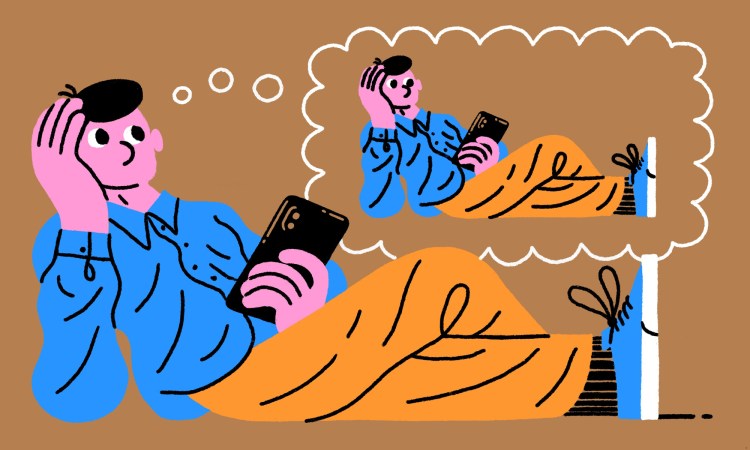

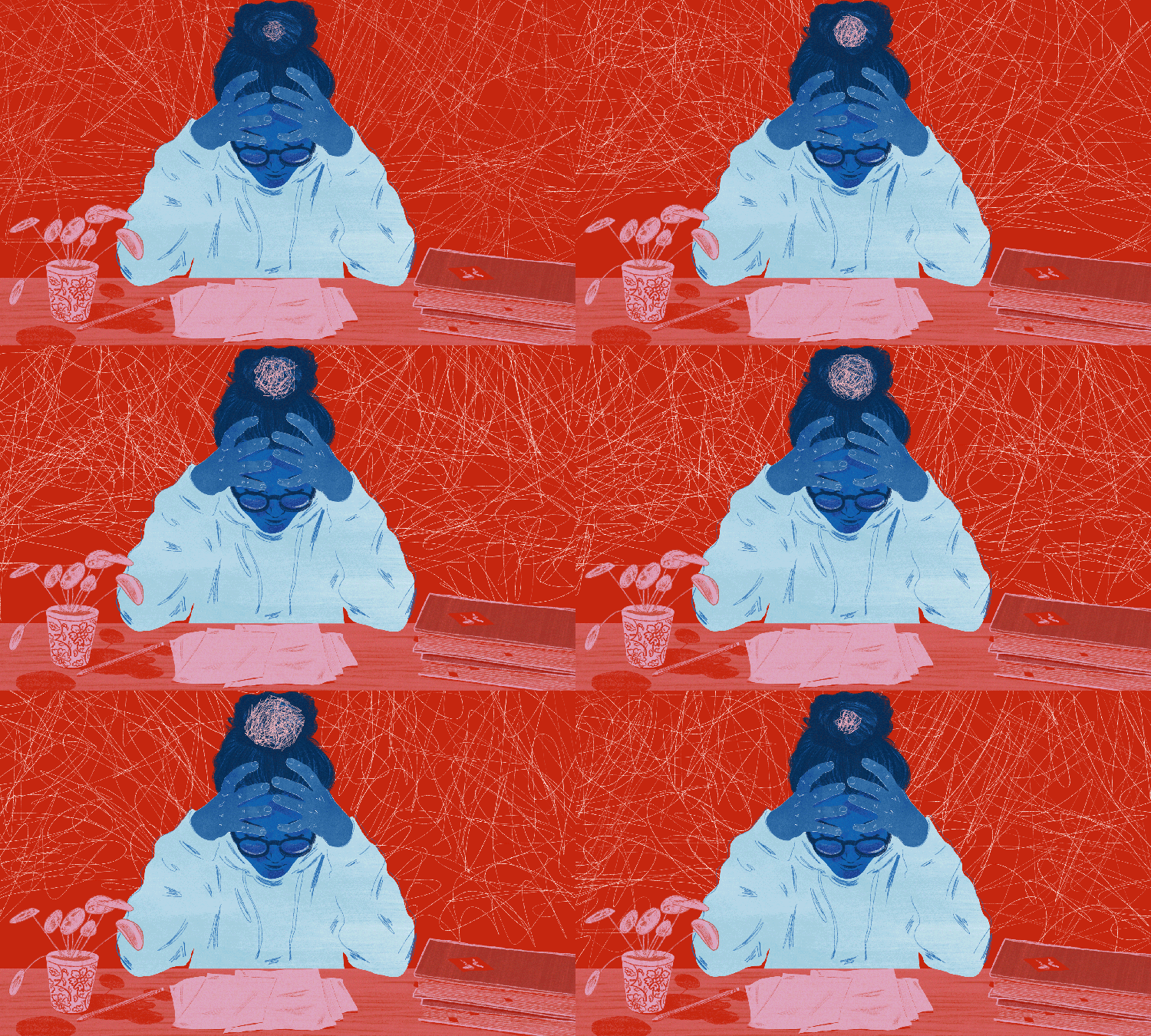


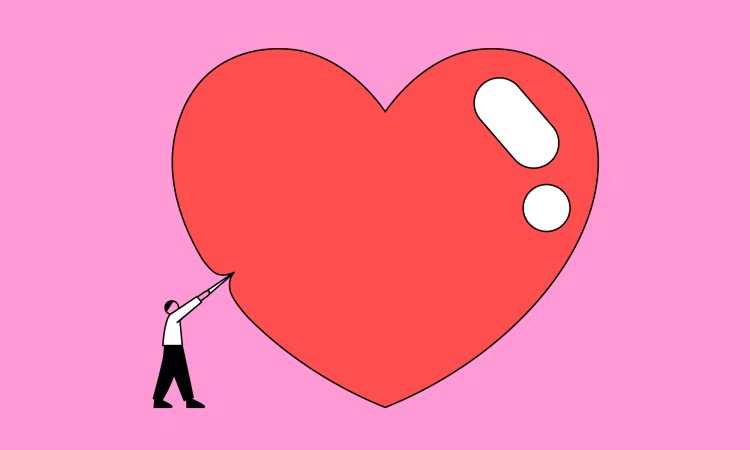








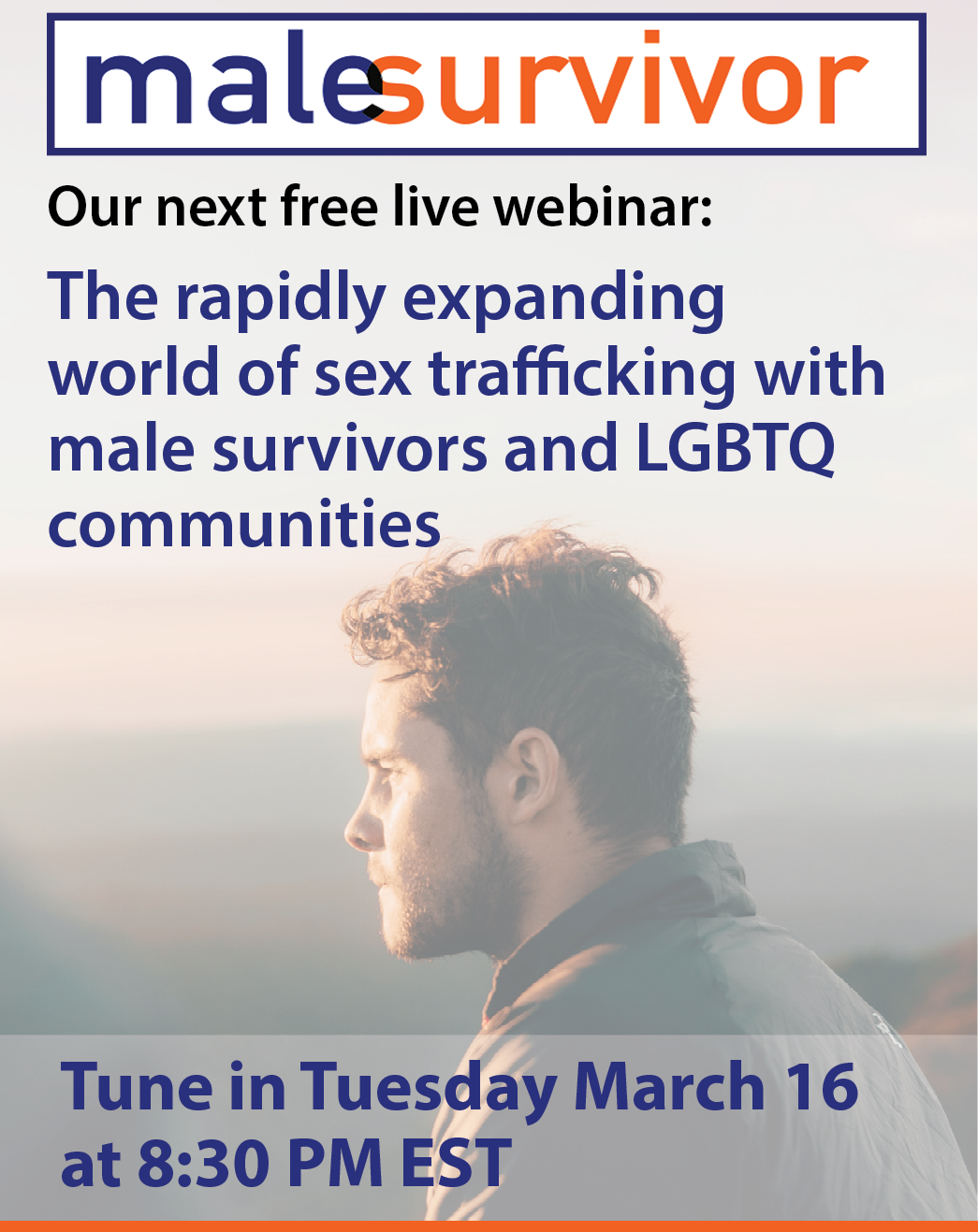 Topics will include:Sex traffickingTransactional nature of sexual abuse and exploitation Elevating male survivor voicesHow recovery efforts are blocked by unenlightened/flawed perceptions of masculinityPanelists:









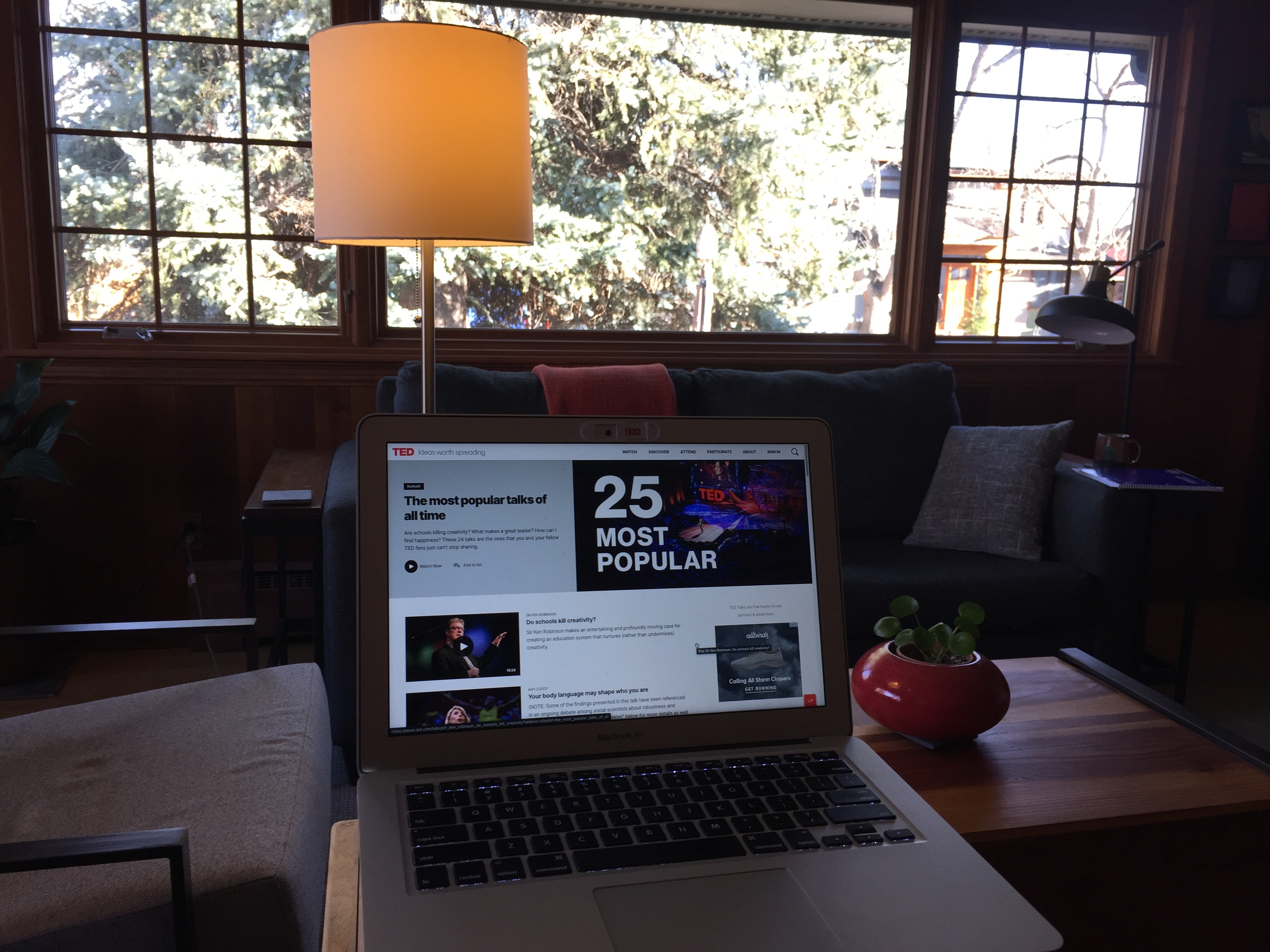
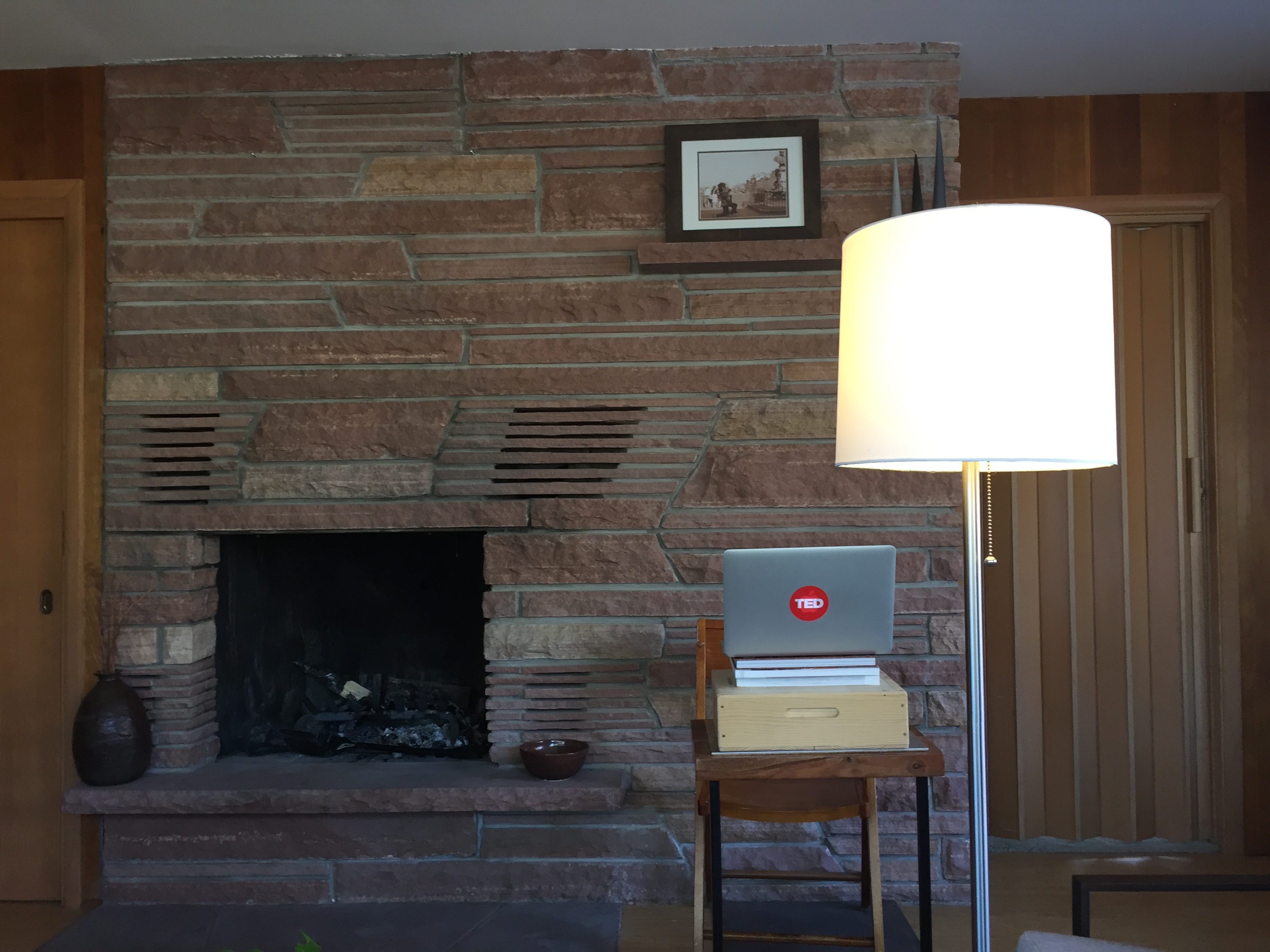
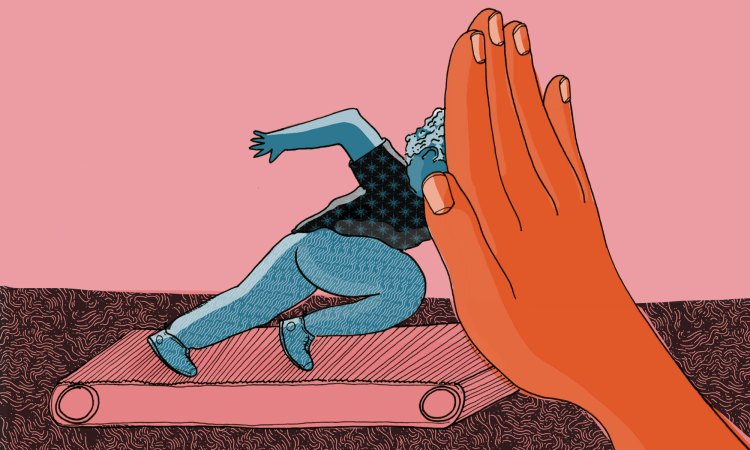
 lookingforthelight.blog