Health and Wellbeing · Men & Womens Health · Mental Health

Are You Experiencing Cognitive Dysfunction?

Have you ever experienced cognitive dysfunction or sometimes called brain fog? If so you will know exactly what it is and what it feels like. In fact, most of us have experienced it at some point or another, and it is actually a very common experience. While at times it might go hand-in-hand with a mental health issue, it can also just happen as a response to temporary stimuli, and can soon pass in those cases. But if you are experiencing it too often, or you just want to know how you can avoid it, try out the ideas in this article. If you have chronic brain fog you should check with your doctor in that it could be a symptom of a medical condition and need more attention. 

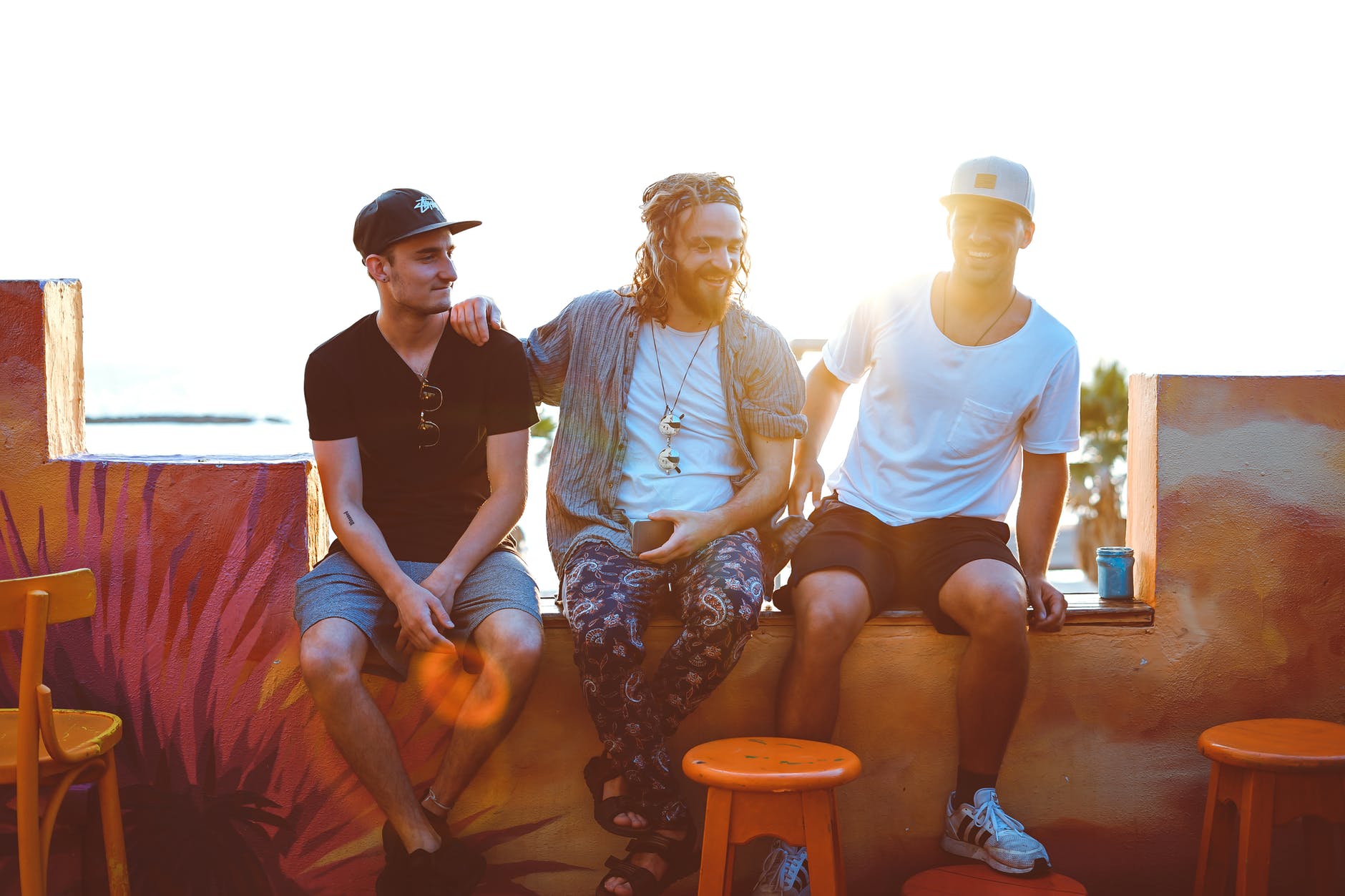
Photo by Sergey Katyshkin on Pexels.com

What Is Brain Fog?

While brain fog is not a specific medical condition that is recognized, it is a common experience and it has entered the language in the past few years for that reason. Generally, it is characterized by cognitive dysfunction, including memory loss and a lack of clarity in the mind, and generally a poor concentration with an inability to focus. If you find yourself experiencing this kind of brain fog, you will find that it is hard to focus on anything for too long. It can be a surprisingly upsetting experience.

Avoiding Brain Fog

How to avoid or get rid of brain fog will depend on what caused it, so the first thing to do is to identify that as closely as you can. There are many common causes of brain fog, including overuse of smartphones and social media, lack of sleep, abusing drugs and alcohol, stress, hormonal alterations, and poor diet. If any of these are jumping out at you as possible issues that you might need to fix, then that should be your first port of call.

Beyond that, it is all about making sure that you are generally looking after yourself. If you do that, you might be able to avoid brain fog altogether.

Photo by nicollazzi xiong on Pexels.com

Other Methods

If you are still experiencing brain fog on a regular basis, you might want to consider some other trusted options, such as meditation. With regular practice, meditation becomes easier and you will find that you have a better and better sense of what is going on in your mind, which will help you to stop brain fog in its tracks. That’s something that we can all look forward to.

Beyond Brain Fog

Life on the other side of brain fog is much clearer, happier, and more engaged, so it is absolutely worth trying to get rid of it as best as you can. If you try the options above and it’s enough, and you will find that you can enjoy life all the more as a result. If brain fog continues, please speak with your general practitioner about your symptoms. 

This is a collaborative post.

Melinda

Health and Wellbeing · Men & Womens Health · Mental Health

How many close friends do most people have? The answer is …

IDEAS.TED.COM

Dec 2, 2021

Going through a global pandemic has brought us together in some ways, but it’s also separated many of us from our routine interactions with friends and acquaintances. And in doing so, it’s led us to look at our relationships and reflect on the ones we’d like to add to our lives — and the ones we’ve left behind. 

Voraciously curious data journalist Mona Chalabi has been thinking about her friendships too, and she recently explored this topic in her podcast Am I Normal?. Here’s an excerpt from that episode, where Chalabi speaks with renowned friendship researcher Robin Dunbar PhD, an evolutionary psychologist at Oxford University: 

Mona Chalabi: According to Dunbar, our apple basket of relationships has an average of 150 people in it. This 150 figure is referred to as “Dunbar’s number“. Now it might seem high, but what Dunbar is looking at is the number of relationships the brain can handle at one time. This includes family, best friends, acquaintances, workmates, even the bartender you know by name. So they’re friends of a wide range of types. 

Dunbar has studied social relationships since the ’70s, first in primates and then in humans. He developed the number while studying primates’ social networks. And that was when he noticed that the size of those social groups was relative to the size of the primates’ brains.

“Introverts prefer to have fewer friends,” says Dr. Dunbar. “They probably sort of hover around the 100 – 150 mark.”

Robin Dunbar: And so I just, out of idle curiosity, thought, “Well, what happens if we stick human brains into this equation?” And when we did that, it gave this figure of 150. And that number then just kept turning up all over the place. 

Chalabi: The figure popped up in surprising places — offices, communes, even Christmas card lists. 150 is also the estimated size of Neolithic farming villages in the Middle East and 11th-century Britain … Dunbar says 150 for simplicity, but really, it’s a range between 100 and 250, depending on several factors.

Dunbar: One is obviously personality. So introverts prefer to have fewer friends. They probably sort of hover around the 100 –  150 mark …

Chalabi: Another factor is age. 

Dunbar: The size of personal social networks over the lifespan increases as you grow through childhood, hits a peak somewhere in the late teens, early 20s at something approaching about 250. And then from about the 30s, surprisingly coinciding with reproduction, it drops to about 150 after which it remains very stable.

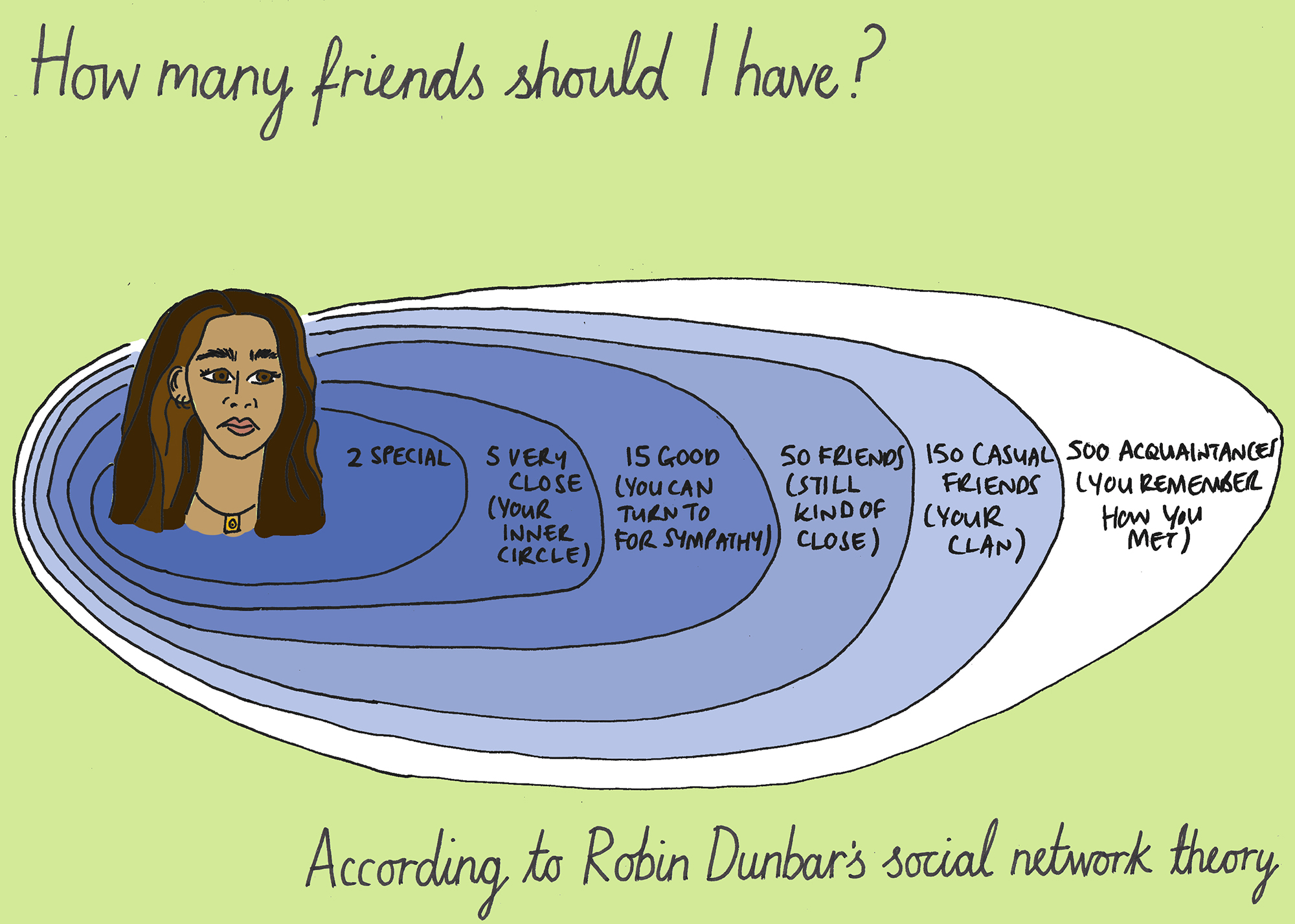
Illustration: Mona Chalabi

Chalabi: … You see, within that 100 – 250 friend range, there are layers or concentric circles. The first layer is about 1.5 people. That often represents your parents or your romantic partner.

Dunbar: Then the next layer out is somewhere around about 5 — we think of those as your intimate friends. The next layer out is 15 — those you might think of as best friends. Then there’s a layer at 50 — good friends. A layer at 150 — just friends. A layer at 500 —  which we think of as acquaintances.

Chalabi: 50 good friends! Five-zero! That feels like a whole lot of people! And I think this is the tier where I’m having the most trouble. 

… The more I think about it, part of the problem here might be that some of the people who were once part of that super-close friend group, maybe I just didn’t do enough to keep them there.

Dunbar: Certainly our research shows very clearly that if you fail to maintain that level of investment, friendships start to die slowly, but surely. Six months after you’ve not contacted them, they will have dropped down from being a good friend to maybe just a friend. And if it carries on for a couple of years, they will end up as an acquaintance.

Want to learn more? In her TED podcast Am I Normal?, data journalist, writer and illustrator Mona Chalabi dives into the numbers to get us answers to some of the most puzzling questions — like just how long does it take to get over a breakup and how bad is it to marry a cousin. But since statistics can’t tell the whole story, she also talks with experts, strangers and even her mother. Go here to listen to the irresistible episodes now. 

You can also watch this TED original video with Mona Chalabi here: 

Health and Wellbeing · Men & Womens Health · Mental Health

Book Review Adaptable by Alexa Carlin

I was kindly gifted a copy of Adaptable-How to Lead with Curiosity, Pivot with Purpose, and Thrive Through Change by Alexa Carlin from NetGalley, GracePoint Publishing, and Wex Press for a review. 


Pub Date 14 Sep 2021 
GracePoint Publishing, WEX Press

About the Author

At 17, Alexa Carlin became CEO of her first company, designing jewelry that made a difference, one bracelet at a time. But at 21, she was induced into a medical coma and given a one-percent chance to live. In Adaptable, she shares the stories of her journey, offering powerful insights into hope, courage, and life’s challenges.

Blurb

Life’s obstacles offer two distinct directions: They can push you backward or fuel you forward. The choice is up to you.

Written in a heartfelt and authentic tone, Adaptable invites readers to develop a new perspective on their past and current obstacles. The stories, lessons, and action steps that fill each chapter gently guide readers back to their true selves, allowing them to connect deeply to their inner light and shine brightly with their true purpose.

Alexa encourages and inspires readers to use their own challenges not as a reason to abandon dreams, but as a springboard from which to thrive.

Reviews

“Empowering, real, raw, and game-changing! Alexa’s stories within Adaptable will remind you of the potential you hold inside of you and the strength to push through any obstacle. An inspiring book by an inspiring woman!” – Jess Ekstrom, author of Chasing the Bright Side

Adaptable is a must read for anyone trying to silence that negative voice in their head and go after their dreams. Alexa’s voice is so real, inspiring, and motivating that you can’t help but feel empowered to live your best life.” – Rachel DeAlto, author of relatable, Relationship Expert, and television personality

My Thoughts

Adaptable is a story about overcoming insurmountable odds and taking the bull by the horns. Alexa inspires you to stay focused on your dreams and to chart a course for success by using your own obstacles as a learning experience for achieving each and every goal you set.

Alexa takes the obstacles in her young life and turns them into the motivation she needs to chart her own course.  

“This book is meant to be consumed in two ways. First, read it from front to back. Second, use it as a tool to help you find hope when it may be lost, to help you through times of self-doubt when pursuing your dreams, or for a beacon of light during some difficult times. Keep it near and anytime you feel you need a reminder, randomly flip open to a new chapter while asking for the answer you’re looking for, and read whatever chapter opens up.” I think this is the best way to read the book, it’s a story and a handbook to reflect on. 

Adaptable is a great book for everyone, from college students, just started out to professionals on the way up the ladder. 

Enjoy Reading!

Melinda

Looking for the Light

@lookinglight

Celebrate Life · Health and Wellbeing · Men & Womens Health · Mental Health

Daily Quote

Happy Thursday!

Photo by Samuel Theo Manat Silitonga on Pexels.com

“I’ll never be content to stay forever in one place. I’m too madly in love with all the places I haven’t been, the people I haven’t met, the food I haven’t tried on the streets I haven’t danced on.”

Brook Hampton

Have a great day.

Melinda

Celebrate Life · Fun · Health and Wellbeing · Men & Womens Health · Mental Health

Everyday Magic


Bella and Grace by Stampington

It is not often that we find ourselves in awe of something, but’s an incredible feeling. When was the last time you saw something so beautiful it took your breath away?


Enjoy your day! 

 Melinda

Health and Wellbeing · Men & Womens Health · Mental Health

How To Stop Languishing And Start Finding Flow

Celebrate Life · Health and Wellbeing · Men & Womens Health · Mental Health

Happy Thanksgiving

Why do Americans celebrate Thanksgiving?

Thanksgiving started with our ancestors, the English pilgrims in 1621 as a festival to give thanks for the plentiful crops and successful year. Many countries today have Thanksgiving celebrations including, Canada, Germany and Korea.  Thanksgiving is a time of gratitude. 

What we know today as American Thanksgiving was first held in 1621 by the English pilgrims who were celebrating their first successful harvest. They held the occasion to thank God for the great harvest in the preceding year. The 16th president of the US, Abraham Lincoln, declared the event a national holiday in America in 1863 during the American civil war. He declared that the fourth Thursday of November should be set apart to give thanks to God in prayer. Now, Americans observe Thanksgiving to celebrate good health, blessings in their family, and prosperity. On this day, families come together and prepare different meals with turkey meat being a major part of the meal.

You are in my thoughts this Thanksgiving Holiday. You’ve shared your stories, pain, growth and comments with me this past year, I’m so thankful. My life would not be as full without you in it and that would be a shame.

Happy Thanksgiving

Melinda

Celebrate Life · Fun · Health and Wellbeing · Men & Womens Health · Mental Health

Everyday Magic


Bella and Grace by Stampington

The most significant gifts are the small ones most easily overlooked. Small everyday blessings: woods, health, music, laughter, memories, books, family, friends, second chances, warm fireplaces, and all the footprints scattered throughout our days


-Sue Monk Kidd


Enjoy your day! 

 Melinda

Health and Wellbeing · Men & Womens Health · Mental Health

What Not To Do When A Friend Is In Need

A good friend is there to offer a shoulder to cry on when it’s needed. Indeed, simply being there for a friend when they come to you with a problem can, in and of itself, be helpful to them. However, there are correct and incorrect ways to respond to problems. It doesn’t mean that the solution is always the same, but that there are definite ways you can worsen the situation before you improve it. Before you jump to help that friend, consider looking at the way that you respond to problems.

Photo by Toa Heftiba u015einca on Pexels.com

One of the most frustrating things you can do to someone who is expressing their emotions about any given experience is rush past those emotions to try and promote a solution as quickly as possible  If someone is struggling with their mental health, the very first thing you should do is listen to them, take in their emotional response, and validate it. You might want to get to the solutions that can help them in no time, flat, but it’s not helping them to neglect their feelings.

Empathizing with your friend can be a good thing. It can help you develop some sense of shared perspective that can make it a little easier for them to open up about their problems. However, if you’re going to say something like this, you need to know the difference between empathy and compassion. Empathy is a quick reaction to a situation or emotional state that we see and can understand. Compassion is the deliberate attempt to understand their feelings and how they’re reacting to that situation or state. Don’t go off into stories about your own similar experiences or downplay their emotional response by stating that it affected you in a different and less harmful way. Even if you don’t mean to, you’re making it harder for them to be honest about their own feelings.

If you are a great problem solver and you do know a very concrete suggestion that will help them, you can share it. Make sure they’ve had the time to express their feelings and what they want to say, first. However, if you don’t have any great ideas for advice, then don’t feel like that you have to share them. Unsolicited advice can be a risky thing to give and that’s especially so if you don’t know what kind of advice to give.

Get an idea of “brutal honesty” out of your head. A lot of people go in with that mindset, but often what they get is brutality, not honesty. Even if you believe that your friend’s own mistakes led them to the predicament that they are in, who does it help to say as much? If you judge them when they are at their most vulnerable, that is what they will remember and, as a result, they’re less likely to come to you in the future. Check to make sure you’re not judgemental when trying to be helpful.

If your friend hasn’t opened up to you in such a way before then they can feel a little awkward and vulnerable about the way they have expressed themselves. You can reassure them that you are there to support them and that you are open to that kind of relationship by checking up on them and asking them how they are doing with the problem the next day. It shows that you’re genuinely interested in their wellbeing and can alleviate any feelings of guilt they might have about “burdening” you with their problems.

If you do think that you can play an active role in helping them with their problems, then that’s great. Rather than rushing to do it yourself, however, you should ask how you can support them. They might just want someone to listen to them, they might want someone to offer advice, or they might be open to more practical and hands-on assistance. The words “what can I do to help?” can be a very important step in making sure you’re not stepping on any toes.

Again, that you’re willing to listen to and help a friend is a great thing, by itself. But if you want to make sure that you are, indeed, being on the helpful side, you need to consider the above mistakes that you might be making.

This a collaborative post.

Melinda

Celebrate Life · Fun · Health and Wellbeing · Men & Womens Health · Mental Health

Just Pondering

What is you favorite tea?

How long do you steep?

I’m getting my tea grove going now that the temps have cooled down. 

Melinda

Celebrate Life · Fun · Health and Wellbeing · Men & Womens Health · Mental Health

Happy Anniversary Honey

Nineteen years ago we said I do in a small chapel in the snowy mountains. It was not our first but knew it was our forever. We had met just 11 months earlier, at New Years Eve party and from the beginning knew we were meant to be together.

We’ve been down many roads in our 20 years together but we’ve always gone down them side by side. 

Happy Anniversary, Honey. I love you. 

Your Wife

Melinda

Celebrate Life · Fun · Health and Wellbeing · Men & Womens Health · Mental Health

Everyday Magic


Bella and Grace by Stampington

Close your eyes and think of the word “whimsy“.

What comes to mind?


Enjoy your day! 

 Melinda

Celebrate Life · Health and Wellbeing · Men & Womens Health · Mental Health

A Moment of Joy — Guest Blogger Happy Healthy Me – a Journey

‘Look for the small things in life to bring joy’ – Confucius Joy! Just the word makes me feel happy! But did you know that experiencing moments of joy helps you think more clearly and helps you navigate through the difficult times? It’s actually a scientific fact! When you experience a moment of joy, your […]

A Moment of Joy — Happy Healthy Me – a Journey
Celebrate Life · Health and Wellbeing · Men & Womens Health · Mental Health

Changing Your Lifestyle for Better Wellbeing

Your health, wellbeing, and mental and emotional happiness should be top of your list of priorities in life. All too often, we get caught up in other things – responsibilities, careers, relationships, and other elements of day-to-day life – and fail to provide ourselves with the support we need to lead a happy and healthy existence. You need to take active steps to improve your lifestyle to get the most from each day. Here are a few suggestions that can help you to achieve this!

Photo by Andrea Piacquadio on Pexels.com

Tackle Bad Habits

We all have bad habits of some sort. At the end of the day, we are all just human. But you do need to make sure that you tackle any bad habits that are proving detrimental to your health or that are posing problems for you. There are many habits out there and the best way to overcome them will depend on the habit itself and you as an individual. If you smoke, you can quit by seeking support from your doctor and using quitting aids, such as nicotine patches or nicotine gum. If you are addicted to drugs, inpatient drug rehab can help to get you back on the right track. If you eat excessive unhealthy foods, a nutritional meal plan and meal prepping can help you to avoid unhealthy convenience foods and to know what you should be putting in your body for a healthy diet. Sure, tackling bad habits can be difficult. But be patient and persevere. You will see the result you want as long as you stick to your support plan.

Removing Negative Elements from Your Life

Is there something in your life that consistently makes you unhappy? It’s time to remove it or to remove yourself from it. If you find that you dread going to work each morning, it may be time to consider a new career or working for a new company. If you find that your partner constantly makes you unhappy, or that you are constantly arguing, you may want to consider ending the relationship or seeking couples therapy. If you are bored, you should pick up some hobbies. If you are lonely, you should reach out to friends and family or engage in activities where you can make new friends. If you are struggling with your mental health, you should seek support from doctors, therapists, or counselors. Whatever your struggle, there will be a logical solution for it.

Relax

Make sure to take some time to relax. All too many of us get caught up in our routines and responsibilities and fail to make time for ourselves. It’s important that you do take time to do either nothing or to let your hair down. Different people find different relaxation techniques beneficial. Whether you want to run a bath, sit and watch a show or film, go for a long walk, or anything else, make sure to schedule time in your routine.

These suggestions should help you to lead a healthier, happier, and more positive life! Give them a try.

This is a collaborative post.

Melinda

Celebrate Life · Fun · Health and Wellbeing · Men & Womens Health · Mental Health

Everyday Magic


Bella and Grace by Stampington

Singing along to our favorite songs is a quick way to turn a day around.

What songs always make you feel good?

Enjoy your day! 

 Melinda

Health and Wellbeing · Men & Womens Health · Mental Health

New Resources For The LGBTQ Community

Hey- 

I’ve updated my list of resources to include the below. 

LGBTQ+ Therapist Directories

  • AGLP: The Association of LGBTQ+ Psychiatrists has been advocating on behalf of the LGBTQ+ community for more than 40 years. You can search for a psychiatrist in your area using the organization’s Referrals page, even filtering the results by gender identity and race.
  • The Gay Therapy Center is a community of highly qualified LGBTQ+ therapists. You can schedule a free 15-minute consultation, which will help match you with a therapist for individual or couples counseling, either in office or online.
  • The National Queer & Trans Therapists of Color Network is committed to “advancing healing justice by transforming mental health for queer and trans POC,” according to its website. The mental health directory allows you to search for a practitioner in your area.
  • Pride Counseling is an online therapy tool for the LGBTQ+ community. Fill out a survey, and you’ll be matched with a licensed therapist, whom you can communicate with via phone, video, and messaging.
  • Inclusive Therapists helps connect marginalized communities with culturally competent care. Search for a therapist near you – filtering by specialty, insurances accepted, and more – or complete a form to be matched with a therapist based on your needs.

LGBTQ+ Mental Health Information and Support

  • The National Alliance on Mental Illness summarizes the unique challenges facing the LGBTQ+ community and provides a list of resources, as well as a step-by-step guide for finding the right therapist.
  • The LGBT National Help Center offers free and confidential peer support for LGBTQ+ youth, including hotlines, chat rooms, and a database of local resources.
  • The Human Rights Campaign has a list of mental health resources for queer and trans BIPOC, including questions to ask when trying to find an identity-affirming therapist.
  • The Trevor Project is the “world’s largest suicide prevention and crisis intervention organization for LGBTQ young people,” according to its website. Counselors are available 24/7, and you can also make connections using TrevorSpace, an online international community for LGBTQ+ young people ages 13-24.
  • The National Center For Transgender Equality advocates for policies that signal a deeper understanding and acceptance of trans folks. The organization offers a number of resources, including information on how to access health care and simple ways to take action.
  • Trans Lifeline offers emotional and financial support to trans people in crisis. All operators are trans or nonbinary, and law enforcement or emergency services will only be called at your request.

Please check out the other resources on my page, Organization That Can Help.

Melinda

Health and Wellbeing · Men & Womens Health · Mental Health

3 Self Care Strategies for Remote Workers

Since the beginning of the pandemic, there has been a wave of workers who have switched remotely. This has led businesses to permanently switch to being remote, and business owners doing the same for their small businesses. It’s proven that working from home still leads to getting the job done, and even makes productivity better. Since remote work creates this very blurred line between work and life, it can be understood that health and even standard self-care practices tend to slip. 

It’s just something that’s completely normal. However, it’s important, even with these blurred work-to-life balances, that you still keep up with your health and take care of yourself. You should create boundaries for yourself so work doesn’t consume you. These are some helpful self-care tips for remote workers.

Photo by Arina Krasnikova on Pexels.com

Don’t neglect your eye health

There is a very high chance that you’re staring at your computer screen for 8 to 10 hours each day. But did you know that this can actually be pretty harmful to your eye health? It’s true, and those who tend to have very dry eyes don’t benefit from it either. If you’re looking into chronic uveitis treatments, then one of the first steps is to take breaks throughout the day for your eyes. This will help in preventing eye exhaustion and dryness.

Look after other aspects of your physical health

A healthy body leads to a healthy mind, and vice versa. It’s very important to give your body the attention that it deserves since it’s sitting at a desk hunched over all day. To alleviate this, you can start with exercising regularly. Even getting a minimum of 3 times a week for an hour each can do a lot of good for you. Another thing you should do is to keep proper nourishment. While junk food can be very tempting, it’s best to stick with whole foods as these are far healthier and they’re going to make you feel better.

Sleep is also something that you should not ever neglect. Don’t risk your sleep just to “catch up” with work, all you’re doing is piling more things on yourself. You need sleep to think better, to be productive, and to stay energized throughout the day. There are plenty of health consequences such as heart disease for skipping out on seven to nine hours of sleep each night.

Don’t neglect your mental health

You need to take care of your mental health in this digital world. This should include getting on social media a lot less as it’s filled with bad news and can lead to insecurities. You should also do things that you enjoy once work is finished for the day. This includes walking away from the computer for a little while and doing something such as go for a walk, gardening, board games, crafts, or anything else you may like. It’s important to step away from your computer and the area that you work at from home so your mind can “clock out” of work. This is going to really help your mental health. 

This is a collaborative post.

Melinda

Celebrate Life · Fun · Health and Wellbeing · Men & Womens Health · Mental Health

TED’s reading list: 78 feel-good books to help you rejoice, reflect or recharge

IDEAS.TED.COM

Enthusiastic recommendations for uplifting reads, as suggested by TED speakers and TED-Ed educators.

If you’re searching for some calm 

The Peace of Wild Things: And Other Poems by Wendell Berry
This little book of poetry is my current morning dose of calm, and I use it like a meditation if I’m feeling stressed about the day ahead. The most famous verse in it is the title poem, which never fails to bring me back from our tech-driven, fast-paced world into memories of beautiful forest walks. Through this volume, I’m enjoying discovering other work by this wonderful poet, who writes: “For a time, I rest in the grace of the world, and am free.”
— Suzie Sheehy (TED talk: The case for curiosity-driven research)

The Rain in Portugal by Billy Collins (TED talk: Two poems about what dogs think — probably)
Collins is by far my favorite poet. His words fill me with such ease and warmth, and they never fail to put me in a better, heightened mood. I always feel like his poems help me to see the world, rather than just pass through it blindly. I could have picked any volume of his work, but this — his latest — is a great place for people to start.
— Luke Sital-Singh (TED performance: “Afterneath” / “Killing Me”)

Bells in Winter by Czeslaw Milosz
This slim book of poetry brings moments of intense wonder about the unknowableness of the human condition. Some of these poems calm me like a drink of cold, clear water. That there is someone like Milosz, who can understand and distill the human experience in this way, helps make our modern social chaos recede.
— Linda Elkins-Tanton (TED-Ed lesson: Why is NASA sending a spacecraft to a metal world?)

Zen Shorts by Jon J. Muth
My husband and I read this illustrated children’s book to my daughter many times, but I think he and I learned more from it than she did! It imparts important life lessons like: “good” and “bad” life events don’t exist — what seems like a good life circumstance can have bad consequences, and what seems like a bad situation can lead to something positive. I practice what I learned from these inspiring stories daily.
— Mara Mintzer (TED talk: How kids can help design cities)

If you’d like to be closer to the people in your life 

Your Body Is Your Brain: Leverage Your Somatic Intelligence To Find Purpose, Build Resilience, Deepen Relationships and Lead More Powerfully by Amanda Blake
I love a read that leaves me believing I can change by practicing simple steps, and this book is all that. Blake teaches us how to tap into our most powerful intelligence — namely, posture, gestures and sensations — and truly live from our authentic power.
— Tammy Lally (TED talk: Let’s get honest about our money problems)

Peaceful Parent, Happy Siblings: How to Stop the Fighting and Raise Friends for Life by Dr. Laura Markham
Markham has been such a companion to me and my wife in our parenting journey. While raising children is perhaps the biggest gift, it is not without its challenges. This book provides actionable tools and advice, all steeped in robust research, that I find myself excited to put into practice. That’s rare with self-help books!
— Vinay Shandal (TED talk: How conscious investors can turn up the heat and make companies change)

Mistakes Were Made (But Not By Me): Why We Justify Foolish Beliefs, Bad Decisions, and Hurtful Acts by Carol Tavris and Elliot Aronson
This book forces me to be self-reflective and recognize when cognitive dissonance enters my decision-making process. Citing numerous historical examples in which this psychological phenomenon has negatively impacted outcomes, Tavris and Aronson brilliantly show the reader how we can identify dissonance in our choices, ultimately helping you make better decisions and foster better relationships.
— Kelly Richmond-Pope (TED talk: How whistle-blowers shape history)

Taking the Work Out of Networking: An Introvert’s Guide to Making Connections That Count by Karen Wickre
Who knew connecting with others for one’s career could be so authentic, observational and reciprocal? In this practical, delightful read, Wickre reveals a whole new kind of networking for our increasingly transactional digital world. Full of insights and helpful tips, especially regarding social media, this is the perfect book for anyone in the midst of a career transition or considering one. (Read an excerpt from the book here.)
— Chip Conley (TED talk: What baby boomers can learn from millennials at work — and vice versa)

If you want a book that makes you feel all your feelings 

Americanah by Chimamanda Ngozi Adichie (TED talk: The danger of a single story)
This was the first book I read as an adult that made me feel understood. Navigating the multiple cultures that you’re a part of — as an immigrant or first-generation person in the West — is quite an endeavor. Doing this while carrying your Blackness and Africanness, in addition to maintaining your humanity, is a journey. Adichie does this with sagacious humor in her novel.
— Michael Rain (TED talk: What it’s like to be the child of immigrants)

The Boys in the Boat: Nine Americans and Their Epic Quest for Gold at the 1936 Berlin Olympics by Daniel James Brown
I loved The Boys in the Boat. It’s the inspiring true story of the University of Washington crew team which ended up, against all odds, competing in the 1936 Olympic Games. In this book, the facts are as fun as fiction.
— Finn Lützow-Holm Myrstad (TED talk: How tech companies deceive you into giving up your data and privacy)

The Apocalypse of Elena Mendoza by Shaun David Hutchinson
In this novel, Elena is born from a mother who is a virgin, but Elena’s life is anything but religious. When a Starbucks logo commands her to heal a gunshot victim — who also happens to be her crush — she does it and then sets off a chain reaction. I love how this book highlights the way we must choose to do good again and again. It isn’t necessarily inherent within us, but we can choose goodness anyway.
— Dawn Wacek (TED talk: A librarian’s case against overdue fines)

We, The Drowned by Carsten Jensen
This novel is so immersive you don’t want it ever to end. A vivid historical epic spanning four generations, it’s told from the point of view of a whole town — a small Danish sailing community tackling the challenges of emergent globalization and war. It’s as exciting as any thriller, as involving as any psychological drama, and as moving as the deepest romance.
— Özlem Sara Cekic (TED talk: Why I have coffee with people who send me hate mail)

Air Traffic: A Memoir of Ambition and Manhood in America by Gregory Pardlo
Air Traffic was written by one of my mentors, the Pulitzer Prize-winning poet Pardlo. It helped me deal with the complicated range of emotions that I struggled with after I lost my father last year. This memoir is about a difficult relationship between a father and son, and it shows us love in a form that we rarely see displayed openly. It’s work to try to understand and accept a complex person while still seeing them in all their humanity — including their anguish and their ugliness.
— Michael Rain (TED talk: What it’s like to be the child of immigrants)

The Storied Life of A. J. Fikry by Gabrielle Zevin
This is a beautiful novel about grief and love, and finding meaning after loss. A.J. owns a bookstore — another thing to love — and he has recently lost his pregnant wife to a terrible accident. He withdraws into his work, but even that doesn’t bring him joy anymore. When a mysterious package is left on his doorstep, A.J. is pushed to begin seeing the world, and his place in it, in a new light.
— Dawn Wacek (TED talk: A librarian’s case against overdue fines)

If you just want a reason to smile

Dirk Gently’s Holistic Detective Agency by Douglas Adams
This book makes me giggle out loud every time. Overshadowed by Adams’ more famous work, the Dirk Gently novels are a delightful read. They’re chock full of his trademark humorous writing and lovable character creations, like the Electric Monk (a labor-saving device that believes things for you so that you don’t have to) and a bored horse. The horse is my favorite.
— Kate Darling (TED talk: Why we have an emotional connection to robots)

Kitchen Confidential: Adventures in the Culinary Underbelly by Anthony Bourdain
The patron saint of chefs and travel tragically died by suicide in 2018. Listen to the audio version of the memoir that made him famous; it’s read aloud by the man himself. It will make you miss him all over again, but you’ll also laugh and smile for what he once gave us.
— Prosanta Chakrabarty (TED talk: Four billion years of evolution in six minutes)

A Walk in the Woods: Rediscovering America on the Appalachian Trail by Bill Bryson
This comical true tale of Bryson’s misadventures as he hikes the Appalachian Trail left me with a stomach ache from laughing out loud. It inspired me to take on new adventures — no matter how ill prepared I might be!
— Lucy Marcil (TED talk: Why doctors are offering free tax prep in their waiting rooms)

The Essential Haiku: Versions of Bashō, Buson & Issa edited by Robert Hass
Whenever I want a good laugh, I browse this compilation of haikus by several of the Japanese masters. Descriptive phrases like “Morning breeze riffling the caterpillar’s hair” and “Year after year, a monkey’s face, on the monkey’s face” capture nature like I’ve never seen elsewhere. Their appreciation for the mundane and the way in which they find hilarity in the natural world makes for a book to be read out loud — whether you’re around the campfire or when you’re enjoying time with friends and family.
— Rebecca Tarvin (TED-Ed lesson: Why don’t poisonous animals poison themselves?)

How To Be Idle: A Loafer’s Manifesto by Tom Hodgkinson
This is a funny, eye-opening guide to why and how we are living is making us so miserable, but we can’t even say that, let alone object. This book explains how we were not always so work obsessed; instead, work was integrated into our lives, which were more than what we did to earn money. Plus, there’s a great chapter on why we do hangovers all wrong.
— Simone George (TED talk with Mark Pollock: A love letter to realism in a time of grief)

How to Be a Woman by Caitlin Moran
This nonfiction book made me laugh hard, as it hand-held me through some of the thinking around feminism and gendered roles. It’s a classic, really, and a great gateway drug for anyone who thinks that diving into the incredible canon of feminist writing might not be for them. It is. Let Moran walk you in.
— Simone George (TED talk with Mark Pollock: A love letter to realism in a time of grief)

The Misadventures of Awkward Black Girl by Issa Rae
Not really a memoir but more a collection of essays, this book made me laugh out loud on one page and then question some of my assumptions and beliefs on another. I particularly connected with it, because Rae is around my age and some of the coming-of-age stories that she tells revolve around the new technologies (AOL chat rooms!) that we were all exploring — resulting in both our edification and corruption — in the mid-to-late ‘90s.
— Elizabeth Cawein (TED talk: How to build a thriving music scene in your city)

The Code of the Woosters by P.G. Wodehouse
Joseph Connolly, in summarizing his 2004 biography of Wodehouse, wrote the following: “Wodehouse was not deep. He had no message. He was merely one of the greatest writers in the history of literature. Behind the happy face there lived a happy man.” While you’re reading this novel about Bertie Wooster’s attempt to track down a Dutch cow-creamer you, too, will be happy.
— Stephen Webb (TED talk: Where are all the aliens?)

If you want to learn more about humans and our collective ingenuity 

Sapiens: A Brief History of Humankind by Yuval Noah Harari (TED talk: Why fascism is so tempting — and how your data could power it)
This book is full of useful information about the past and present of humanity. I loved how open-minded it was, and I was very excited to learn the little details that drive the way we behave.
— Lina Marieth Hoyos (TED-Ed lesson: What is the coldest thing in the world?)

The Innovators: How a Group of Hackers, Geniuses, and Geeks Created the Digital Revolution by Walter Isaacson
If you want to learn about the history of the digital revolution, this book is for you. It takes readers on a tour through the stories of several innovators and creators of devices and developments that are very useful in our present-day lives. Traveling from the ideas of Ada Lovelace to Steve Jobs, this book shows us how they took a step beyond conventional thinking with their revolutionary ideas.
— Lina Marieth Hoyos (TED-Ed lesson: What is the coldest thing in the world?)

One Good Turn by Witold Rybczynski
This nonfiction book is aimed at the technologically minded but also at anyone who has an interest in the historical development of civilization. Around the turn of the millennium, the author was asked to find and write about the most useful tool of the previous 1,000 years. I won’t spoil what it was — you need to read it to find out, but it’s certainly something that none of us can do without.
— Ian Firth (TED talk: Bridges should be beautiful)

If you’re fascinated about the inner lives of well-known people

Minority Leader: How to Lead from the Outside and Make Change by Stacey Abrams (TED talk: 3 questions to ask yourself about everything you do)
I work in government affairs, and the last thing I enjoy reading for pleasure are books by politicians. However, this book is different on so many levels and is a must-read — whether you’re a political junkie or just someone seeking inspiration to chart your own course. I instantly related to and was inspired by Abrams’s candid struggles to overcome self-doubt and embrace the full range of her abilities as a talented woman of color. Her writing is candid, eloquent, familiar, funny and highly digestible. I found myself nodding, smiling, dog-earing pages, and taking deep inhalations to digest her inspiring wisdom.
— Nikki Clifton (TED talk: 3 ways business can fight sex trafficking)

Grant by Ron Chernow
Chernow — who also gave us the famed biography of Alexander Hamilton — was the featured speaker at the White House Correspondents Dinner in April 2019, in a break from the tradition of having a comedian. But after reading Grant, I can understand why. This biography tells us how an alcoholic, gullible sad-sack became one of the the most famous soldiers in US history as well as the civil-rights championing 18th President — it has all the elements of the next great Lin-Manuel Miranda musical.
— Prosanta Chakrabarty (TED talk: Four billion years of evolution in six minutes)

Alibaba: The House That Jack Ma Built by Duncan Clark
I enjoyed this very inspiring book about the personal and professional life of Alibaba founder Jack Ma. Ma’s likable and easy-going personality makes the book very inspiring and fun to read, while also providing interesting insights as to how he managed to establish one of the highest-valued companies in China and the world.
— Pierre Barreau (TED talk: How AI could compose a personalized soundtrack to your life)

Becoming by Michelle Obama
In this memoir, First Lady Michelle Obama is elegant and unapologetic about living your truth, being of great public service, dreaming big, and never giving up. She is eloquent, raw and real in describing her personal experiences and how she found her voice. Her account of public service — both in the White House and in her private life — is truly remarkable, and I’m excited to see this book encourage others to “become” the next, greater version of themselves.
— Darieth Chisholm (TED talk: How revenge porn turns lives upside down)

Entertaining with Vegetables: A Recipe Collection for Modern Home Cooks to Make Lovely and Delicious Food with Produce by Chadwick Boyd
Every kitchen needs this inspiring cookbook. I am “almost” a vegetarian because of it. Each recipe is so creative, packed full of Imagination and flavor, flavor and more flavor. You can feel Chadwick’s love for food and connection on every page.
— Tammy Lally (TED talk: Let’s get honest about our money problems)

Strudel, Noodles & Dumplings: The New Taste of German Cooking by Anja Dunk
I love an avocado as much as the next guy, but nothing makes me happier than a proper, hearty, home-cooked meal — that’s what Dunk’s cooking is all about. She’s written my favorite kind of cookbook with the perfect blend of originality and familiarity. Every recipe looks as achievable as it looks delicious, and it’s all written up with a warmth and honesty that can come only from a real person doing real life.
— Luke Sital-Singh (TED performance: “Afterneath” / “Killing Me”)

The Life-Changing Magic of Tidying Up: The Japanese Art of Decluttering and Organizing by Marie Kondo
At first glance, one would think this book is only about organizing your closet (and closet organization is discussed), but what I learned is that the same principles applied to organizing your home can apply to your calendar, your finances and your business relationships. After applying the Kondo principles to my entire life, I regained valuable time which led to greater mental clarity. This book taught me a mindset that’s led to extreme happiness and productivity.
— Kelly Richmond-Pope (TED talk: How whistle-blowers shape history)

This book helps you practice living with freedom from material possessions. It’s a very practical, actionable guide to decluttering your life and helping you trade chaos for clarity.
— Alex Edmans (TED talk: What to trust in a “post-truth” world)

Joyful: The Surprising Power of Ordinary Things to Create Extraordinary Happiness by Ingrid Fetell Lee (TED talk: Where joy hides and how to find it)
I really enjoyed this really well-written and easy-to-read book. It talks about how we can make the world a much better place if we’d only build environments which make us smile and bring joy to our lives, instead of the usual, mundane gray spaces that so many of us are forced to live and work in. Every designer, architect, politician, civil servant and, in fact, everyone should read this book and start to make a difference in the patch where they live. (Read an excerpt here.)
— Ian Firth (TED talk: Bridges should be beautiful)

If you want to enjoy a book with your favorite little person

Rosie Revere, Engineer by Andrea Beaty

This is a favorite read of mine — and of my two-year-old and and my four-year-old. It offers uplifting lessons in creative problem solving, perseverance with trial and error, and innovation, and I love how it ties into history — young Rosie’s namesake Aunt helped build airplanes during WWII and serves as inspiration and cheerleader for the next generation. It also has great whimsical illustrations.
— Daniel Kraft (TED talk: The pharmacy of the future? Personalized pills, 3D printed at home)

Does It Fart? The Definitive Field Guide to Animal Flatulence by Nick Caruso and Dani Rabiotti
When I showed this book’s cover page to my seven-year-old daughter, she covered her mouth and giggled — and then she called her sister over to flip through the book. The text is fun and full of facts for anyone of all ages. It covers animal farters (actual and alleged) from herrings to humans, even unicorns. (The authors say that these creatures would fart if they were real, basing their contention on an Arabian oryx or the extinct Elasmotherium, the so-called “Siberian unicorn”). If you’re looking for a new way to get natural history knowledge that you didn’t know you needed, this book is for you.
— Prosanta Chakrabarty (TED talk: Four billion years of evolution in six minutes)

The Monster Book of Switzerland by Jeanne Darling
This is a fantastic and beautifully illustrated children’s book with lots of enjoyable monsters and trivia about Switzerland, where I spent most of my life. And the author just happens to be my mother, who started writing popular Swiss children’s books as a 70-year-old retired teacher! It makes me feel both at home and truly inspired to follow my dreams.
— Kate Darling (TED talk: Why we have an emotional connection to robots)

It’s Okay to Be Different by Todd Parr
Parr delivers an impactful message in an impactful way. This children’s book empowers kids to be who they are, accept who others are, and do so without judgment. I read this with my toddler son at least once a week.
— Vinay Shandal (TED talk: How conscious investors can turn up the heat and make companies change)

If you thrill to people’s survival stories, both real and fictional 

Eva Luna by Isabel Allende (TED talk: Tales of passion)
When I was 17, I read this novel, which was the first book I ever read by Allende. Eva Luna is orphaned at an early age in a unidentified country in Latin America, and her story highlights some of the political issues post-World War II. It opened my eyes to magical realism and to the region as a whole.
— Finn Lützow-Holm Myrstad (TED talk: How tech companies deceive you into giving up your data and privacy)

The Examined Life: How We Lose and Find Ourselves by Stephen Grosz
This book s a collection of deeply moving stories of self-discovery by psychoanalyst Grosz. His writing about therapy has been described as “like a combination of Chekhov and Oliver Sacks.” Whether it’s finding and keeping love, facing trauma in a family history, or confronting the most sensitive personal or professional vulnerabilities, this book brings hope by showing that humans have the capacity to heal — even bloom — when living with life’s most painful emotional scars.
— Alexandra Sacks (TED talk: A new way to think about the transition to motherhood)

Unbroken: A World War II Story of Survival, Resilience and Redemption by Laura Hillenbrand
I hesitated reading this nonfiction book after it was given to me by a friend, because it seemed like more of a feel-good story than what usually attracts me. Wow, was I mistaken! I found this book about the life of Louis Zamperini to be incredibly uplifting and almost impossible to put down. Hillenbrand does an elegant job of capturing details that make his story come alive without weighing down the amazing narrative of this real-life hero, who was an Olympic distance runner, an Air Force pilot in WWII, and a Japanese POW, among many other things. This beautifully told story of the life of Zamperini inspired me to be more than who I am.
— Ben Cort (TED talk: What commercialization is doing to cannabis)

News of the World by Paulette Jiles
I’m a sucker for books today that help us rethink — and rewrite — our founding myths of the American West. Jiles’ novel takes a harrowing tale of a German girl captured by the Kiowa Indians and spins it into a feel-good yarn about humanity’s capacity for empathy.
— Chip Colwell (TED talk: Why museums are returning cultural treasures)

Heavy: An American Memoir by Kiese Laymon
Laymon’s memoir hit home for me as he lives in Oxford, Mississippi, which is within 100 miles of my own creative work base. The author grapples with childhood traumas and coming-of-age revelations and emotions, all of which served to define the man he has become. This book, which is in the second person, is written as an engaging confession to his brilliantly damaged mother. It’s transformative, empowering and soulful.
— tobacco brown (TED talk: What gardening taught me about life)

If you want to regain a sense of wonder about the world 

Black Hole: How an Idea Abandoned by Newtonians, Hated by Einstein, and Gambled On by Hawking Became Loved by Marcia Bartusiak
Not many people know that the story which led to the discovery of black holes is as odd as the astronomical objects. From the late 17th-century publication of the gravitational theory by Isaac Newton, it took almost three centuries to accept that, when it comes to black holes, the apparently impossible is real. Black holes are collapsed objects that possess infinite density. In this exciting scientific adventure, Bartusiak describes the emergence of the crazy ideas behind these objects. This book will teach you that sometimes the impossible can become true.
— Fabio Pacucci (TED-Ed lesson: Could the earth by swallowed by a black hole?)

The Feynman Lectures on Physics by Richard Feynman, Robert B. Leighton and Matthew Sands
It may seem strange to pick a three-volume collection of physics lectures and try and sell it as feel-good reading, but as I can confirm, you can return to these famous “red books” time and again and, each time, find insight, ingenuity and inspiration.
— Stephen Webb (TED talk: Where are all the aliens?)

Seeing Science: An Illustrated Guide to the Wonders of the Universe by Iris Gottlieb
While I use music and sound, Gottlieb uses the universal language of visual art to understand and share the elegant beauty of the world around us. Equal parts fascinating and whimsical, this book tells the stories of scientific wonders big and small, with many frame-worthy pages along the way. It shows the potential rewards of fearlessly following your curiosity and imagination, wherever it leads.
— Matt Russo (TED talk: What does the universe sound like? A musical tour)

The Feather Thief: Beauty, Obsession, and the Natural History Heist of the Century by Kirk Wallace Johnson
This nonfiction book is part mystery, part natural history, and part jaw-dropping mirror of our modern society. Johnson does an amazing job of seeking to understand the role of natural history collections and explaining how misinterpreting their role can lead people astray. He follows one man’s obsession with the obscure and ancient art of fly-tying and how that led him to break into a museum to steal priceless specimens. If you love nature or museums, this crime will chill you to the bone.
— Prosanta Chakrabarty (TED talk: Four billion years of evolution in six minutes)

The Best American Science and Nature Writing 2018, edited by Sam Kean
The science of the soul. Tiny jumping spiders who can see the moon. Firestorms. Fantastic beasts. You can’t go wrong with the latest installment of this annual series — it will leave you filled with questions, knowledge, motivation and wonder!
— Chip Colwell (TED talk: Why museums are returning cultural treasures)

H is for Hawk by Helen MacDonald
I really enjoyed this beautifully written memoir, a mixture of philosophy with the author coming to terms with the death of her father and her insightful story about training a pet goshawk. It’s a great holiday present for someone, particularly if they love birds of prey.
— Ian Firth (TED talk: Bridges should be beautiful)

The Skeptic’s Guide to the Universe: How to Tell What’s Really Real In a World Increasingly Full of Fake by Steven Novella
Novella is right up there with Carl Sagan as people who taught me the joy and humility that comes with understanding how our brains actually work (or don’t!) in our quest to understand the cosmos and ourselves. This is the ultimate guide to critical thinking, with all the charm and irreverence that Steve and the other “Rogues” bring to their weekly podcast of the same name. As the subtitle suggests, this book comes at a time when we need it most.
— Matt Russo (TED talk: What does the universe sound like? A musical tour)

Pale Blue Dot: A Vision of the Human Future in Space by Carl Sagan
This book highlights our place in the universe in a very uplifting way. The earth, this place we call our home, is just a tiny spot in the vastness of space, and the book shows us that the small “pale blue dot” where we live is a small dot full of life and love.
— Lina Marieth Hoyos (TED-Ed lesson: What is the coldest thing in the world?)

The Invention of Nature: Alexander von Humboldt’s New World by Andrea Wulf
This is a deeply human story of our drive to explore, as told through the biography of polymath, naturalist and geographer Alexander von Humboldt. This nonfiction book inspired me to build a cyanometer to measure the blueness of the sky, to channel the courage that he used to climb unclimbable mountains, and to imagine how scientists and humanists can invent a better world.
— Linda Elkins-Tanton (TED-Ed lesson: Why is NASA sending a spacecraft to a metal world?)

If creativity and art are what get you out of bed in the morning 

Jonathan Livingston Seagull by Richard Bach
This is a short read, but this classic novel touches on creativity, learning, freedom from conformity, and flying, one of my favorite elements. I first read it when I was in my early 20s and then re-read it years later. It’s served as a touchtone to finding and flying through one’s own passions and paths.
— Daniel Kraft (TED talk: The pharmacy of the future? Personalized pills, 3D printed at home)

Engineering and the Mind’s Eye by Eugene S. Ferguson
Although this isn’t a new book — it was published in 1994 — it reminds us that the innate creativity in the mind of an engineer is what matters, not his or her ability to do math. Creativity lies at the heart of all good engineering, and this excellent book shows why so much of the content in our university education programs is wrongly focused, particularly so in this day and age.
— Ian Firth (TED talk: Bridges should be beautiful)

The Ensemble by Aja Gabel
I liked this novel about a string quartet because it offers such a great portrait of ambition and friendship that’s created by the love of music. It illustrates how a common love for art can shape a beautiful bond that goes through failures and successes, yet never breaks.
— Pierre Barreau (TED talk: How AI could compose a personalized soundtrack to your life)

Dreaming the Beatles: The Love Story of One Band and the Whole World by Rob Sheffield
I am a self-described Rob Sheffield superfan, and while I would love most anything he wrote, this is particularly special. Even the Beatles aficionado will find new insight in this nonfiction book, which explores not just the Beatles but also the world that revolves around them, unpacking the way each generation has discovered and claimed the band as its own. Dreaming is as much about the Beatles as it is about pop culture, pop music, fandom, obsession and the power of our emotional connection to art.
— Elizabeth Cawein (TED talk: How to build a thriving music scene in your city)

Feel Free: Essays by Zadie Smith
Feel Free is a collection of intriguing essays that speak about modern-day, socio-political, newsworthy topics, including the movie Get Out and pop icon Justin Bieber. Smith is an inventive free thinker — she’s viscerally, audibly and visually refreshing. Through her writing, she offers readers the opportunity to learn to trust their own voices.
— tobacco brown (TED talk: What gardening taught me about life)

If you want to feel fired up to change the world

Rage Becomes Her: The Power of Women’s Anger by Soraya Chemaly
NPR has named this book as one of the best in 2018. It challenges the conventional wisdom that anger, especially coming from women, is not a valid expression of emotion. Rage explores the importance of anger for women in these troubling political times as we take to the streets and occupy more political offices, and it reveals how stiffing our anger is part of a systematic pattern of power and oppression to silence women and prevent gender equality. (Read an excerpt from the book here.)
— Laura L. Dunn (TED talk: It’s time for the law to protect victims of gender violence)

Poems, Protest and a Dream by Sor Juana Inés de la Cruz
This anthology of writings by the 17th-century Mexican nun — among the best poets in the Spanish language — shows the degree to which the #MeToo movement has deep historical roots. Sor Juana, whose fight with the male ecclesiastical establishment ultimately forced her to take a vow of silence, writes in such pungent explosions of clarity, it’s as if her thoughts were ready-made for the age of Twitter. Almost 350 years after her death, she is at once a calming force and an inspiration to fight against censorship and for true gender equality.
— Ilan Stavans (TED-Ed lesson: Why you should read Don Quixote?)

Women Who Run With the Wolves by Clarissa Pinkola Estes
This book weaves together lessons about our psyche and feminine energy from the author’s psychoanalytic background, as told through stories like the girl with the matchbox. It’s packed with beautifully told lessons about how we can grow our awareness of ourselves — both our light and shadow, both our conscious and subconscious — so that we can contact our inner feminine power and unleash it.
— Rola Hallam (TED talk: The doctors, nurses and aid workers rebuilding Syria)

A Grace Paley Reader: Stories, Essays, Poetry by Grace Paley
Paley’s soothing voice — at times, it feels as if her rhythmic English is an effortless translation of the Yiddish once used by many Jewish immigrants — has the capacity to make the reader enter an alternative universe, one in which empathy is the law of the land. Yet she was also a tireless activist who saw writing as a way to denounce those who abuse power. Her legacy makes one grateful that literature, even though it may appear insignificant to some, is what actually remains.
— Ilan Stavans (TED-Ed lesson: Why you should read Don Quixote?)

If you yearn to visit other worlds 

Lilith by George MacDonald
Anyone who inspired such household names as J.R.R. Tolkien and C.S. Lewis to write — as MacDonald indeed did — should be carefully considered. MacDonald wrote several remarkable novels and stories, but at the top of my list is this masterpiece. His ability to convey deep truth through allegory has been often mimicked but seldom duplicated. This book changed my entire worldview and brought me great hope. My guess is that Lilith will make a MacDonald fan out of many of the people who pick it up.
— Ben Cort (TED talk: What commercialization is doing to cannabis)

From the Earth to the Moon by Jules Verne
In this classic 1865 novel, there’s everything you’d ever need to be inspired: curiosity towards the unknown, challenge, impossible travels, faith in scientific knowledge, and unshakable courage. It also anticipated the lunar landing by more than a century. I read this book when I was 12 years old, and it has greatly inspired my efforts to reach for the stars.
— Fabio Pacucci (TED-Ed lesson: Could the earth by swallowed by a black hole?)

To Say Nothing of the Dog by Connie Willis
Science fiction isn’t a genre usually associated with comfort reads, but Willis is an expert at exploring speculative concepts through lovable, quirky characters. Here, her time-travelling Oxford University professors become embroiled in a Victorian-era farce of mistaken identity, temporal paradox and love.
— Stephen Webb (TED talk: Where are all the aliens?)

If you’d like to engage in some spiritual exploration

The Spiral Staircase: My Climb Out of Darkness by Karen Armstrong (TED talk: Let’s revive the Golden Rule)
This memoir is about Armstrong’s journey to find God after she joins a convent at 17 and the unexpected path that she finds herself on. I found this book an inspiring and intriguing look at one woman’s path, the human condition and spirituality.
— Lucy Marcil (TED talk: Why doctors are offering free tax prep in their waiting rooms)

The Art of Happiness: A Handbook for Living by the Dalai Lama
We all want to be happy, but so few of us know how or even what the word really means. In this profound book, the Tibetan leader shares practical suggestions on how to do the inner self-work necessary for cultivating it and also the exceptional wisdom that we can only find true happiness when that work is dedicated to the benefit of other beings. In other words, our happiness is intrinsically linked to the happiness of others — true happiness is when we work hard, internally and externally, to make it a reality for all of us.
— Rola Hallam (TED talk: The doctors, nurses and aid workers rebuilding Syria)

Calm My Anxious Heart: A Woman’s Guide to Finding Contentment by Linda Dillow
I am a mother and, therefore, I’m prone to limitless worry. As a divorced, single mom, I went through periods where my worry turned to unproductive anxiousness. A good friend recommended this book as a way to reconnect to my spiritual upbringing, and it set me on a path to thrive — rather than simply survive — through life challenges. This guide has inspired me to seek contentment, instead of certainty, and to have a deeper connection to my faith.
— Nikki Clifton (TED talk: 3 ways business can fight sex trafficking)

The Rhythm of Life: Living Every Day with Passion and Purpose by Matthew Kelly
Kelly, founder of the Dynamic Catholic Institute, inspires you to lead a life filled with passion and purpose. He offers strategies for discovering your desires, identifying your unique talents and becoming the best version of yourself.
— Christine Porath (TED talk: Why being respectful to your coworkers is good for business)

Why Buddhism is True: The Science and Philosophy of Meditation and Enlightenment by Robert Wright (TED talk: The evolution of compassion)
Wright writes with a combination of humility and wisdom, summarizing the best research on the science behind Buddhist practices in an approachable manner. This book makes me feel hopeful that there is a life beyond our human neuroses, no matter what form they take, and it’s a great read for both skeptics of meditation and experienced meditators.
— Mara Mintzer (TED talk: How kids can help design cities)

If you’re a visual reader 

Art Forms in Nature by Ernst Haeckel
Haeckel is one of my favorite biologists from the 19th century. He is famous in part for the incorrect idea that animals go through several stages of evolution during development (“ontogeny recapitulates phylogeny”) and for coining several words we still use today, such as “ecology.” However, I personally enjoy him most for his extraordinary artistic skills. This book is a compilation of his illustrated prints of many different animals and enshrines his attention to detail and his odd sense of aesthetic perfection in nature.
— Rebecca Tarvin (TED-Ed lesson: Why don’t poisonous animals poison themselves?)

That’s What She Said: Wise Words from Influential Women by Kimothy Joy
There’s a new generation of female illustrators whose work combines art and insight in the same tradition as Kalman’s. My favorite is Kimothy Joy; her illustrated book That’s What She Said is a collection of colorful drawings and
razor-sharp quotes from some of history’s most inspiring female leaders, including Maya Angelou and Malala Yousafzai. I reach for this whenever I’m looking to feel re-energized in the fight for women’s issues.
— Alexandra Sacks (TED talk: A new way to think about the transition to motherhood)

My Favorite ThingsBeloved Dog; and The Principles of Uncertainty — all by Maira Kalman (TED talk: The illustrated woman)
Illustrator Kalman tells stories through drawings and prose that are like the dreamscapes of the most delicious and magical children’s books — except they’re meant for adults. Keep My Favorite ThingsBeloved Dog and Principles of Uncertainty on your nightstand or office shelf for whenever you’re craving a joyful escape to ponder everything from how memory works to how cake tastes.
— Alexandra Sacks (TED talk: A new way to think about the transition to motherhood)

If you’re craving a jolt of pure inspiration

Daring Greatly: How the Courage to Be Vulnerable Transforms the Way We Live, Love, Parent, and Lead by Brené Brown (TED talk: The power of vulnerability)
This book is all about having courage. Based on 12 years of research, it explains how vulnerability is both the core of difficult emotions like fear, grief and disappointment and the birthplace of love, belonging, joy, empathy, innovation and creativity. If we want to lead full lives, Brown encourages us to step into the arena in all aspects of our lives and dare greatly. She writes, “When we shut ourselves off from vulnerability, we distance ourselves from the experiences that bring purpose and meaning to our lives.”
— Christine Porath (TED talk: Why being respectful to your coworkers is good for business)

The Alchemist by Paulo Coelho
This is my favorite book. I reread it every year as a reminder that working through uncertainty, doubts and fears is perhaps the most important process on the path of following one’s dreams. Coelho’s beautiful fable is timeless, and the older I get, the more richly I relate to the various characters that influence Santiago, the curious main character who is pursuing his life’s purpose. I have recommended and gifted this book more times that I can recall. In fact, many years ago I was in a book club and my recommendation was met with spirited objection because as a fable, it was seen as not quite serious enough for our scholarly ladies. However, everyone quickly came to understand why I selected this gem.
— Nikki Clifton (TED talk: 3 ways business can fight sex trafficking)

This fictional story about the journey of a shepherd from Andalusia to Egypt has sold more than 30 million copies since it first appeared in 1988. It’s about taking risks to follow your dream — even when you’re tempted by safer or seemingly saner alternatives. It argues that fortune favours the brave – if you live boldly, things fall into place to ease your path.
— Alex Edmans (TED talk: What to trust in a “post-truth” world)

The Little Prince by Antoine de Saint-Exupéry
While ostensibly a children’s book, this gem has important lessons for adults. It’s about the importance of savoring the breadth, length, height and depth of life, rather than focusing on narrow goals. It encourages us to look at the world with childlike wonder rather than through the “rational” lens of a battle-weary grownup.
— Alex Edmans (TED talk: What to trust in a “post-truth” world)

Wishes Fulfilled: Mastering the Art of Manifesting by Wayne Dyer
This book changed my life. Dyer encourages readers to live at a higher level of awareness and consciousness, and he is unwavering in his instructions on how to master the art of manifesting. I have used positive affirmations, meditation and mindfulness to better understand myself and the law of attraction, and Wishes Fulfilled — along with his other popular books — have been instrumental in helping me grow and expand even further.
— Darieth Chisholm (TED talk: How revenge porn turns lives upside down

If you’d like reasons to feel hopeful about the future

How to Live Forever: The Enduring Power of Connecting the Generations by Marc Freedman
I think that Freedman is one of the wisest thought leaders in the aging and longevity world. With this book, he’s crafted a masterpiece — it’s written with such deep humanity and insight — in which he delivers a soulful rallying cry for intergenerational collaboration like we’ve never seen before. I finished it brimming with optimism about our future.
— Chip Conley (TED talk: What baby boomers can learn from millennials at work — and vice versa)

Adventures in the Anthropocene: A Journey to the Heart of the Planet We Madeby Gaia Vince
It might seem strange to include a nonfiction book about climate change in a list of feel-good books, but in it, Vince tells how she quit her job as a journalist to travel the world and find people who are having to adapt to our changing world. What she uncovers is an uplifting story of the ingenuity of humans. It’s beautifully written, and you will come away inspired.
— Suzie Sheehy (TED talk: The case for curiosity-driven research)

The Rapture by Liz Jensen
Everyone is now aware of the warming planet, but when I read Jensen´s compelling thriller after it was published in 2009, it was the first time I had seen the warming planet portrayed almost as a character in itself. The heroine, Gabrielle, is a wheelchair-user — which adds to the odds stacked against her — in this story brimming with action and emotional conflict. In spite of the dark subject matter, I came away from it with renewed hope for humankind.
— Özlem Sara Cekic (TED talk: Why I have coffee with people who send me hate mail)

Enjoy!

Melinda


Celebrate Life · Fun · Health and Wellbeing · Men & Womens Health · Mental Health

Everyday Magic


Bella and Grace by Stampington

Sunshine is delicious, rain is refreshing, wind braces us up, snow is exhilarating; there is really no such thing as bad weather, only different kinds of good weather. 

-John Ruskin


Enjoy your day! 

 Melinda

Health and Wellbeing · Men & Womens Health · Mental Health

Childhood Sexual Abuse Can Cause Mental Health Problems In Adults

Carrying trauma from your childhood is so draining and it has far-reaching effects on your physical and mental health. Many people experience flashbacks and PTSD symptoms after surviving sexual abuse as a child, but often, the impact is less direct. Even those that do not think about the abuse itself that much and assume that they are not affected by the trauma that much may experience a range of mental and physical health issues. Survivors of childhood sexual abuse do not always connect the dots and they don’t realize that the issues they experience are related to their trauma.

Photo by Leigh Patrick on Pexels.com

Understanding what potential issues can be caused in adulthood can help survivors recognize when their trauma is affecting them. These are some of the most common physical and mental health issues caused by childhood sexual abuse. 

Depression

Depression is one of the most common mental health issues we face right now and there are a lot of reasons why people develop it in the first place. However, studies show that there is a strong correlation between people that experienced abuse as a child and people that suffer from serious depressive disorders. As an adult, attending depression counseling can help manage the symptoms and you may even be able to start unpacking some of that trauma.

However, research suggests that early intervention to support children is the key to avoiding this issue in later life. 

Substance Abuse And Eating Disorders 

Dangerous behaviors like substance abuse and eating disorders are also more prevalent in survivors of childhood sexual abuse. The symptoms of trauma are often difficult to manage, especially if the survivor does not have the support that they need. Many sexual abuse survivors also suffer from other mental health issues and it’s common for them to self medicate with alcohol or drugs. Eating disorders are often a way of gaining control over one aspect of their life because a person feels so out of control in other areas. 

Sexual Confusion

Sexual confusion is incredibly common in male survivors of childhood sexual assault. Boys that are abused by older men when they are too young to understand sexuality will be confused about whether they are homosexual or not. This confusion remains as they grow older and it can make it incredibly difficult for them to form meaningful relationships. 

Obesity 

We think of obesity as a fairly straightforward problem; if you eat too much, you gain weight. But it’s far more complicated than that and childhood sexual abuse often has a role to play. During a weight loss study, it was discovered that many of the participants that struggled to stop overeating had been abused as children. Further research in the area has shown that there is a direct correlation between obesity and childhood sexual abuse. 

If we are ever to deal with the issue of childhood sexual abuse and help survivors regain power over their lives, it is important that we understand just how much impact it has in adulthood. These are some of the most common ways that sexual abuse manifests in adulthood, but there are countless other health issues that it can cause.  

This is a collaborative post.

Melinda

Celebrate Life · Fun · Health and Wellbeing · Men & Womens Health · Mental Health

Everyday Magic


Bella and Grace by Stampington

As we get older, we often forget to play and have fun, which is why we should be making more of an effort at it.

What brought you immense joy as a child? How can you bring that into your adult life?

 Melinda

Celebrate Life · Health and Wellbeing · Men & Womens Health · Mental Health

National Gratitude Month

I think it is nice to have a month dedicated to Gratitude Awareness. With our lives being so hectic it can be easy to forget the things we are grateful for. I can recall many years when I was so sick I didn’t feel grateful at all but in reality, had so much to grateful for. Being alive is one key one!

What is National Gratitude Month all about?

National Gratitude Month was an initiative started by Stacey Grewal, who believes gratitude to be an essential ingredient of a happy and fulfilling life. When one embraces gratitude, they immediately shift their focus from the negative to the positive things in their lives.

Being always grateful does not mean that one would deny the fact that negative things happen in life (that will be delusional); it means finding and focusing more on the good. It means finding something to be grateful for amid the preponderance of bitterness and hardship.

I have so many things to be grateful for and believe with all my heart that being grateful also improves our mental health.

What are you grateful for today?

Melinda

Health and Wellbeing · Men & Womens Health · Mental Health

Lin Health Is Your Pain Management Solution

As the weather changes not only do the fluctuations in the temperature affect your chronic health conditions but the bad weather can limit your access when you need it the most.

Lin Health is your pain management solution including access to a Pain Diognositc Specialist which you can schedule right from the app, bringing flexibility to your fingers tips.

What is Lin?

A remote chronic pain care program that delivers integrative, personalized, science-based solutions by pain experts who really care.

I signed up with Lin Health and went thru the initial questionnaire, and was assigned to Coach Terri for an initial session. Below I go into more detail about the process.

One of the most important messages I can relay to you is Lin Health works to treat the whole person, not just your pain but the mental health aspects of living with pain. Pain can affect sleep and lack of sleep affects our life, we need support in that area too.

Lin Health has a process that guides you through the sign-up all the way to a care plan.

Here’s the process in a nut-shell

  1. Sign up
  2. Four-day onboarding with dedicated topics/day
  3. Care plan proposal
  4. Subscribe to Lin to get access to the plan
  5. Work on care plan depending on the condition

A comprehensive and whole-person treatment approach

Treatment begins with an in-depth assessment conducted by a pain diagnostic specialist who is trained to identify the factors that contribute to your pain. Our unique partnership with SteadyMD represents the first telehealth providers who have been trained to diagnose Primary Chronic Pain using the ​​newest WHO standards, ICD-11, a standard of care that will not exist in most pain care clinics until at least 2023.

Accurate diagnosis is essential to understanding where and how the brain may be contributing to persisting pain. Likewise, this allows the Lin team to adjust treatment approaches where structural or inflammatory concerns are also present.

Today I started by:

Completing my comprehensive medical history and medication information.

After completing my comprehensive questionnaire about my medical history, the medications I take, allergies, and family history, I scheduled an appointment with Pain Specialist Dr. Abigail Hirsch for a 30-minute consultation on November 4th, 2021. A form was provided to let the doctor know what issues I wanted to address.

How many doctors give you 30 minutes of face time? When was the last time you even got the full 15 minutes?

After you schedule your consultation there are four days of dedicated topics to explore.

Example:

Day One “Does mood, worrying, or sleep bother you too? There is a one-minute video discussing the topic.

Then you take a short two-minute quiz on how the above affects your sleep.

I have been having sleeping problems due to pain for months so I was curious about the quiz. It gave me good insight into how lack of sleep has been affected my mood and some suggestion to help combat the effects.

On day four my coach asked me to dream about a life without pain. This exercise is to help you visualize what life can be like with less pain.

Completing Day Four means that you’re on the cusp of opening up the full power of Lin. After you complete today’s activities, we’ll be ready to talk about what kind of Lin package looks right for you.

Once a month, Lin Health adds questions to your check-in with your coach to help deepen your understanding of the progress you’ve made. As always, these check-ins give insight into your current experience of pain and serve as a baseline as you continue to move through your health journey with Lin.

My Consultation

During the Telehealth consultation, we discussed the issues I put forward when scheduling the meeting.

Dr. Hisrsch and I had an in-depth talk about what types of pain I’m having, what long-term health issues are, and my main issues to address in the meeting. I had her full attention for the 30-minute video call, she asked great in-depth questions and had me think about some of my thoughts surrounding my pain.

From this meeting, Dr. Hirsch will meet with my coach, Terri and they will put together a wellness plan. At this point, if you haven’t sign-up up with Lin Health you will need to in order to get access to your plan and work with the team to accomplish your goals.

Lin Health is a high-touch pain management company with a team of people behind the scenes to help you reach your goals.

My experience has been great and the flow is flawless. I would recommend anyone who is dealing with chronic pain to sign up with Lin Health and go thru the process to see how they can help put our pain in its place.


Our coaches: they’ve been there and they get it

Personal coaching is core to our pain treatment model. Our coaches are all people who have their own pain history and have reclaimed their lives using the tools we provide at Lin. Our coaches know pain treatment options inside and out and are available for you every day.

The Lin care model works. 90% of Lin members lower their pain intensity, reduce pain interference in their lives, and/or start to sleep comfortably, feel happy and calm, and cope better if pain flares.

It’s all about you

Lin Health gives you the tools and support needed to get on the road to a better you, you with less pain.

To your health,

Melinda

Celebrate Life · Health and Wellbeing · Men & Womens Health · Mental Health

National Family Caregivers Month

I’ve been a caregiver for both of my grandparents and know firsthand how difficult it can be no matter how much you love them or how many hours you give to the task at hand.

Most caregivers don’t get the support they need from family members at the time and some are resistant to bringing in help. I will encourage you to don’t think twice about the negative emotions of the lack of family support and hire home health to support you. Even if it’s one day a week to come to check their general health, it can take a load off.

They also have Senior Day Care Centers if you have to run an errand or need a few hours to yourself. I know this is a hard one and honestly one I could not do but it’s an option and there are good centers out there.

I tip my hat to all the caregivers who put all the energy and love they have into caring for a friend or loved one. Not everyone is cut out for the task and thank God some are.
I’ve included a few posts I’ve written about my caregiver experiences in case you missed them.
Caregiver Tips 101 I missed 

Caregiver to Grieving in Four Days

Lost in Caregiver Twilight Zone

A day in the Life of A Caregiver 

Stay strong, take time for yourself, even if’s it’s 10 minutes a day, take advantage of the time when they are sleeping to rest and recharge.

I would not miss one day I spent with my grandparents, no matter how long, frustrating, and painful, I treasure them now. I was there when they took their last breath and made good on my promise to take care of them until the end.

Be gentle on yourself, you’re one person with only so much energy, bandwidth, and hours in the day. the emotional drain is high. you have to find ways to take care of your mental health.

Melinda

Health and Wellbeing · Men & Womens Health · Mental Health

3 Ways To Achieve And Maintain Focus

A lot of everyday tasks benefit from a combination of relaxation and focus. Driving is possibly the most obvious example of this. At a minimum, getting this balance right can help to avoid negative consequences. At best, it can really boost your performance. With that in mind, here are three tips to help.

Photo by Marcus Aurelius on Pexels.com

Clear your mind before you begin

What this means in practice will depend on the situation. Ideally, you’ll resolve any troubling issues before you begin your task. In the real world, sadly, that’s not always going to be possible. What you can do, however, is offload them and commit to dealing with them later.

What this means in practice will depend on you. For example, you might get the most release from just speaking your thoughts into a voice recorder (most cellphones have one). Alternatively, you may prefer offloading your thoughts onto paper. This doesn’t have to mean writing. It can also mean drawing or doodling.

This may be enough to clear the mental/emotional block from your system. If it doesn’t, however, remember to commit to addressing it later.

Make sure you’ve taken care of your body

If you want to achieve and maintain a relaxed focus, your body must support that. For example, you want to be comfortably full and properly hydrated. Be aware that even milder chemicals may disrupt either your relaxation or concentration. Alcohol and caffeine are obvious culprits here. Both of these can be difficult to give up, but especially alcohol. If you find it challenging to give up alcohol, then receiving treatment from a rehabilitation center can help. 

Be aware that medication (or withdrawal from medication) can also cause issues. If it does, try speaking to your doctor. They may be able to switch your medication or give advice on how to minimize the effects of withdrawal from it.

Another important point to note is that temperature can play a huge role in your ability to achieve and maintain a relaxed focus. Ideally, you should control the ambient temperature to keep it pleasant. You may, however, find it useful to have a way to add extra heating/cooling where and when you need it.

Get the right stimulation

The right stimulation keeps you relaxed but helps you to maintain alertness. Most tasks require you to use your eyes and hands. That leaves your ears, nose, and mouth potentially free. Audio stimulation can be massively helpful. You do, however, need to be slightly careful with it.

Firstly, spoken-word audio, including songs, can overload your brain. When you need to focus, it’s often better to stick to music without lyrics or ambient sounds. Secondly, you need to think about your hearing. If you listen to the audio a lot, invest in a quality pair of headphones. Ideally, use ones that go over the ear.

Stimulating your sense of smell can have a very powerful effect on your mind. One useful point to note, however, is that the effect of a scent becomes less powerful over time. This isn’t just the scent fading, it’s the brain tuning it out. You can, however, use different scents to keep your brain engaged.

Last but not least, remember the power of taste. Some foods can also help to get your brain moving. Citrus fruits and mints are often particularly good for this.

This is a collaborative post.

Melinda

Celebrate Life · Fun · Health and Wellbeing · Men & Womens Health · Mental Health

Everyday Magic


Bella and Grace by Stampington

Soon the weather will shift and we’ll be indoors. 

What’s your favorite way to spend a stormy day? 

 Melinda