


Kenny Rogers brought so many great songs which created many good memories for me. He will be missed. M

Kenny Rogers brought so many great songs which created many good memories for me. He will be missed. M
I’ve recently been diagnosed with the immune disorder Hypogammaglobulinemia which requires the expertise of an Endocrinologist. My doctor isn’t sure how I contracted it since I don’t fit any noted categories.
Infusion treatments may become necessary for Hypogammaglobinemia, some patients only require one treatment and others require ongoing infusion treatment for life.

Hypogammaglobulinemia is a problem with the immune system that prevents it from making enough antibodies called immunoglobulins. Antibodies are proteins that help your body recognize and fight off foreign invaders like bacteria, viruses, and fungi.
Without enough antibodies, you’re more likely to get infections. People with Hypogammaglobulinemia can more easily catch pneumonia, meningitis, and other infections that a healthy immune system would normally protect against. These infections can damage organs and lead to potentially serious complications.
Several gene changes (mutations) have been linked to Hypogammaglobulinemia.
One such mutation affects the BTK gene. This gene is needed to help B cells grow and mature. B cells are a type of immune cell that makes antibodies. Immature B cells don’t make enough antibodies to protect the body from infection.
THI is more common in premature infants. Babies normally get antibodies from others through the placenta during pregnancy. These antibodies protect them from infections once they’re born. Babies that are born too early don’t get enough antibodies from their mothers.
A few other conditions can cause Hypogammaglobulinemia. Some are passed down through families and start at birth (congenital). These are called primary immune deficiencies.
They include:
More oftenTrusted Source, Hypogammaglobulinemia develops as a result of another condition, called secondary or acquired immune deficiencies. These include:
Certain medications can also cause hypogammaglobulinemia, including:
If your Hypogammaglobulinemia is severe, you may get Immune Globulin replacement therapy to replace what your body isn’t making. You get this treatment through an IV. The immune globulin comes from the blood plasma of healthy donors.
I’ll keep you posted.
Melinda
I have the right to ask for what I want.
I have the right to say no to request or demands I cannot meet.
I have the right to express all of my feelings, positive or negative.
I have the right to change my mind.
I have the right to make mistakes and not be perfect.
I have to right to follow my own values and standards.
I have the right to say no to anything when I am not ready, it is unsafe, or it violates my values.
I have the right to set my own priorities.
I have the right not to be responsible for others’ behaviors or actions, feelings, or problems.
I have the right to expect honesty from others.
I have the right to be angry at someone I love.
I have the right to be uniquely myself.
I have the right to be safer and say, “I’m afraid”.
I have the right to say I don’t know.
I have the right to not give excuses or reasons for my behavior.
I have the right to make decisions based on my feelings.
I have the right to own needs for personal space and time.
I have the right to be playful and frivolous.
I have the right to be healthier than those around me.
I have a right to be in a non-abusive environment.
I have the right to make friends and be comfortable around people.
I have the right to change and grow.
I have the right to have my needs and wants respected by others.
I have the right to be treated with dignity and respect.
I have the right to be happy.
-Author Unknown

IDEAS.TED.COM
Jan 14, 2020 / Meik Wiking

Jared Oriel
Ask any older person to recall some of their memories, and there’s a good chance they will tell you stories from when they were between the ages of 15 and 30. This is known as the reminiscence effect, or reminiscence bump.
Memory research is sometimes conducted by using cue words. If I say the word “dog,” what memory comes to mind? Or “book’? Or “grapefruit’? It’s best to use words that are not related to a certain period in life. For instance, the phrase “driver’s license” is more likely to prompt memories from when you were a specific age than the word “lamp.”
In studies, when participants were shown a series of cue words and asked about the memories they associate with those words and how old they were at the time of the memory, their responses will typically produce a curve with a characteristic shape, the reminiscence bump. The recency effect — a final upward flip of the curve — can usually be seen, too. For example, when asked what memory comes to mind when cued with the word “book,” what people have read recently may pop up more easily than what they read 10 years ago.
You can also see the reminiscence effect in some autobiographies, where adolescence and early adulthood are described over a disproportionate number of pages. If you look at Agatha Christie’s autobiography, which is 544 pages long, the death of her mother happens on page 346, when Christie was 33. In the period that covers the reminiscence bump in her life, memories fill more than 10 pages per year. In contrast, she sums up the events of 1945 to 1965, when she was aged between 55 and 75, in just 23 pages — a little over one page per year.
What do you remember about being 21, or from another year? And how do your memories from different decades compare?
One theory behind the reminiscence bump is that our teens and early adulthood years are our defining years, our formative years. Our identity and sense of self is developing at that time, and some studies suggest that experiences linked to who we see ourselves as are more frequently retold in explaining who we are and are therefore remembered better later in life.
One study found that 73 percent of people’s vivid memories were either first-time experiences or unique events.
Another theory is that the period involves a lot of firsts. Our first kiss, our first flat, our first job. In the Happy Memory Study we conducted at the Happiness Research Institute, we found that 23 percent of people’s memories were of novel or extraordinary experiences.
Novelty ensures durability when it comes to memory. Several studies show that we are better at remembering the novel and the new, the extraordinary days when we did something different. One study by British researchers Gillian Cohen and Dorothy Faulkner found that 73 percent of vivid memories were either first-time experiences or unique events. Extraordinary and novel experiences are subject to greater elaborative cognitive processing, which leads to better encoding of these memories. That is the power of firsts. Extraordinary days are memorable days.
The importance of firsts also means that, say, if you go to university, you are more likely to remember events from the beginning of your first year than later in that same year. In a study led by David Pillemer, professor of psychology at the University of New Hampshire, participants were asked to describe memories from their freshman year in college. “We are not interested in any particular type of experience,” said the researchers, “just describe the first memories that come to mind.” The researchers interviewed women who had graduated 2, 12 or 22 years ago from Wellesley College in Massachusetts.
In the second part of the study, participants were asked to analyze, one by one, each of the memories they had described earlier. The memories were rated on the intensity of the emotions the experience involved, the impact the event had on their life (both at the time of the memory and also in retrospect), and the estimated date of the experience they remembered.
The study showed that the majority of memories took place at the beginning of the academic year: around 40 percent in the month of September and around 16 percent in October. These results suggest that transitional and emotional experiences are especially likely to persist in the memory for many years. That is the power of firsts.
In our study, we also found evidence of the power of extraordinary days and novel experiences when it comes to happy memories. That is why I remember every first kiss I’ve ever had — including the very first.
In our study, we also found evidence of the power of extraordinary days and novel experiences when it comes to happy memories. More than 5 percent of all the happy memories we collected are explicitly about firsts. First dates, first kisses, first steps — or traveling alone to Italy at the age of 60 for the first time. The first job, the first dance performance or the first time you watched a movie in the cinema with your dad.
That is why I remember every first kiss I’ve ever had — including the very first. Her name was Kristy and I was 16 and scared of her dad, who was a professional rugby player.
If you want to create a night to remember for dinner guests, serving them something they have not tasted before might do the trick.
New and memorable experiences can also come in the form of food. I was 16 when I first tasted a mango. It was in 1994, I was an exchange student in Australia, and mangoes had not yet been introduced to supermarkets in Denmark, where I grew up.
I remember the sweetness, the texture. I remember thinking, “Where have you been all my life?” Since then, I have been chasing mangoes — other great food experiences out there which I have not yet had. I have tried fermented Icelandic shark and snails in a street market in Morocco. Both made me throw up a little, but I remember those moments quite vividly.
My point is that firsts can come in the shape of gastronomy. If you want to create a night to remember for your dinner guests, serving them something they have not tasted before might do the trick (but maybe not fermented shark, if you want them to come again). Ideally, it would be something that is not over and done with in a second, like a shot of licorice vodka at 3 AM. Nobody remembers that — for several reasons.
Better to go with something like an artichoke, which takes a bit of an effort to eat, as you have to peel each leaf off, dip it in salted butter, then use your teeth to harvest that wonderful flesh. This makes the whole experience longer lasting and multisensory.
It might also be the reason why life seems to speed up as we get older. When we’re in our teens, there are a lot of firsts, while firsts at age 50 are rarer. This is also why studies find that people who immigrated from a Spanish-speaking country to the US have their reminiscence bump at different times, depending on how old they were at the time of the move. Temporal landmarks of firsts and changes of scene play an important role in organizing autobiographical memory. There is a before and an after.
If we want life to slow down, to make moments memorable and our lives unforgettable, we may want to remember to harness the power of firsts. In our daily routines, it’s also an idea to consider how we can turn the ordinary into something more extraordinary in order to stretch the river of time. It may be little things. If you always eat in front of the television, it might make the day feel a little more extraordinary if you gather for a family dinner around a candlelit table—and if you are always eating candlelit dinners, it might be nice to eat dinner during a movie marathon.
Adapted from the new book The Art of Making Memories: How to Create and Remember Happy Moments by Meik Wiking. Published by William Morrow. Copyright © 2019 by Meik Wiking. Reprinted courtesy of HarperCollins Publishers.
Watch his TEDxCopenhagen talk here:
Meik Wiking is CEO of the Happiness Research Institute, research associate for Denmark at the World Database of Happiness, and founding member of the Latin American Network for Wellbeing and Quality of Life Policies. He is the author of The Little Book of Hygge, and he lives in Copenhagen, Denmark.
IDEAS.TED.COM
Jan 6, 2020 / BJ Fogg

Krystal Quiles
Psychologist BJ Fogg is the founder and director of the Behavior Design Lab at Stanford University — he’s coached over 40,000 people in his behavior change methods and influenced countless more. His Tiny Habits method states that a new behavior happens when three elements come together: motivation, ability and a prompt.
If we really want to make lasting changes in our lives, Fogg believes we need to break them down into specific, easy behaviors (what he calls Tiny Habits), and find ways to trigger and reward them. Taking 30 seconds or less, a Tiny Habit is fast, simple and will grow For example, instead of having “get in shape” as a vague and intimidating goal, do two push-ups every time you make your morning coffee — that’s your Tiny Habit. After a while, you can increase the number of push-ups and expand into different exercises.
In working with thousands of people, Fogg has found one thing really helps fledgling habits to stick: Celebrating them. Here, he explains how the power of celebration can wire new behaviors into our lives — and make us feel great in the process.
Linda had a postcard taped on her fridge next to her kids’ finger-painted masterpieces. It was a black-and-white illustration of a 1950s housewife talking on the phone. Above the woman’s perfectly coiffed head was a talk bubble: “If the kids are alive at five o’clock, I’ve done my job.”
When Linda saw it, she laughed out loud. It made her smile, then it made her think. It represented an attitude of self-acceptance that she badly wanted but felt was too difficult to adopt.
Linda was a full-time stay-at-home mom with six kids under the age of 13. She loved being home and wouldn’t have had it any other way, yet she felt constantly underwater and overwhelmed. Unlike the woman on the postcard, Linda’s every thought at the end of the day was about all the things she didn’t get done or had done badly: the Cheerios on the back seat of the car (“I should have vacuumed it”); the dirty plates in the sink (“I should have washed them; my mom would never left them”); her son’s face falling after she snapped at him for teasing his sister (“I should be more patient”), and so on.
In my research, I’ve found that adults have many ways to tell themselves “I did a bad job” and very few ways of saying “I did a good job.” Like Linda, we rarely recognize our successes and feel good about our accomplishments. We focus only on our shortcomings as we scamper through our days and trudge through our years.
I want to show you how to gain a superpower — the ability to feel good at any given moment — and use this superpower to transform your habits and, ultimately, your life. Feeling good is a vital part of the Tiny Habits method. You can create this good feeling by using a technique I call “celebration.” When you celebrate, you create a positive feeling inside yourself on demand. This good feeling wires the new habit into your brain. Celebration is both a specific technique for behavior change and a psychological frame shift.
I discovered the power of celebration when I was trying to pick up a tooth-flossing habit. I stumbled on it at a time when I felt so much stress that I could barely get through each day. A new business I’d started was failing, and my young nephew had died tragically. Navigating the fallout of those events meant I hadn’t gotten a good night’s sleep in weeks. I was so anxious most nights that I would get up at 3 AM and do the only thing that calmed me down: watch videos of puppies on the Internet.
One early morning, after a particularly bad night, I glanced in the mirror and thought to myself, “You know, this could be the day when the wheels totally fall off.” A day of not just setbacks but paralyzing failure.
As I went about my morning routine, I picked up the floss and flossed one tooth. I thought to myself, “Well, even if everything else goes wrong today, I’m not a total failure. At least I flossed one tooth.”
I smiled in the mirror and said one word to myself: “Victory!”
Then I felt it.
Something changed. It was like a warm space had opened up in my chest where there had been a dark tightness. I felt calmer and even a little energized. And this made me want to feel that way again.
But then I worried that I was losing it. My nephew had just died, my life seemed ready to fall apart, and flossing one tooth had made me feel better? That’s nuts.
If I hadn’t been a behavior scientist and endlessly curious about human nature, I might have laughed at myself and left it alone. But I asked myself, “How did flossing that tooth make me feel better? Was it the flossing itself? Or was it saying ‘Victory!’ into the mirror? Or was it smiling?”
I tried it again that evening. I flossed one tooth, smiled at myself in the mirror, and said, “Victory!” In the days that followed, many of which were still difficult, I continued to floss and proclaim victory. No matter what else was going on, I was able to create a moment in each day when I felt good — and that was remarkable.
When I teach people about human behavior, I boil it down to three words: Emotions create habits. Not repetition. Not frequency. Not fairy dust. Emotions. When you are designing for habit formation — for yourself or for someone else — you are really designing for emotions.
Celebration is the best way to use emotions and create a positive feeling that wires in new habits. It’s free, fast, and available to people of every color, shape, size, income and personality. In addition, celebration teaches us how to be nice to ourselves — a skill that pays out the biggest dividends of all.
Celebration is habit fertilizer. Each individual celebration strengthens the roots of a specific habit, but the accumulation of celebrations over time is what fertilizes the entire habit garden. By cultivating feelings of success and confidence, we make the soil more inviting and nourishing for all the other habit seeds we want to plant.
You can adopt a new habit faster and more reliably by celebrating at three different times: the moment you remember to do the habit, when you’re doing the habit, and immediately after completing the habit. Your celebration does not have to be something you say out loud or even physically express. The only rule is that it has to be something said or done — internally or externally — that makes you feel good and creates a feeling of success. It could be a “yes!”; a fist pump; a big smile; a V with your arms. You might imagine the roar of the crowd; think to yourself “Good job” or “I got this”; or picture fireworks.
I like to call this feeling “Shine.” You know it already. You feel Shine when you ace an exam. You feel Shine when you give a great presentation and people clap at the end. You feel Shine when you smell something delicious that you cooked for the first time.
If you’re stumped on what celebration might work for you, put yourself in the following scenarios and watch how you react. This will give you a clue about your natural ways of celebrating. As you read them, don’t overthink or analyze. Just let yourself react.
Scenario #1: You apply for your dream job. You make it through the process all the way to the final interview. The hiring manager says, “We’ll send an email with our decision.” The next morning the manager’s email is waiting for you. You open it, and the first word you read is: “Congratulations!” What do you do at that moment?
Scenario #2: You’re sitting at work. You have a piece of paper to recycle, and the recycling bin is in the far corner of the room. You decide to wad up the paper and throw it; you are not sure you’ll make it. You aim carefully and toss the paper. Up it goes into an arc and it vanishes into the bin — perfect shot! What do you do at that moment?
Scenario #3: Your favorite sports team is in the championship game. The score is tied and as the time on the clock runs out, your team scores — and wins the championship. What do you do at that moment?
Suppose you have this as a proposed habit: “After I walk in the door after work, I will hang up my keys.” I encourage you to celebrate the exact moment your brain reminds you to do your new habit. Imagine you walk in the door after work, and as you’re putting down your backpack, this idea pops into your head: “Oh, now is when I said I was going to hang my keys up so I can find them tomorrow.”
Celebrate right then. You’ll feel Shine, and by feeling it, you are wiring in the habit of remembering to hang up your keys, not the habit of hanging up your keys. When you celebrate remembering to do your habit, you’ll wire in that moment of remembering. And that’s important. If you don’t remember to do a habit, you won’t do it.
Another time to celebrate is while you’re doing your new habit. Your brain will associate the behavior with Shine. A woman named Jill was trying to adopt the practice of wiping down the kitchen counter right after she used it. What most reliably prompted the feeling of Shine for her was picturing the meal that her husband would make that night and imagining him giving her a kiss and saying, “Nice work, babe.” Her celebration was her visualizing this moment. It allowed her to connect her small action with positive feelings of togetherness. This celebration wired in the remembering and increased her motivation to wipe the counter in the future. Fast-forward to today: Jill wipes the counter without even thinking about it.
I know that celebration can sometimes trip people up. They can’t get themselves to celebrate, or they’ve tried out different celebrations and still feel like a big faker. It also may not feel that compelling or comfortable. If that’s how you feel, I suggest that you try one of my favorite techniques to get a taste of the power of celebration: the Celebration Blitz.
I encourage everyone to do a Celebration Blitz when you need a score in the win column: Go to the messiest room or corner in your house or office, set a timer for three minutes, and tidy up. After every errant paper you throw away, celebrate. After every dishtowel you fold and hang back up, celebrate. After every toy you toss back into its cubbyhole — you get the idea. Say, “Good for me!” and “Wow. That looks better.” And do a fist pump or whatever works for you. Celebrate each tiny success even if you don’t feel it authentically, because as soon as that timer goes off, I want you to stop and tune into what you are feeling.
I predict that your mood will be lighter and that you will have a noticeable feeling of Shine. You will be more optimistic about your day and your tasks ahead. You may be surprised at how quickly you’ve shifted your perspective. You’ll see that you made your life better in just three minutes. Not just because the room is tidier, but because you took three minutes to practice the skills of change by exploring the effects of tiny celebrations done quickly.
Excerpted from the new book Tiny Habits: The Small Changes that Change Everything by BJ Fogg. Copyright © 2019 BJ Fogg. Used with permission from Houghton Mifflin Harcourt Publishing Company. All rights reserved.
Watch his TEDxFremont Talk here:
BJ Fogg , PhD, is the founder and director of the Behavior Design Lab at Stanford. In addition to his research, he teaches boot camps in Behavior Design for industry innovators and also leads the Tiny Habits Academy helping people around the world.


“But we, insofar as we have power over the world and over one another, we must learn to do what the leaf and the whale and the wind do of their own nature. We must learn to keep the Balance.”
-URSULA K. LE GUIN, The Farthest Shore
I wish everyone a safe and healthy holiday season. Your friendship, walking the journey with me, your loving and many times hilarious comments, just being there…..I deeply appreciate you and look forward to what we share in 2020.

Friday, November 22, 2019
The team from Charity Navigator, the nation’s largest independent charity evaluator and leading donor advocate, shares their thoughts on emerging nonprofit-sector issues and offers tips to better inform your intelligent giving decisions.
Find a charity to support today

I don’t know about you, but I love this time of year. For a few weeks, it feels like we’re largely able to put aside our differences for a renewed spirit of goodwill, hospitality, and generosity.
For many of us, the holiday spirit manifests itself in gifts to loved ones, as well as charities working on the causes close to our hearts. This year, make the most of those gifts by using Charity Navigator to inform your charitable giving.
Keep reading for tips on how to get the most of our (forever) free charity ratings and donation resources this holiday season.
Discover an Organization
Has the holiday spirit ignited your inspiration and generosity? If you already have a favorite charity, or charities, you can skip down to “Review their Rating.” If you’re looking for a charity that aligns with your philanthropic interests, stay here.
Charity Navigator provides in-depth evaluations for more than 9,000 of America’s largest and most well-known organizations. We understand that you’re busy, especially this time of year, which is why we’ve made discovering the right charity for you quick and easy.
Through our Discover tool, you can find a charity working on a current issue (or Hot Topic), or begin your search with the cause you care most about. Simply select your favorite cause and sub-cause, and use the search filters in the left corner to filter your results. Some donors filter their search by a charity’s size, regional scope, or star rating.
Take some time to review your results–read through the charities’ mission statements to understand where and how an organization is tackling the issue it set out to solve. You can also scroll to the bottom of the charities’ profiles to view a list of charities performing similar kinds of work.
Review their Rating
Charity Navigator’s free charity ratings make it easy to determine whether or not a charity is worthy of your support. Our multidimensional ratingsconsider a charity’s financial health and accountability/transparency: two important indicators of an organization’s efficiency and efficacy.
Organizations receive a 0-4 star rating for their financial health, accountability and transparency, and overall performance. Charity Navigator strongly encourages donors to consider 3- and 4-star rated organizations, which we consider to be highly-rated and meeting or exceeding industry standards. Organizations that receive 0-, 1-, or 2-star ratings are in need of varying degrees of improvement to come in line with best practices.
Charity Navigator provides the information and data you need to do as deep a dive into a charity’s health and performance as you’d like. We have found that all some donors need to make their donation is a quick glance at our evaluations. Others prefer to spend time reviewing how much a charity spends on things like programs and fundraising, or what policies they have in place to protect their staff, constituents, and donors. Whichever route you decide, Charity Navigator has what you need to feel confident giving generously this holiday season.
Make your Donation
Once you’ve discovered a charity and reviewed its rating to determine that its worthy of your support, you’re ready to make a donation. Charity Navigator’s Giving Basket makes it easy to support the charity, or charities, you’ve been researching without having to leave our site.
Charity Navigator’s Giving Basket is an easy, secure way to support the causes you’re passionate about. To initiate your donation, click on the green “Donate to this Charity” button at the top of the organization’s rating profile. A pop-up window will guide you through the donation process.
There are two additional features our users love about the Giving Basket. The first is their ability to give anonymously. Before you finalize your donation through the Giving Basket you have the opportunity to elect how much personal information you want to share with the organization you’re supporting. Whether you choose to share full information or remain anonymous, your gift will be properly receipted fully tax-deductible.
The second is their ability to support multiple charities in one, easy transaction. This saves time, keeping you from having to bounce from charity website to charity website to make all of your donations. It also eliminates the hassle of tracking down and saving all of those donation receipts. You will immediately receive an electronic receipt that reflects your individual and total contributions and the tax-deductible nature of your gifts.
Since its launch in October 2015, donors have used Charity Navigator’s Giving Basket to direct more than $67 million dollars to efficient and effective organizations. Join this community of satisfied donors by using the Giving Basket to make your year-end donations this holiday season.
More Tips and Tools
Charity Navigator helps America’s donors give confidently by providing them with the resources they need to make better-informed giving decisions. Thanks to the generous support of our users, we continue to offer all of our resources for free, all year round.
In addition to our ratings, some of our most popular resources are our Hot Topics, curated lists of highly-rated organizations working on a particular cause or issue; our Top Ten lists and Tips for Donors; and, this blog, which features expert voices, opinions, and guidance on topics like CEO compensation and support disaster relief effectively. And, there are many more tips and tools available to you at charitynavigator.org.
To our loyal readers who continue to use Charity Navigator to inform your charitable giving: thank you. Thank you for making us America’s largest and most-trust charity evaluator. To our new readers or first-time users: welcome. We hope you find our service and resources helpful, and welcome your thoughts and feedback. Please contact info@charitynavigator.org to ask questions and share comments with our team.
Written by Ashley Post, Communications Manager at Charity Navigator.
As a 501 (c) (3) organization itself, Charity Navigator depends on public support to help donors make informed choices. Please consider investing in the future of Charity Navigator by making a donation today. Donate now >> at 2:04 PMEmail ThisBlogThis!Share to TwitterShare to FacebookShare to PinterestLabels: Charity Navigator, discover feature, giving basket, giving tips,Holiday Giving, hot topics, ratings, resources, top 10
As we close in on the end of the year, it makes me stop and think about how thankful I am for you, for following and your helpful and often funny comments. You don’t have to celebrate Thanksgiving to be thankful, I pray you have much to be thankful for in your life.
Melinda

It’s hard to believe it’s been seventeen years, so many have been spent caring for loved ones or being sick. I’ve lost so many years, no they weren’t technically lost, I was present during the first three years of our marriage, we had fun cooking together, enjoying a late-night swim and grocery shopping together.
When your vows say for better or worse you don’t think the worst will come so soon. You also don’t realize those years aren’t the worst, they get worse.
I was caring for my ill and dying grandparents over an eight-year period during the last years of their life. I stayed for weeks at a time. Absent, absent from my husband, our life and myself. It’s not a pity party today, it’s a real reflection of how marriage can be so different than you plan.
The year my gramps died I started getting sick and a year-long journey with a neurologist started. Every test was abnormal but she could not make a diagnosis. Luckily, I learned Internet search skills from my previous job and could start my research. I narrowed my guesses to eight autoimmune diseases and took a wild guess at Lyme. This is one of those times I wish I were wrong. Lyme and the illnesses it brings along have been in the driver seat since 2012.
This post isn’t about me, it’s about my husband. I’ve been absent, mentally unavailable, sick and dying since the early years of our marriage. I do think he got short-changed. We don’t know what we are committing to when we make our vows. The difference is those who stay committed to the vows no matter how shitty life gets.
I still expect the other shoe to fall, he’s never given me any reason to feel this way, it comes from from my traumatic childhood. Complete trust is impossible for me but I continue to build towards 100%.
When you’re chronically ill quilt is constantly over your shoulder, as I approach our anniversary day guilt has tainted my feeling of celebration. It angers me I’m not up to going to a restaurant for dinner, enjoy a bottle of wine or hold hands walking thru a park under the stars.
I am blessed to find someone who stands by their vows no matter how hard it gets.
Happy Anniversary Honey
Melinda
Willow and Sage by Stampington

The Danish concept of hygee never gets old. It’s all about slowing down and taking your time, creating space for warmth, coziness, and being in the moment. Although it’s not specific to wintertime, hygee lends itself well to the season. Here are a few ideas on how to infuse hygee into your cozy living this winter.
Snuggle up with blankets and pillows
Use soft lighting and candlelight
Decorate with natural items
Wear thick soaks and wooly sweaters
Drink warm apple cider or hot cocoa
Pay attention to textures
Declutter your home
Make soup from scratch
Reread a favorite book
Handwrite letters to friends or family
Eat dinner by candlelight
Practice embroidery
This woman is talking to me, maybe you. She talked about her shame in away I’m unable to articulate, she can see her failures in a light when I’m in the dark. Please watch the video, maybe she will touch your life too. Melinda

Happy Rosh Hashanah, I pray you have the opportunity to spend time with friends and family. Sending my blessings.
Melinda
Whatever this obstacle is, it started 18 months ago, there wasn’t a moment I can pin this inability on. Inability is the right word, I’m not afraid to leave the house, I’ve driven a few times in the past year, I know how to drive and live in the same town.
Yet I have my husband take me to all my appointments even if there just a mile or two away. I never feel nervous when we’re getting ready to go, no uncomfortable feelings on the way there and no sigh of relief when we’re back home.
For the longest time, I denied I had Agoraphobia but now understand people drive while suffering from Agoraphobia. The famous Chef Paula Dean was Agoraphobic for years, she drove and took care of business as needed but she feared it, didn’t want to drive, couldn’t even walk around the block at one point. Her book helped me understand you can function but it still didn’t convince me I have Agoraphobia.
I feel tremendous pressure to drive to my doctor’s appointments so my husband won’t have to take off work. He has to take an average of five days a month to drive me, sometimes very short distances. Even thou he’s been with the company 20 years that is still a lot of days off. I hate to think of how many days off since 2012 when I first got sick.
There is only one factor I can come up with, my dementia. I have lost big chunks of knowledge, simple things like where I used to go shopping. I don’t remember how to get there. One other factor is our city has grown so big since I got sick nothing looks the same. We passed a restaurant we use to frequent and I barely noticed it because everything had grown around it.
I’m not sure I could drive the 30 miles to my grandparent’s house. I had to really think hard about what streets I would take, exits, what freeways and then doing in reverse. My husband said he wouldn’t feel comfortable with me driving to their house.
I am afraid of getting lost, not being able to take care of myself as before or forgetting my phone, which I did the first appointments I drove to. Not only did I get lost but forgot my phone. Another small part is I have a different car than before. My previous car was a sexy BMW hot rod and I knew how fast it could get to the on the freeway ramp. I now have a Suburu which is really cool but not the same get up and go. I’m still adjusting to how fast I have to turn in front of someone and all the good things you learn when you get a new vehicle. My Suburu is two years old and has 1300 miles on it. I have driven about 15 of those miles.
Does any of this make sense, is the real issue my dementia and I’m trying to avoid admitting?
Please give any feedback you have, I want to hear every thought and idea. Thanks a million.
Melinda
Repost from 2019

Happy 4th of July, today is a day to celebrate the Declaration of Independence which is the backbone to our conrties freedom. It is also a day to remember those who sacrificed to keep America free.
Let freedom Ring! M
Thank everyone who’ve read my post the past week and sent such nice comments. I’m proud to be American, as I’m sure you’re proud of your country. The temps here have reached over 100 and a refreshing video about being at the lake sounds good. Even better if you like country music.

It’s not about “bridezillas” or the fight for bigger centerpieces.
The summer wedding season is upon us—the culmination of months or years of planning and executing the day that honors a couple’s legal union. For many couples and their families, these months mean navigating a complex web of logistical decisions tied to culture, religion, money, relationships, and identity. The fight over centerpieces, a stressed out “bridezilla,” or even mundane miscommunications may immediately come to mind as the culprit for inter-family discord during wedding planning, but the fights are typically much deeper. Here are some of the real reasons wedding planning can be so acrimonious and stressful:
The Couple’s Joint Identity and Split Loyalties
When a couple comes together, they merge their experiences, traditions, and values into a life that reflects shared goals and priorities. In the process, they may step away from their original families’ religious, political, financial, geographical, and dietary values. Typically, couples can gloss over or avoid these differences, attending their family’s religious events even if they no longer believe in the tradition or eating before attending a family dinner that doesn’t meet their dietary needs. But during wedding planning, these differences must be negotiated and decisions must be made about what the wedding will look like, leading to hurt feelings. Families may experience the couple’s diverging views with feelings of irrelevance, confusion, alienation, abandonment, or rejection.
Complicating matters, during arguments, each partner may feel loyal both to their future spouse and their family. When a future spouse and a parent disagree about the religious nature of the ceremony, for example, the partner may feel compelled to both defend their parents and defend their partner. In that process, somebody’s feelings can get hurt. Weddings force couples to draw lines in the sand and declare their loyalty to one another while managing delicate family ties.
Whose Wedding Is It, Anyway?
Perhaps it seems obvious that a wedding should reflect the choices and preferences of the couple getting married. But if the members of a couple come from different religious backgrounds, ethnic cultures, geographical regions, socio-economic classes, or culinary traditions, the question of “whom should this wedding reflect” will almost certainly emerge and create tension. Should the day reflect the couples’ wishes and beliefs, even if they diverge from those of their families? Should one family expect the wedding to reflect their own needs and values? When the wedding cannot reflect everybody, who takes priority, and does that change based on who is paying for the wedding—one or both sets of parents, or the couple themselves? Some weddings more closely resemble the desires and preferences of parents while others focus more on the couple’s vision for the day. Many couples and their families try to work together to incorporate important cultural elements to create a sense of inclusion and respect, but parsing out those details can lead to many arguments and hurt feelings.
Fear of Judgement and Community Perception
The question of whom the wedding reflects may be tied not only to a family’s commitment to their culture and beliefs but also to the issue of perception. With family, friends, business colleagues, and community members from all sides of the family attending, many worry about how the wedding will reflect back on them. The couple and both families may worry about what their friends and family will say about the event and what others will assume about them based on what it looks like, how much money was spent, and what religious and cultural traditions did or did not take place. Fear of gossip, judgment, and community standing may be at stake, heightening the stakes of the wedding. Concerns about perception muddy the waters of decision-making because they turn the question of What do we want for the event? into What does this event need to look like to receive the approval of others?
Control and Inclusion
When families argue over venues, centerpieces, and colors, the point of the disagreement can quickly become less about the centerpieces and more about who has the power to make the decision about the centerpieces. Logistical conversations quickly turn to who said what to whom, what families think about one another, and who feels included and excluded. For some, the desire to have control may reflect the fear of being left out or feeling irrelevant on the couple’s big day. For others the need for control over decisions ties back to the idea of parental control over their now-adult children. Many adult children no longer live at home by the time they get married, leaving parents with less say over their decisions and choices. When a wedding comes around, that parent/child dynamic can re-emerge and parents and kids may seek or unconsciously recreate that power differential.
A more complicated truth
For many families, weddings are not merely a day to celebrate the couple, but a way to illustrate family identity, beliefs, wealth, and culture. And so the couple, with its new differentiated identity, as well as each family, must address their different priorities, needs, and beliefs. It is much easier to blame a stressed-out bride or disagreements about wedding decor for ongoing tension, but the underlying dynamics tell a different story. Indeed, some couples avoid these dynamics all together when they decide to make all decisions unilaterally, taking full responsibility for their wedding. But even then, families may carry expectations.
Melinda
Source:
Psychology Today

Jumped from a helicopter on a chopper into protected airspace and pulled over by DOD drone, written a ticket and followed the drone to jail?
Jumped out of a helicopter in freezing cold weather on a chopper in a bathing suit while the top is flapping in the wind.?
Driven thru a toll booth on a chopper with no toll tag or money and the line is building?
Called your husband, I borrowed the chopper. Remembered he’s your ex and she answers the phone?
Trying to make a cell call on a chopper in the snow while missing your exit?
Me either, this one on my famous vivid dreams
I did wake up with less pain, if you find this post funny then my funny bone woke up with the dream.
Ride on!
M

Feel free to use the ‘Weekend Music Share‘ banner in your post, and don’t forget to use the hashtag #WeekendMusicShare on social media so other participants can find your post.
Last week I shared a song that brought back sad memories from my teenage years. The song this weekend is one of my favorite songs, it gives me the boost that I can do anything, just do it. Though the song ends in death, overlook that part since that’s not my story. Thank you for reading/listening, have a great weekend.
Vivaldi makes me happy, ready to celebrate, and dance all night. I don’t listen to Classical music except Vivaldi. The music never makes me feel sad.
I hope you are having a great Wednesday, the tunes will get you dancing. M
IDEAS TED TALKS
May 1, 2019 / Nora McInerny
I quit my job shortly after my husband Aaron died in 2014 following three years with brain cancer. It made sense in the moment, but I needed money to keep my son and myself alive so I went to a networking event to hopefully make connections. I was introduced to a successful woman in her early 70s who everyone referred to as a “legend.” She wanted to meet me for coffee and I thought, “What could she possibly see in me?”
What she saw in me was herself. She had been 16 when her boyfriend died. He was her first love and they were teenagers in a different era, when it was perfectly plausible that you would be married after high school. Instead, he went to the hospital one day and never came back. She learned later that he’d died of cancer, which his parents had kept secret from him and from his friends. They didn’t know how to talk about it, and they didn’t want him or his friends to worry.
This boy had died decades ago. She was married, a mother and a grandmother. And she told me about his death as if it had happened weeks ago, as if she were still 16, still shocked and confused that her beloved was gone and she’d not had a chance to say goodbye. Her grief felt fresher than mine did, because I didn’t feel anything yet.
The only guarantee about grief is that however you feel right now, you will not always feel this way.
Time is irrelevant to grief. I cannot tell you that it will feel better or worse as time goes by; I can just tell you that it feels better and worse as time goes by. The only guarantee is that however you feel right now, you will not always feel this way.
There are days when Aaron’s death feels so fresh that I cannot believe it. How can he be gone? How can it be that he will forever be 35 years old? Likewise, there are days when his death feels like such a fact of my life I can hardly believe that he was ever not dead. I thought I would be able to control the faucets of my emotions — that certain days (his birthday, his deathiversary) would be drenched in meaning, and most days would not.
I wish that were the case; I wish we could relegate all our heaviest grieving to specific days of the year. It would certainly be more efficient. Instead, I know that I have some friends who will understand perfectly when I call them to say that the entire world feels heavy, that I’ve been crying for reasons I can’t quite explain other than that I am alive and Aaron is not, and the reality of that happened to hit me in the deodorant aisle, when I spotted Aaron’s favorite antiperspirant. I bought a stick for myself, so that my armpits and his armpits would be forever connected.
In 2017, Lady Gaga released her Joanne album, named for an aunt who died before she was even born. The titular song is 100 percent guaranteed to make you cry, and it’s written about someone Lady Gaga never even met. In her Netflix documentary, Gaga: Five Foot Two, she plays the song for her grandmother and bawls uncontrollably. Her grandmother listens to the song, watches Gaga weep, and thanks her for the song. She does not shed a tear. Their grief — even for the same person — is different. The roots of grief are boundless. They can reach back through generations. They are undeterred by time, space or any other law you try to apply to them.
The woman I met had lived far more of her life without that boyfriend than with him. Time had not healed that wound, and it never will.
A common adage is “time heals all wounds.” It is true physically, which I am grateful for because I am typing this while hoping the tip of my thumb fuses back together after an unfortunate kitchen accident involving me attempting to cook a potato. But it is not true mentally or emotionally. Time is cruel. Time reminds me of how long Aaron has been gone, which isn’t a comfort to me.
The woman I met for coffee had lived far more of her life without that boyfriend than she had with him. Her grandchildren were now the same age she’d been when she lost him. Time had not healed that wound, and it never will. If you’re still sad, that’s because it’s still real. They are still real. Time can change you, and it will. But it can’t change them, and it won’t.
And here’s some advice for the grief adjacent. For you, time marches on, steadily and reliably. A year is just a year. A day is just a day. You are not aware of the number of days it’s been since they took their last breath or said their last word. You’re not mentally calculating when the scales of time tip, and more of your life has been lived without them than was lived with them.
We do not move on from the dead people we love or the difficult situations we’ve lived through. We move forward, but we carry it all with us.
You may be tempted to tell the grieving to move on. After all, it’s been weeks. Years. Decades. Surely this cannot still be the topic of conversation. Surely, at this point, they must have moved on? Nope.
But, you may be thinking, “This person has gotten married again or had another baby! They have so many good things in their life, this one awful thing can’t possibly still be relevant … can it?”
We do not move on from the dead people we love or the difficult situations we’ve lived through. We move forward, but we carry it all with us. Some of it gets easier to bear, some of it will always feel Sisyphean. We live on, but we are not the same as we once were. This is not macabre or depressing or abnormal. We are shaped by the people we love, and we are shaped by their loss.
“Why are they still sad?” you may think. Because this is a sad thing, and always will be.
Excerpted from the new book The Hot Young Widows Club: Lessons on Survival from the Front Lines of Grief by Nora McInerny. Reprinted with permission from TED Books/Simon & Schuster. © 2019 Nora McInerny.
Nora McInerny has a lot of jobs. She is the reluctant cofounder of the Hot Young Widows Club (a program of her nonprofit, Still Kickin), the bestselling author of the memoirs “It’s Okay To Laugh”, “Crying Is Cool Too”, and “No Happy Endings” and the host of the award-winning podcast “Terrible, Thanks for Asking.” McInerny is a master storyteller known for her dedication to bringing heart and levity to the difficult and uncomfortable conversations most of us try to avoid, and also for being very tall.

I’m waiting on the rain, Griffy and Shaggy are demanding my full attention. So far my first “self-care” day isn’t going so well. I do have cup of tea and will try again later.
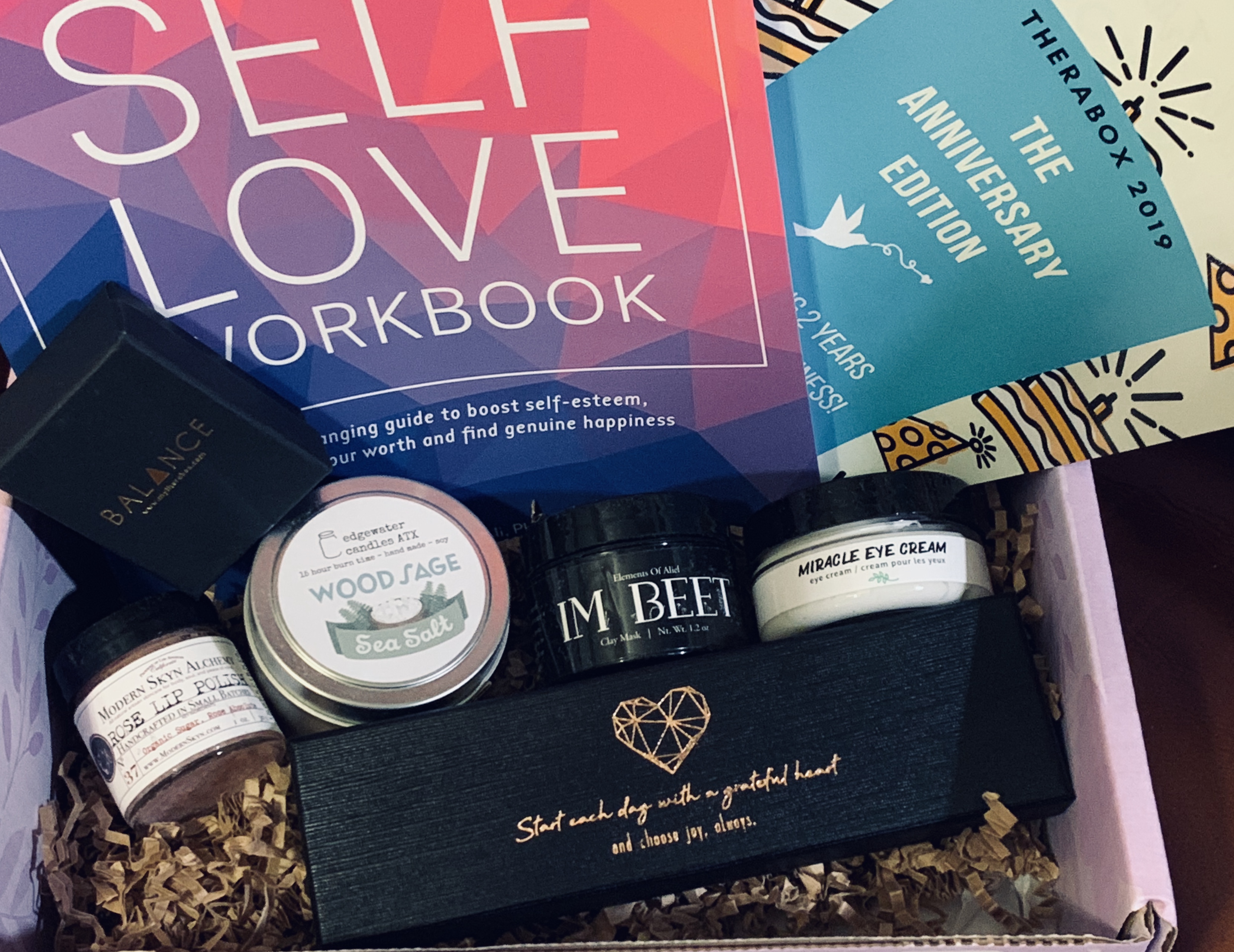
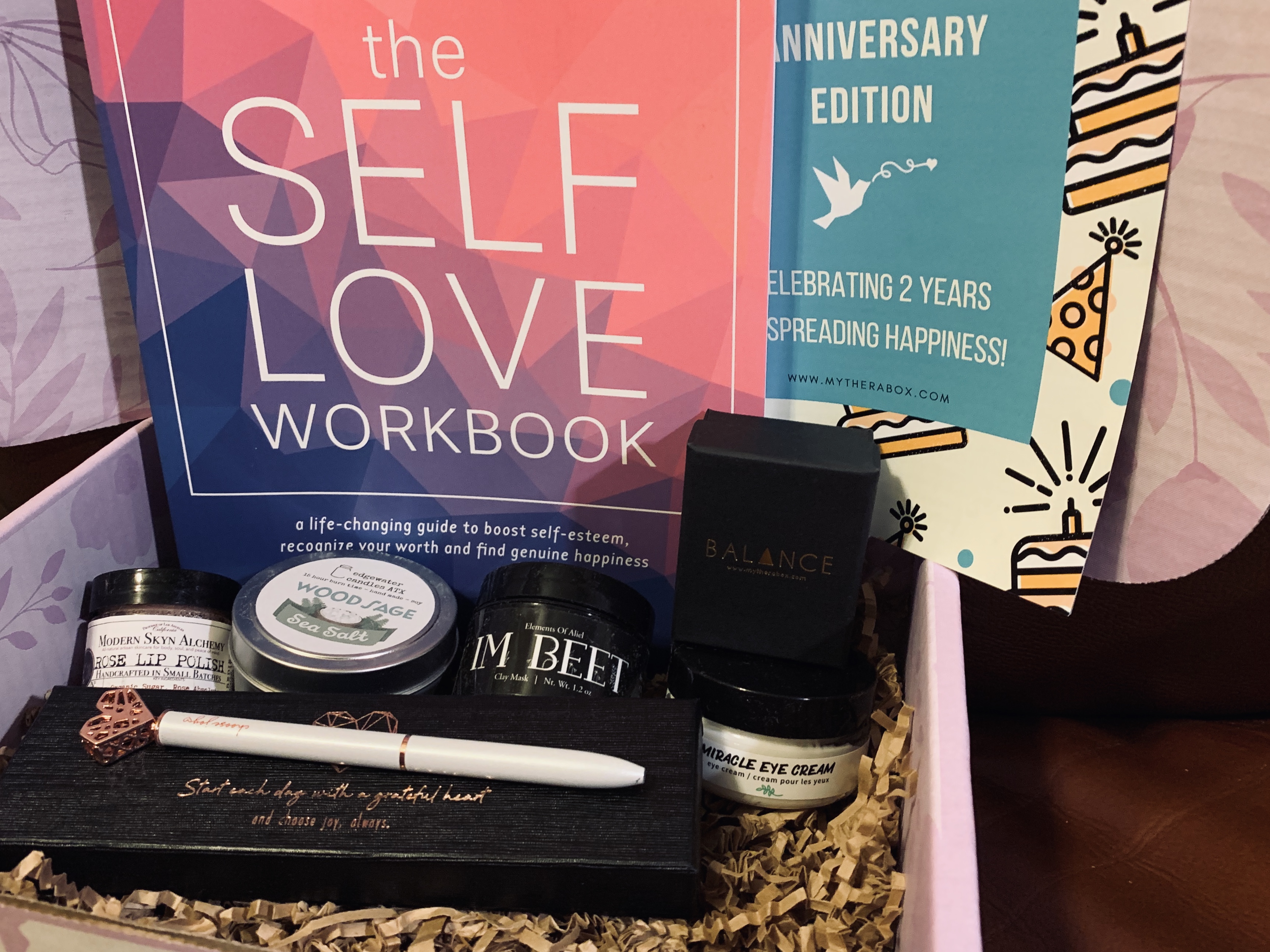
I have The Self Love Workbook beside me for when they take a nap. The book is written by Shannia Ali, PhD. The brief over view is “a life-changing guide to boost self esteem, recognize your worth, and find genuine happiness”.
The Cardiologist office called and the doctor wants me to do a Stress Test before he clears me for surgery. The test is tomorrow morning, and takes four hours. Two hours of testing, 30 minutes to eat and test for remaining two hours. This means fasting starting now, no chocolate, cafeenie or decaf, and only water after midnight. The second worst part is not taking my medicine in the morning. Do I sit in the lobby taking meds why trying to eat or skip for day? Another destration.
I’m keeping a journal to keep track of how well I manage “self-care” time over the next month. I subscribed to a monthy self-care box for body and mind called TheraBox. The creators are both Therapist, the box included the book, a nice pen, eye cream, hand cream, candle, lip scrub and a nice gold plated necklace.
It’s now 2:00 p.m. CST and my body isn’t thinking about self-care right now. Pain in pain no matter what you have on your agenda. I will try again tomorrow when I get home. I’m not high on workbooks so the book is going to have to grab me at the very beginning.
To be continued…….
Melinda






 Looking for the Light