
Celebrate Life · Health and Wellbeing · Medical · Men & Womens Health

Once unwanted, these dogs are now on the front lines of wildlife conservation

These incredible pups catch poachers, sniff out invasive plants and diseases, and more, thanks to the work of wildlife biologist and conservation-dog expert Megan Parker.

What happens to those dogs that are just too much dog for people to handle? “You know them — you go to your friend’s barbecue, their dog is so happy to see you that she pees on your feet, and she drops a slobbery ball in your lap,” says Megan Parker (TEDxJacksonHole talk: Dogs for Conservation), a wildlife biologist and dog expert based in Bozeman, Montana. “You throw it to get as much distance between you and the dog as possible, but she keeps coming back with the ball. By the 950th throw, you’re thinking, Why don’t they get rid of this dog?” All too often, their owners reach the same conclusion and leave their pet at a shelter.

Thanks to Parker and the team at Working Dogs for Conservation (WD4C), some of these dogs have found a new leash lease on life. They’re using their olfactory abilities and unstoppable drive in a wide variety of earth-friendly ways, working with human handlers to sniff out illegal poachers and smugglers, track endangered species, and spot destructive invasive plants and animals.

Chai is shown here with a trainer. After a dog learns to recognize a particular scent, the education isn’t over — their handler works with them regularly so they maintain their skills. These days, you can find this sweet German shepherd protecting wildlife in Zambia, along with her brother Earl.

Parker first considered using dogs in conservation when she worked on the reintroduction of wolves to Yellowstone Park and was asked how researchers could track wolves through their scat, or droppings. “I started thinking how best to detect their scat off a large landscape, and the idea came up for dogs,” she says. In 2o00, she cofounded WD4C to train and use canines in conservation work. Most of their dogs are adopted from shelters or from organizations or work settings where they didn’t quite fit in.

While it’s fair to say almost all dogs love toys, wildlife-detection dogs areobsessed with them. “They’ll do anything to chase a ball or a tug toy,” says Parker. If their preferred plaything is thrown far into the brush or buried in a massive pile of leaves, no worries — they won’t stop looking until they find it. No food, obstacle or distractions can deter them, and WD4C staff have turned this single-minded focus into a powerful incentive. Their canine friends are rewarded with their favorite toy every time they locate a desired wildlife-related scent, anything from elephant ivory and poachers’ guns in Zambia and trafficked snow leopards in Tajikistan to predatory Rosy wolf snails in Hawaii and invasive Argentine ants on California’s Santa Cruz Islands. The dogs are careful not to disturb or touch any specimens they pinpoint; it’s all about the toy.

Lily, a yellow Lab, is one of the group’s many sad-start-happy-ending stories. When the then-three-year-old came to the attention of WD4C trainers, she’d already bounced her way in and out of five different homes. She couldn’t sit still and she never, ever wanted to stop playing. Oh, and she was a bit of a whiner. Since joining WD4C in 2011, she has been trained to recognize a dozen different conservation-related scents and been deployed to track grizzly bears and sniff out the eggs, beetles and larvae of emerald ash borers, an insect that has killed millions of trees in the US and Canada.

Hilo was originally meant to be a guide dog for the blind, but when that didn’t work out, he found a place at WD4C. Here, he wears the standard orange vest that tells conservation dogs it’s time to get to work. Hilo helps detect quagga and zebra mussels on boats.

The three-dozen-strong WD4C pack also includes purebred working dogs who weren’t right for their intended occupations. Orbee, a border collie, had the enthusiasm and live-wire energy required of ranch dogs, but there was one problem: he had zero interest in herding sheep. He also barked a lot. Since joining WD4C in 2009, Orbee has had a globe-trotting career — he has spotted invasive quagga and zebra mussels on boats in Alberta and Montana, monitored the habitats of the endangered San Joaquin kit fox in California, and assisted scientists in northern Africa in counting up Cross River gorillas, the world’s rarest gorilla.

Jax is a Belgian malinois, a sturdy breed frequently used by the police and military. He was in training to serve with the US Army’s special unit, the Green Berets, until his handlers realized Jax doesn’t like to bite people — just toys. And, boy, does he loves toys; he’s even tried to climb trees to reach prized objects. Since 2017, Jax’s athleticism and high spirits have been used by the WD4C to perform tasks such as mapping the movements of bobcats in the western US.

Tule gets to roam the great outdoors for WD4C, using her keen nose — dogs have around 300 million olfactory receptors compared to humans’ 6 million — to track animals such as the endangered black-footed ferret in Wyoming.

“Different dogs have different strong suits,” says Parker. She and the WD4C team try to place their charges in environments that match their skillset, likes and dislikes. Unlike many dogs, Tule (above), a Belgian malinois who flunked out of a job with US Customs and Border Patrol, has absolutely no desire to chase small animals such as cats, squirrels and rabbits. This made her the perfect fit to help researchers monitor black-footed ferrets, which live in the same territory as a large, scampering prairie-dog population. The ferrets, once thought extinct in the US, were reintroduced in Wyoming in recent years. Tule alerts her handlers to the scent of live ferrets or their scat, information that allows state wildlife officials to map their distribution and see if the population is recovering. Without Tule and her pack, researchers would be forced to study the elusive creatures with cameras or live traps, undependable methods at best.

The dogs’ efforts have resulted in positive, substantial changes. The organization teamed up with the nonprofit Wildlife Conservation Society so their dogs could track the scat of four keystone carnivores (grizzly bears, black bears, mountain lions and wolves) through the Centennial Mountains in Idaho and Montana. Five years of doggie data showed that all four species depended on the mountains to move between the Greater Yellowstone ecosystem and central Idaho wilderness areas. Thanks to this information, activists were able to stop construction of a housing development that would have interrupted their migratory pathway.

Tobias is a former stray who was found on the streets of Helena, Montana. He has searched for Argentine ants on California’s Santa Cruz Island, and now he spots invasive mussels on watercraft in and around Glacier National Park.

Some dogs are searching for animals and plants that are most wanted for the opposite reason: they’re invasive species proliferating where they don’t belong and driving out native flora and fauna. There’s the previously mentioned zebra and quagga mussels, which spread by clinging to boats and watercraft, and which clog water and sewage pipes, foul up power plants, and destroy good algae. Tobias (above) is a specialist in finding them. In one test, WD4C dogs identified 100 percent of the boats with mussels aboard (human screeners spotted 75 percent). The dogs did the job more quickly, and they could also detect the mussels’ microscopic larvae.

Former shelter dog Seamus (shown at the top of the post), a border collie, is an expert in searching out dyer’s woad on Mount Sentinel in Montana.Humans have tried to eradicate the invasive weed by spotting its flowers and pulling out plants by hand, but these attempts barely made a dent. By the time it’s found, it’s often already seeded (and a single plant can produce up to 10,000 seeds). Seamus’s keen nose, along with those of three canine colleagues, learned to sniff out woad before it flowered, a time when it’s extremely hard for human eyes to see. They also found root remnants left in the ground. At a recent checkup, just 19 of the invasive plants were found on the mountain. “It will be a complete extermination,” says Parker. “It’s just going to take a long time because we don’t know how long their seeds last in the soil.”

The dogs’ hunting grounds even extend into the water. Although prized in their native habitat, brook trout are an invasive species elsewhere; in some places in the Western US, they are pushing out the native cutthroat trout. WD4C was brought to Montana by the US Fish and Wildlife Service, the US Geological Survey and the Turner Endangered Species Fund to see whether their animals could learn to sniff out live fish in moving water. Reports Parker, “This project confirmed what we long suspected: that dogs can detect and discriminate scents in water.”

Pepin can recognize 20 wildlife scents, including the scat of snow leopards, wolverines and cheetahs. In one cheetah study, he and another conservation dog located 27 scats in a 927-square-mile area. How many did humans find in the same territory? None.

Pepin (above), who worked on the brook trout project, is part of an ambitious charge to train the dogs to detect infectious diseases in animals.“He’s done the first of a lot of things for us, because he’s so game,” says Parker. Some wildlife carry brucellosis, a bacterial disease that is particularly harmful to cattle. It’s difficult to tell when animals are first infected because they typically don’t display symptoms, so in areas where the disease is prevalent, ranchers tend to keep livestock and wildlife as far away from each other as possible — severely limiting the territory and movement of both kinds of animals. The hope is that dogs could provide a fast, reliable way to identify infected herds. So far, Pepin has shown he can discriminate infected elk scat with higher and lower concentrations of the bacteria, and W4DC is eager to explore this use of dog power. “We have proof of concept,” says Parker. “I’d like to move that work forward.”

There are so many other unexplored capacities and environments where dogs could help, Parker believes. To that end, WD4C started a program in 2015 called Rescues 2the Rescue, which aims to help shelters around the world identify would-be detection dogs and place them with wildlife and conservation organizations. What kind of dogs are they looking for? Ones that are, uh, crazy.

To clarify that adjective, we’ll close by telling you about Wicket, a black Lab mix who retired from WD4C in 2017 at the top of her game, having detected 32 different wildlife scents in 18 states and seven countries. Wicket languished in a Montana shelter for six months, barking up a storm and scaring away potential owners, until WD4C cofounder Aimee Hurt found her there in 2005. When she went to adopt her, the shelter director said, “You don’t want that dog — that dog’s crazy!” To which Hurt replied, “I think she might be the right kind of crazy.”

Celebrate Life · Fun

This Day in History December 20th

1946

Frank Capra’s film starring James Stewart and Donna Reed debuts at New York’s Globe Theatre. Though not a critical or box office hit right away, it will become a holiday classic, showing in theaters and on TV for decades to come.

1957

The 22-year-old refuses special treatment, despite thousands of fans writing letters asking for this national treasure to be spared. Presley will serve two years and reach the rank of sergeant. An Army pal will introduce him to 14-year-old Priscilla Beaulieu, whom he will later marry.


1803

The French surrender Orleans to the U.S.

Without a shot fired, the French hand over New Orleans and Lower Louisiana to the United States. In April 1803, the United States purchased from France the 828,000 square miles that had formerly been French Louisiana. The area was divided into two territories: the northern half …read more

“Funky Drummer” is recorded

Hip hop was born when DJs began rapping over dance records, and no dance records were better suited to rapping than those that included a “breakbeat”—a drum break that could be repeated almost endlessly as an accompaniment to rapping. It is impossible to know who first employed …read more
Celebrate Life

Friday Quote

“A dog is the only thing on earth that loves you more than he loves himself.”

Josh Billings (a.k.a. Henry Wheeler Shaw; humorist and lecturer)


“Dogs are not our whole life, but they make our lives whole

Otto von Bismarck (1st Chancellor of Germany)


“The world would be a nicer place if everyone had the ability to love as unconditionally as a dog.”

Agatha Christie (author, Death on the Nile

fullsizeoutput_9f

GRIFFY

Shaggy

SHAGGY

Celebrate Life · Fun

#WATWB Steph Curry Responds To Girl’s Letter

Steph Curry Responds To Girl’s Letter About Why His Shoes Do Not Come In Girls Sizes

November 30, 2018

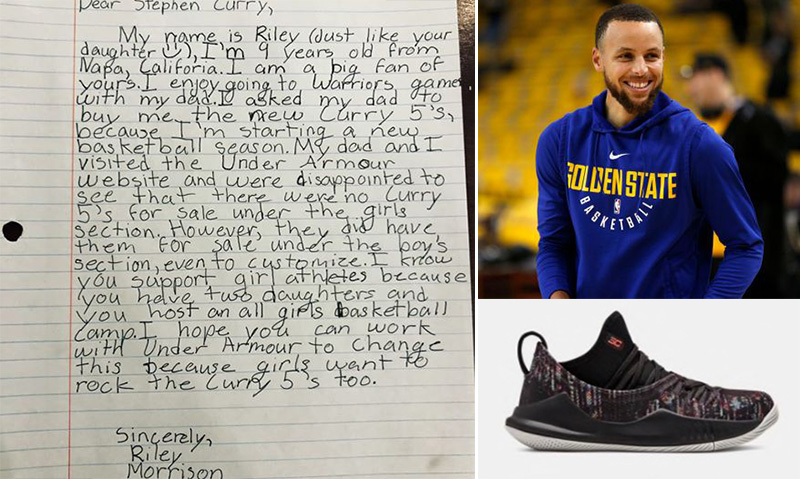
A 9-year-old girl wrote a letter to NBA star Steph Curry pointing out that his shoes do not come in girl sizes, and not only did Curry respond, he made a change.

steph curry responds to girl letter shoes

Riley Morrison wrote in her letter that she’s a big fan of the Golden State Warriors point guard and she wanted a pair of Icon Curry 5 sneakers, but when she visited the Under Armour website to buy them, she didn’t see them listed under the girls’ section.

“Dear Mr. Stephen Curry,

My name is Riley (just like your daughter), I’m 9 years old from Napa, California. I am a big fan of yours. I enjoy going to Warriors games with my dad. I asked my dad to buy me the new Curry 5s, because I’m starting a new basketball season. My dad and I visited the Under Armour website and were disappointed to see that there were no Curry 5s for sale under the girls section. However, they did have them for sale under the boys section, even to customize. I know you support girl athletes because you have two daughters and you host an all-girls basketball camp. I hope you can work with Under Armour to change this because girls want to rock the Curry 5s, too.

Sincerely,
Riley Morrison”

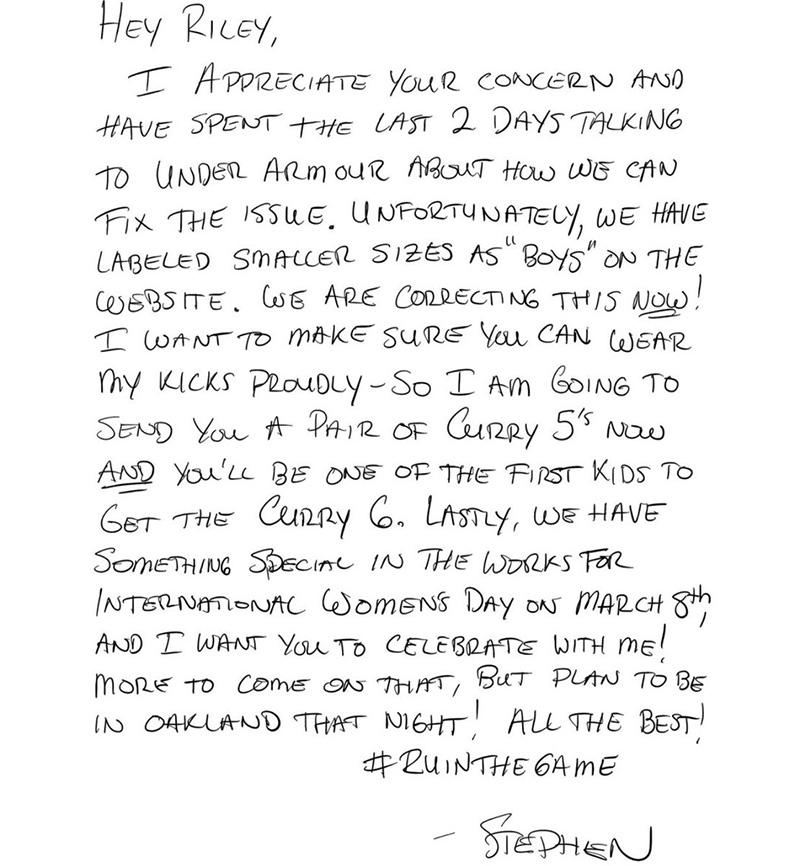
On Thursday, Steph Curry tweeted the handwritten note that he sent Riley in response.

steph curry responds to girl letter shoes

He said he has now worked with Under Armour to put them in the girls section too, and sure enough the shoes are now there.

Curry has been an outspoken advocate for women’s rights, writing earlier this year, “I want our girls to grow up knowing that there are no boundaries that can be placed on their futures, period.”FacebookTwitter

We Are the World Blogfest

We Are The World  Blogfest: Spreading Stories of Positivity and Compassion in Social Media. #WATWB


Have your followers click here to enter their link and join us! Bigger the #WATWB group each month, more the joy!


Melinda

http://Lookingforthelight.blog

Celebrate Life

Friday Quote

If at first you don’t succeed, try, try again. Then quit. No use being a damn fool about it.” 
― W.C. Fields

“Try not to become a man of success. Rather become a man of value.” 
― Albert Einstein

“Failure is the condiment that gives success its flavor.” 
― Truman Capote

“Success is stumbling from failure to failure with no loss of enthusiasm.” 
― Winston S. Churchill

Celebrate Life

Happy Thanksgiving America

I work hard to acknowledge the little things happening everyday. Many days it’s hard to take a minute to acknowledge and let the smile sink in. 

I have many things to be grate full everyday but this past week it came in a big reminder. I fell eight stairs last weekend landing on my head and neck. When I came to all I could think of is is my neck broken, what about my back. I told myself to calm down and figure out how to get up and not make my injuries worse. 

I managed to get up and walk. The accident could have been life changing. I shattered my wrist, broke right elbow, broke left Orbital bone and broke nose. My Orthopedic doctor rushed me to surgery on Sunday to have a plate in my left hand. My body all over hurts, bad whiplash and back strain, I have two arms and can’t use either one. 

I’m thankful my husband is taking care of me and making life as comfortable as possible. There are no words to say how happy I am about escaping an accident that could have been fatal. 

I hope you spend quality time with family and friends, sharing what you are grateful for this year and a nourishing meal. 

M

Celebrate Life

Today in History October 21

Today was an interesting day in history. How history making was Your Day?

1934

A 17-year-old Ella Fitzgerald goes to New York’s Apollo Theater to dance on stage for Amateur Night, but opts to sing instead. She wins the competition with her renditions of Hoagy Carmichael’s ‘Judy’ and the Boswell Sisters’ ‘The Object of My Affection,’ and an American music legend is born.

1901

Alice Calhoun, American Silent film actress (Flowing Gold), born in Cleveland, Ohio (d. 1966)

1907

 Jim Bishop, author (The Day Lincoln was Shot)

1920 

Stan Musial, American MLB outfielder (St Louis Cardinal, 7 times NL bat champ), born in Donora, Pennsylvania (d. 2013)

1924 

Christopher Tolkien, British author and son of J. R. R. Tolkien, born in Leeds, England

Birthdays


Celebrate Life · Fun

On This Day In History November 1

Happened on this day November 1st

2018

Sistine Chapel ceiling opens to public

The ceiling of the Sistine Chapel in Rome, one of Italian artist Michelangelo’s finest works, is exhibited to the public for the first time.

Michelangelo Buonarroti, the greatest of the Italian Renaissance artists, was born in the small village of Caprese in 1475. The son of a government administrator, he grew up in Florence, a center of the early Renaissance movement, and became an artist’s apprentice at age 13. Demonstrating obvious talent, he was taken under the wing of Lorenzo de’ Medici, the ruler of the Florentine republic and a great patron of the arts. After demonstrating his mastery of sculpture in such works as the Pieta (1498) and David (1504), he was called to Rome in 1508 to paint the ceiling of the Sistine Chapel—the chief consecrated space in the Vatican.

Michelangelo worked until his death in 1564 at the age of 88. In addition to his major artistic works, he produced numerous other sculptures, frescoes, architectural designs, and drawings, many of which are unfinished and some of which are lost. In his lifetime, he was celebrated as Europe’s greatest living artist, and today he is held up as one of the greatest artists of all time, as exalted in the visual arts as William Shakespeare is in literature or Ludwig van Beethoven is in music.

On August 3, President George H.W. Bush had approved a joint resolution designating November 1990 as National American Indian Heritage Month to celebrate native cultures, traditions, and history. Future presidents will reiterate the proclamation, changing the name to Native American Heritage Month.

Jacques Plante is the first goalie to wear a facemask

On November 1, 1959, Montreal Canadien Jacques Plante becomes the first NHL goaltender to wear a full facemask. Montreal Maroon Clint Benedict had worn a leather half-mask for a brief time in 1930, after an errant puck smashed his nose and cheekbone—but it blocked his vision, he …read more

Newman stars in Cool Hand Luke

On this day in 1967, Cool Hand Luke, starring Paul Newman as a tough, anti-authoritarian, poker-playing prisoner, debuts in theaters. Newman received a Best Actor Oscar nomination for his portrayal of the jail-breaking Luke Jackson, whom the American Film Institute in 2003 named …read more

Birthdays on November 1st

1871  Stephen Crane is born, American journalist, author, poet

1972  Jenny McCarthy, American model, actress, author

1898 Arthur Legat, Belgian racing driver

1923 Gordon R[upert] Dickson, Canadian sci-fi author 


Celebrate Life

#WATWB NBC Nightly News 10/25/18 SINGING JANITOR

We Are the World Blogfest


With the constant media chatter it’s easy to fall into the negativity thrown at us. I want the media to target more compassion, good neighbor stories, tweets of support not trolls. Here’s a story that touched my heart.


SINGING JANITOR: For 37 years, janitor Freddie Wiggins has been encouraging his hospital patients with fist bumps and songs: “I bring joy in here!” We’re looking back at NBC Nightly News stories, like this one from June, that we saw our audience respond to the most this year here on our Facebook.

We Are the World Blogfest


We Are The World  Blogfest: Spreading Stories of Positivity and Compassion in Social Media. #WATWB

Your cohosts for this month are: Eric Lahti, Inderpreet Uppal, Shilpa Garg, Mary Giese and Roshan Radhakrishnan Please link to them in your WATWB posts and go say hi!

To add more sunshine to your week visit the link below.

Have your followers click here to enter their link and join us! Bigger the #WATWB group each month, more the joy!

xo M

http://lookingforthelight.blog

Celebrate Life · Fun

This Day In History October 24th

His studio cuts can be mind-blowing, but James Brown and his fans know there’s nothing like seeing the R&B dynamo live, fronting his Famous Flames. When a recording of tonight’s session at the Apollo Theater in Harlem is released as an album, it will rocket up the charts.

1945

The United Nations charter, written earlier in the year at a conference in San Francisco, takes effect. The first meetings of the General Assembly and Security Council will take place the following January in London. The New York headquarters will be completed in 1952.

1969
Butch Cassidy and the Sundance Kid is a 1969 American film. It stars Paul Newman and Robert Redford.


Born on the Day

1936 Bill Wyman

1986 Drake

1947  Kevin Kline

Celebrate Life

Happy Anniversary Robert Goldstein

I heard this song yesterday, Robert instantly came to mind, his enthusiasm for the band reminds me of how I felt hearing them for the first time.

Robert, I’m sending my love as you celebrate 27 years, thick, thin, rich, poor, sick, sicker and still in love!      M


Celebrate Life · Fun

Busy, Busy, Busy

Robert this is my all time favorite Lucy scene! I miss the simple times of older tv shows. I am dedicating a song to you, it came on radio yesterday and knew how much you love Steely Dan. Hugs and Happy Anniversary! Raise a glass to many more. M

Celebrate Life · Men & Womens Health

My 2018 Mammogram News

pink leafed trees on green grass field
Photo by Jan Krnc on Pexels.com

When you have a Chronic Illness that creates severe pain it’s easy to skip one more doctor appointment, I did. This week was my first mammogram in six years. Although it did feel like ANOTHER doctor appointment this week, I feel good about myself. A mammogram is for me, it can save my life and mark one item off my stress list. Please stay as current as possible on your mammogram and do monthly breast exams. 

My doctor has a black ceiling with holes made to look like stars, it’s so relaxing. Twinkle Twinkle! 

M


We wish to inform you that the results of your recent mammogram are normal.

As you know, early detection of breast cancer is very important. A thorough examination includes a combination of mammography, physical examination and breast self-examination.

ANNUAL MAMMOGRAPHIC SCREENING BEGINNING AT AGE 40

is recommended by the American College of OB/GYN, the National Comprehensive Cancer Network, the American College of Radiology, and the Society of Breast Imaging. You should also have an annual breast physical examination by your health care provider.

Your imaging examination results have been sent to your physician.

Your images will become part of your medical file here at Breast Imaging Center for at least 10 years. It is important for you to inform any new health care provider or mammography facility of the date and location of this examination.

It was a delight to see you again. I am always happy to give good news :-) As we discussed, your mammogram demonstrates no evidence of cancer in either breast. As you surmised, I think some of the stabbing pain in the breasts, right greater than left, may be a reflection your other chronic pain issues and/or neuropathy. In the absence of new or worsening symptoms, I recommend you resume your annual screening mammogram next year. If you have any questions about your breast health prior to your return, feel free to contact me. Otherwise, I look forward to serving you and your sparkly self next time-even if it is just electronically for your screening mammograms sans the twinkly lights :-) In the meantime, I hope you and your family have a joyous and healthy rest of 2018! Love and blessings.

Thank you for allowing us to help in meeting your health care needs.

Celebrate Life · Fun · Moving Forward

On This Day October 18, 2018

affection appreciation decoration design
Photo by Carl Attard on Pexels.com

On this day October 18, 2018


I thought about you, how awesome you are, how you help me even on your worst days. Thank you for offering support, the kindest comments and honesty. You’ve made a positive impact on my life and attitude. Thank you for following me, sharing your life, sharing your story, most importantly growing together.

M

Celebrate Life · Fun · Moving Forward

Get your Money for Nothing

If you’ve watched daytime television you’ve heard every get rich quick scheme, start your own business and make $3,000 this month………I’m getting off track. I enjoy making money! I keep it simple by making money on purchases I’m already making. There are tons of apps that do coupons, check prices and anything imaginable if you want to be a SUPER SHOPPER.

I use two apps, Ebates.com and Honey.com. Both are installed in my browser and recognize when I shop at one of their partners. An Ebates.com pop-up ask you to activate by clicking and it shows % on sale received on purchase.

Ebates.com is my long-term favorite, it’s easy and they partner with all the places I shop. To date I’ve earned approximately $600. Ebates.com pays out every quarter for your previous purchases. The big money days are when their partners offer double percent back and 10% days make me very happy. Small sales add up over the year.

Honey.com works based on finding coupon codes for your purchase. It runs thru a long list of coupon codes to see if one applies. You’ll see a pop up that says there are coupons codes. You click and it does it trick. I have not used Honey.com very long but received free shipping on several purchases.

If you are a Prime Member at Amazon.com you have a world of free goodies offered movies, bookes…..on and on. I rely on Amazon.com since I don’t drive and Prime Members get two-day free shipping.

The best discovery I’ve made is the Amazon Prime Member Card. It’s a credit card that can only be used at Amazon.com, it’s offered with no fees. You receive 5% back on every purchase you make on Amazon.com. WOW!!!!!

To give my husband down time on weekends, we get our groceries delivered. Prime Members get free delivery. The amount of time saved has surprised him, the money has brought a smile to my face. The grocery section is Amazon Fresh, they have thousands of products including fresh bread.

Another up side to the delivery Amazon Fresh uses frozen bottled water to keep items cold. Each week we receive 6-8 bottles of water free.

If you really want to save money, work all the coupon apps and be a Super Shopper. You have to be organized to handle that many coupons and will need lots of extra storage space.

Happy Shopping!

M

Celebrate Life · Fun · Moving Forward

Let’s Smile Thursday

person holding round smiling emoji board photo
Photo by rawpixel.com on Pexels.com

I’ve struggled with a deep depression since the start of the year, comedy provides relief and Robin Williams always makes me smile. I know he understood and helped many people have open conversations about their depression. This video is a forgotten treasure, it’s the first time Robin went on The Tonight Show. I  hope your day is filled with sunshine. M


Celebrate Life

This Day In History October 10th

1956 

The drama starring Elizabeth Taylor, Rock Hudson, and James Deandebuts, telling the tumultuous story of a Texas ranching family. It marks Dean’s third and final big-screen role, as he had died in a car accident a year earlier after completing work on the film.

1957

A fuel cartridge has burst in one of the channels of England’s Windscale nuclear weapons facility and catches fire, sending iodine-131 radioactive contamination into the air. Eleven tons of uranium will be ablaze before the world’s first known nuclear accident is contained two days later.

1845

Seven professors will teach 50 midshipmen in Annapolis, Maryland, as the Naval School, later known as the United States Naval Academy, begins its first term. Commodore Matthew Perry has helped plan the five-year curriculum, with the first and last year taught on land, and the middle three at sea.

Famous People Born Today

Brett Farve 1969

David Lee Roth 1954

Helen Hayes  1900

Ben Vereen  1956

Nora Roberts  1950


Celebrate Life · Fun

On this day September 26, 1969

The Beatles returned to the studio one last time and released Abbey Road on September 26, 1969. The media gave mixed reviews but fans made it their best-selling album. Here are two of my favorites from Abbey Road.  M


Celebrate Life · Fun

Friday Quotes

group of people holding message boards
Photo by rawpixel.com on Pexels.com


“The way get started is to quit talking and begin doing.”

– Walt Disney. This straight-to-business …

Perfection is not attainable, but if we chase perfection we can catch excellence. — Vince Lombardi

Nothing is impossible, the word itself says “I’m possible”!

— Audrey Hepburn.

Celebrate Life · Fun · Moving Forward

Friday Quote

“None of the truest things in life-like love or faith-was arrived at by thinking; indeed, one could almost define the things that mattered as the ones that came as suddenly as thunder.”

-Pico Iyer

Celebrate Life · Moving Forward · Survivor

A Love Letter To Realism In A Time Of Grief

TED TALKS: A Love Letter To Realism In A Time Of Grief.

Mark and Simone share the difficulties of having a relationship with Mark who is blind and paralyzed. They are honest, it made me look inside and think if I was strong enough or do I love enough. The connection as a couple and their combined strength is amazing. I have no doubt they will continue to push technology forward. The activities Mark still participates in blows my mind! Traveling to the coldest place on earth, hiking on Everest, you know he can do anything.

I hope you enjoy.  M

Celebrate Life · Men & Womens Health

How a new kind of community is creating a better aging experience

Jan 4, 2018 /

By joining the Beacon Hill Village in Boston, older people commit to helping each other while they stay in their own homes. And they have plenty of fun while doing it, says MIT AgeLab director Joseph F. Coughlin.

Joan Doucette was sipping coffee in a small café at MIT, her bicycle resting next to her. The Institute tends to frown on bringing bicycles into buildings, but only a hard soul could have stopped Doucette from wheeling in hers, with its ribbons streaming from the handlebars, white tires and a front basket filled with yellow and pink flowers.

The demeanor of the 75-year-old cyclist was just as sunny. Doucette peered up from a travel itinerary for a trip to Chicago. “There’s going to be 20 of us going,” she said. “We’re going to take a river trip. We’re going to go to the museums … then we’re going to the Russian tearoom. We’ve got a tour of the skyscrapers. And a lot of us are going to the Frank Lloyd Wright house. So, very busy.”

Doucette spoke with an English accent redolent of her native Surrey, where she was born in 1938. As a young woman, she was a nanny and became involved with the US embassy, which assigned her to foreign posts where she cared for diplomats’ families. When the father of one of those families died, she moved with the mother and kids to Massachusetts. “I was their nanny until I married and their mother remarried,” she said.

In 1970, Doucette began a career at MIT, moving among the Institute’s libraries, alumni relations department, Center for Transportation Studies (now the Center for Transportation and Logistics, home of the AgeLab), industrial relations, corporate development and more. She retired at 62, after having worked at MIT for 25 years. “What am I going to do with my days?” she wondered. The answer that presented itself seemed opportune at the time. She had no idea how revolutionary it would become.

Doucette and her husband moved to an apartment on Beacon Hill, one of the oldest areas in Boston. She didn’t know anyone there and worried about her social life. Then she received an invitation to join the Beacon Hill Village. But it’s not a village per se. It’s a loose confederation of older people who live on Beacon Hill, who, instead of moving to a community or facility devoted to old age, want to stay in their own homes, interact with their friends, eat at their favorite restaurants, and attend their favorite cultural events.

Many of the Village’s founders had seen elder care gone wrong and were resolved to find a better way. “Each of us had witnessed firsthand the distress our relatives experienced as they aged: a mother in a retirement community in Florida who felt lonely and abandoned; a parent in a nursing home, marginalized and overdrugged; an uncle with very limited means and no immediate family to help out,” founding member Susan McWhinney Morse has written.

n 1999, when the Beacon Hill neighbors began to consider creating something different, the story pervasive in the culture was clear. When you grew old, there was only one thing to do: move, whether it was to an independent or assisted living facility, country-club retirement community or nursing home. The neighbors were determined to tell a new story.

The Village’s members agreed to help each other with the small things that come up and to help each other find assistance for the big things. Today, in exchange for annual dues of $675, the Village offers help with tasks like grocery shopping, pet care, light housework and small repairs. For issues that pose a greater challenge — including health, caregiving and financial needs — the organization curates lists of trusted service providers, who sometimes even give member discounts.

The Village also provides access to vetted drivers trained in transporting elderly people who need special care. “They’ll take you shopping for your groceries. If you’re having an operation, they’ll come and pick you up and take you home,” said Doucette. “When I had the new knee put in last September, somebody came and picked me up.”

Perhaps the most essential aspect of life in Beacon Hill Village is what might sound like the least important: the fun. Doucette and her husband joined when the Village first opened to the public in 2002 and began building out its membership base as well as relationships with vendors, providers and contractors. Doucette helped build its social schedule, which, these days, is full.

“On Mondays we have a movie group that come in my house, and we have tea, and I stream a movie. And there’s about ten of us do that. And on Tuesdays, twice a month, there’s another group that meets down at 75 Chestnut” — a snug Beacon Hill restaurant — “and we talk about anything we want to, mostly about theater and movies,” she says. “And that’s called Terrible Tuesdays. And then every Wednesday a group meets on Charles Street in one of the restaurants there. And we talk world affairs mostly . . . And then on Thursdays I got my husband to go and do First Drink, because that’s for the men.” Doucette’s groups are so popular, she says, that she’s started to set up satellite gatherings in other parts of the city.

My immediate response was skeptical when I heard something special was going on across the river from my MIT office. Older people helping each other sounded great in theory, but I wondered how long such an altruistic collective could last. What I found: The Beacon Hill philosophy has not only endured; it’s spread. In the US, the Village to Village Network facilitates the development of Beacon Hill-esque communities. According to the Network, there are at least 190 villages built on the “Beacon Hill model” in all but four states, with 150 in development.

One 2014 study found that a quarter of Villages along the Beacon Hill model are actively working to improve their communities’ attitudes toward older adults. Every day, by going out and creating a positive impression on the people around them, the members of Beacon Hill and other Villages dispel the old myth that elders are unfit to co-mingle with society.

As new Villages have sprung up, several themes have emerged. One is the development of a pay-it-forward ethos. Paid staffs tend to be small, averaging between one and two-and-half full-time employees, so the majority of what Villages provide their members comes from volunteers, most of them members. They’re typically younger and healthier — people in their 50s, 60s and 70s — who provide occasional care to older members in their 80s and 90s. This care isn’t medical or care with the activities of daily living, which usually requires help from professionals or family members. Rather, Villagers assist each other with the issues that come up over the course of a full life.

At the San Francisco Village, member Bill Haskell said he had joined hoping to “pay it forward” to the local older community. “Within 30 days, my partner found out he had to have open-heart surgery. So we needed not to volunteer, we needed help. I needed a lot of help because I’m his primary caregiver,” he said. “Bob had a difficult surgery with a lot of complications. He was in the hospital for two weeks” — far longer than the expected three days. “Then there’s the home period.”

The Village provided Bill with vetted referrals for home care. For times when he needed to run out to the store or the gym, it sent a volunteer to sit with Bob. “People who are members brought over meals when I couldn’t cook any longer,” Bill said. “People we didn’t know brought over dinner for us.”

As appealing as this pay-it-forward mentality may sound, there are drawbacks. For one thing, it’s hard to market. Beacon Hill started as an organization devoted to mutual care and later took on its social-club vibe. The intrinsic focus on care can scare off potential members who don’t think of themselves as patients.

Beacon Hill also doesn’t offer an entirely coherent solution to the problem of identity in retirement. But in many ways, this is a feature, not a failure. Beacon Hill embraces complexity. Members are free to not just pursue a leisure-oriented idea of retirement but other aspirations, including caregiving, interacting with other generations, patronizing cultural institutions, volunteering and working.

If Beacon Hill’s embrace of complexity over clarity makes sense for its members, it also poses a liability in terms of defining a new way of life in old age. It’s hard for its subtle, complicated message to compete with the volume, vividness and simplicity of that broadcast by traditional senior communities. However, Beacon Hill could fight back by doubling down on its own model and offering more services and activities. Increasing its number of social events might allow those in the midst of a transition away from a primary career to wrap themselves in new interests. And a wider variety of workshops, classes, clubs and volunteer jobs would increase its visibility — turning Beacon Hill into, well, a beacon on a hill.

The barrier to achieving this kind of scale is considerable. Joanne Cooper, part of the membership committee at Beacon Hill, said bringing in new members is a challenge. “Two new members come in, four leave, one way or another,” whether they’re “moving to a more structured setting or, unfortunately, passing away.”

The relatively new San Francisco Village has 300 members. Nationwide, said San Francisco leader Kate Hoepke, Village memberships can be measured in the low tens of thousands. “You know, it should be ten times that many.” She wonders if the issue is a lack of funding or visionary leadership. The Village to Village Network’s pattern of growth — fast to spread across America and the globe, yet slow to flourish in sheer membership — might come down to the fact that “so much has happened in such a short period of time. That infrastructure isn’t there yet.”

If you, like me, want to live in a world where older adults and their kids aren’t antagonists but invest in each other, work for each other and help each other, then the Village movement is a good guide to follow. The Beacon Hill model is finding fertile ground in countries such as the UK and Germany. Other experiments in age integration are springing up as well. One program in Germany and Switzerland, Wohnen für Hilfe or Housing for Help, subsidizes the rent of carefully screened students who want to live in older people’s homes and help out with minor chores. The UK has a similar program called Homeshare. A law in Germany provides the 82 percent of elders who say they do not want to live in a nursing home with a grant of up to €10,000 to establish shared, community apartments, with a monthly subsidy of up to €200 per tenant.

The Beacon Hill Village and others like it aren’t perfect. They’re small, and they don’t leverage mobile technology as well as they could to improve connectedness. They’re limited mainly to urban areas, and they tend to skew middle-class-and-up, leaving people out. Still, as new generations of longevity-economy products make it easier to do more in old age than merely recreate and relax, it’s easy to envision something resembling the Beacon Hill Village emerging from our current state of frontier chaos.

Excerpted from the new book The Longevity Economy: Inside the World’s Fastest-Growing, Most Misunderstood Market by Joseph F. Coughlin. Published by PublicAffairs, an imprint of Hachette Book Group. Copyright © 2017 Joseph F. Couglin.