My Parathyroid surgery was July 8th and I’m healing nicely. The surgeon found quite a surprise, I had five Parathyroids instead of four. She said it was rare. I hope that translates to feeling all the better. She is getting my calcium levels adjusted and it was painful in the beginning with cramping legs and numb fingers.
It’s not what you take, it’s what you leave at home! Hospital don’t have to make all of your medicines available to you when you stay over. Either check with the hospital to see what on your list is not available or guess that the most expensive and newest ones won’t be available. That’s a crap shoot but it has worked.
I didn’t plan on staying in the hospital so I didn’t give any consideration to what meds I needed, boy was that a mistake. They didn’t have three of the meds I’m addicted to and it set off a mini withdrawal for two days.
Thank you for reading, your a good friend and I appreciate you. Have a great day. Drink plenty of water and get in the a/c or shade often to avoid overheating.
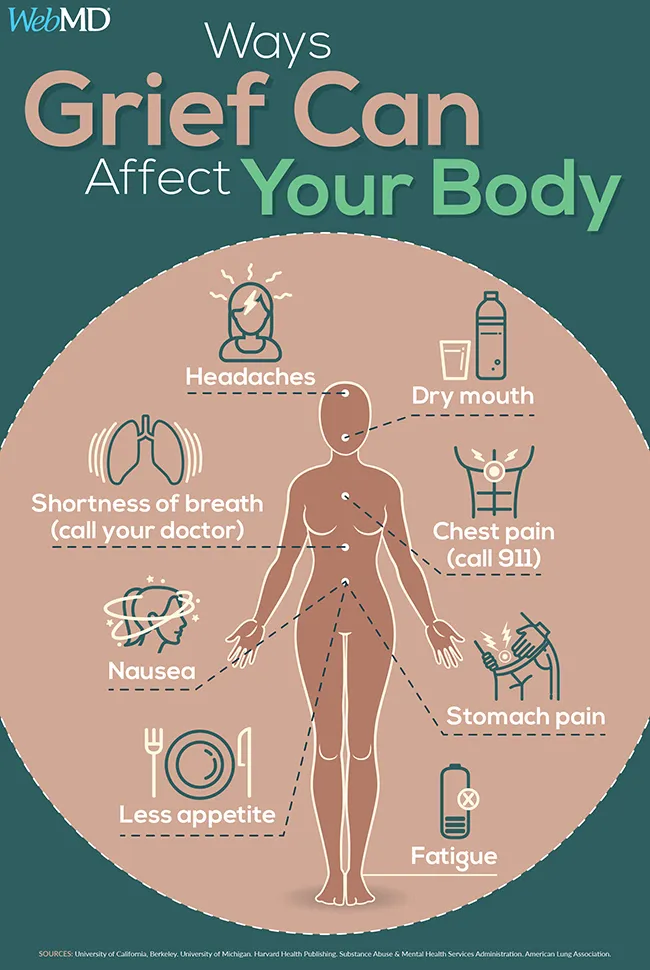
July 11, 2019 — It’s surprising how physical grief can be. Your heart literally aches. A memory comes up that causes your stomach to clench or a chill to run down your spine. Some nights, your mind races, and your heart races along with it, your body so electrified with energy that you can barely sleep. Other nights, you’re so tired that you fall asleep right away. You wake up the next morning still feeling exhausted and spend most of the day in bed.
Amy Davis
Amy Davis, a 32-year-old from Bristol, TN, became sick with grief after losing Molly, a close 38-year-old family member, to cancer. “Early grief was intensely physical for me,” Davis says. “After the shock and adrenaline of the first weeks wore off, I went through a couple of months of extreme fatigue, with nausea, headaches, food aversion, mixed-up sleep cycles, dizziness, and sun sensitivity. It was extremely difficult to do anything. … If there’s one thing I want people to know about grief, it’s how awful it can make your body feel.”
What causes these physical symptoms? A range of studies reveal the powerful effects grief can have on the body. Grief increases inflammation, which can worsen health problems you already have and cause new ones. It batters the immune system, leaving you depleted and vulnerable to infection. The heartbreak of grief can increase blood pressure and the risk of blood clots. Intense grief can alter the heart muscle so much that it causes “broken heart syndrome,” a form of heart disease with the same symptoms as a heart attack.
Stress links the emotional and physical aspects of grief. The systems in the body that process physical and emotional stress overlap, and emotional stress can activate the nervous system as easily as physical threats can. When stress becomes chronic, increased adrenaline and blood pressure can contribute to chronic medical conditions.
Research shows that emotional pain activates the same regions of the brain as physical pain. This may be why painkilling drugs ranging from opioids to Tylenolhave been shown to ease emotional pain.
Normal vs. Pathological Grief
Depression is not a normal part of grief, but a complication of it. Depression raises the risk of grief-related health complications and often requires treatment to resolve, so it’s important to know how to recognize its symptoms. Sidney Zisook, MD, a grief researcher and professor of psychiatry at the University of California, San Diego, says people can distinguish normal grief from depression by looking for specific emotional patterns.
“In normal grief, the sad thoughts and feelings typically occur in waves or bursts followed by periods of respite, as opposed to the more persistent low mood and agony of major depressive disorder,” Zisook says.
He says people usually retain “self-esteem, a sense of humor, and the capacity to be consoled or distracted from the pain” in normal grief, while people who are depressed struggle with feelings of guilt and worthlessness and a limited ability “to experience or anticipate any pleasure or joy.”
Complicated grief differs from both depression and normal grief. M. Katherine Shear, MD, a professor of psychiatry at Columbia University’s School of Social Work and director of its Center for Complicated Grief, defines complicated grief as “a form of persistent, pervasive grief” that does not get better naturally. It happens when “some of the natural thoughts, feelings, or behaviors that occur during acute grief gain a foothold and interfere with the ability to accept the reality of the loss.”
Symptoms of complicated grief include persistent efforts to ignore the grief and deny or “rewrite” what happened. Complicated grief increases the risk of physical and mental health problems like depression, anxiety, sleep issues, suicidal thoughts and behaviors, and physical illness.
How Does Avoidance Harm Your Health?
Margaret Stroebe, PhD, a bereavement researcher and professor of clinical psychology at Utrecht University, says that recent research has shed light on many of “the cognitive and emotional processes underlying complications in grieving, particularly rumination.”
Research shows that rumination, or repetitive, negative, self-focused thought, is actually a way to avoid problems. People who ruminate shift attention away from painful truths by focusing on negative material that is less threatening than the truths they want to avoid. This pattern of thinking is strongly associated with depression.
Rumination and other forms of avoidance demand energy and block the natural abilities of the body and mind to integrate new realities and heal. Research by Stroebe, and others shows that avoidance behavior makes depression, complicated grief, and the physical health problems that go with them more likely. Efforts to avoid the reality of loss can cause fatigue, weaken your immune system, increase inflammation, and prolong other ailments.
How Do Role Adjustments Affect Your Health?
When someone close to you dies, your social role changes, too. This can affect your sense of meaning and sense of self.
Before losing Molly, Davis says she found a personal sense of value in “being good at helping other people and taking care of them.” But after Molly died, she felt like she “couldn’t help anyone for a while.” Losing this role “dumped the bucket” of her identity “upside down.” Davis says, “I felt like I had nothing to offer. So I had to learn my value from other angles.”
Caregivers face especially complicated role adjustments. The physical and emotional demands of caregiving can leave them feeling depleted even before a loved one dies, and losing the person they took care of can leave them with a lost sense of purpose.
“Research shows that during intense caregiving periods, caregivers not only experience high levels of stress, they also cannot find the time and energy to look after their own health,” says Kathrin Boerner, PhD, a bereavement researcher and professor of gerontology at the University of Massachusetts in Boston.
“This can result in the emergence of new or the reemergence of existing ‘dormant’ health problems after the death of the care recipient. These health issues may or may not be directly related to the caregiver’s grief experience, but they are likely related to the life situation that was created through the demands of caregiving,” Boerner says.
It can be hard to make life work again after a close family member dies. Losing a partner can mean having to move out of a shared home or having to reach out to other loved ones for help, which can further increase emotional stress and worry. Strobe says the stress of adjusting to changes in life and health during and after a loss can “increase vulnerability and reduce adaptive reserves for coping with bereavement.”
“Most often, normal grief does not require professional intervention,” says Zisook. “Grief is a natural, instinctive response to loss, adaptation occurs naturally, and healing is the natural outcome,” especially with “time and the support of loved ones and friends.”
For many people going through a hard time, reaching out is impossible. If your friend is in grief, reach out to them.Amy Davis
Grief researchers emphasize that social support, self-acceptance, and good self-care usually help people get through normal grief. (Shear encourages people to “plan small rewarding activities and try to enjoy them as much as possible.”) But the researchers say people need professional help to heal from complicated grief and depression.
Davis says therapy and physical activities like going for walks helped her cope. Social support helped most when friends tried to reach out instead of waiting or asking her to reach out to them.
“Th thing about grief and depression and sorrow and being suicidal is that you can’t reach out. For many people going through a hard time, reaching out is impossible. If your friend is in grief, reach out to them. Do the legwork. They’re too exhausted!”
Davis’ advice to most people who are grieving is to “Lean into it. You only get to grieve your loved one once. Don’t spend the whole time trying to distract yourself or push it down. It does go away eventually, and you will miss feeling that connected to that person again. And if you feel like your whole life has fallen apart, that’s fine! It totally has. Now you get to decide how to put yourself back together. Be creative. There’s new life to be lived all around you.
“WebMD News Special Report Reviewed by Neha Pathak, MD on July 11, 2019
Whatever this obstacle is, it started 18 months ago, there wasn’t a moment I can pin this inability on. Inability is the right word, I’m not afraid to leave the house, I’ve driven a few times in the past year, I know how to drive and live in the same town.
Yet I have my husband take me to all my appointments even if there just a mile or two away. I never feel nervous when we’re getting ready to go, no uncomfortable feelings on the way there and no sigh of relief when we’re back home.
For the longest time, I denied I had Agoraphobia but now understand people drive while suffering from Agoraphobia. The famous Chef Paula Dean was Agoraphobic for years, she drove and took care of business as needed but she feared it, didn’t want to drive, couldn’t even walk around the block at one point. Her book helped me understand you can function but it still didn’t convince me I have Agoraphobia.
I feel tremendous pressure to drive to my doctor’s appointments so my husband won’t have to take off work. He has to take an average of five days a month to drive me, sometimes very short distances. Even thou he’s been with the company 20 years that is still a lot of days off. I hate to think of how many days off since 2012 when I first got sick.
There is only one factor I can come up with, my dementia. I have lost big chunks of knowledge, simple things like where I used to go shopping. I don’t remember how to get there. One other factor is our city has grown so big since I got sick nothing looks the same. We passed a restaurant we use to frequent and I barely noticed it because everything had grown around it.
I’m not sure I could drive the 30 miles to my grandparent’s house. I had to really think hard about what streets I would take, exits, what freeways and then doing in reverse. My husband said he wouldn’t feel comfortable with me driving to their house.
I am afraid of getting lost, not being able to take care of myself as before or forgetting my phone, which I did the first appointments I drove to. Not only did I get lost but forgot my phone. Another small part is I have a different car than before. My previous car was a sexy BMW hot rod and I knew how fast it could get to the on the freeway ramp. I now have a Suburu which is really cool but not the same get up and go. I’m still adjusting to how fast I have to turn in front of someone and all the good things you learn when you get a new vehicle. My Suburu is two years old and has 1300 miles on it. I have driven about 15 of those miles.
Does any of this make sense, is the real issue my dementia and I’m trying to avoid admitting?
Please give any feedback you have, I want to hear every thought and idea. Thanks a million.
Made from stinging nettle plants, organic nettle tea can help relieve seasonal allergy symptoms with it’s natural antihistamine. You reap all the benefits of antihistamine symptom relief without having to take conventional medicines. You can drink the daily as a preventative or as needed.
Spirulina & Other Superfoods
Spirulina is a superfood full of amazing plant nutrients, like iron, calcium, vitamin A and C, and protein. While great for overall health, spiraling may be beneficial during allergy season because it is high in antioxidants and has been shown too protect the body from anything that might compromise the immune system. It is high in chlorophyll and is detoxifying. Other superfoods like Kale, turmeric, mace powder, hemp, and flax are great for reducing inflammation and boosting your immune system.
Probiotic
A probiotic can help boost your gut and immune system health, which plays a big part in seasonal allergies. You can digest probiotics by eating fermented items like sauerkraut, and kombucha, or by taking a supplement. Make sure it is a high-quality probiotic from an organic source.
Apple Cider Vinegar
Apple Cider Vinegar is detoxifying and practically a remedy for everything. Taking as little as 1 tablespoon a day can help you feel and be healthier, which will, in turn, reduce your allergy symptoms. Make sure you purchase unfiltered organic Apple Cider Vinegar.
Essential Oils
Essential oils, such as melaleuca, peppermint, lavender, frankincense, lemon, and eucalyptus, help with seasonal allergy relief. I like to fill a roller bottle with a carrier oil and 5-10 drops of each chosen essential oil. I apply this to my nose, on my temples, and behind my ears when I begin to feel swollen or puffy, as well as to the bottom of my feet. You can use these as needed as well as preventative.
Enjoy the day and the freedoms we have as Americans. I can love our country and not like the leadership. That’s all the more reason to get out the vote!
All drugs, prescription, over the counter and holistic have side effects, short and long term side effects. One important fact to know is holistic, supplements and over the counter drugs are not put thru clinical trials or FDA supervised. Basically, these products can make any claim, true or false and it’s not backed by the FDA.
I’m not saying don’t take, I’m saying take with caution the way you should with prescription drugs. Short term side effects are ones that usually go away after taking, other short term side effects might not go away and you have to decide if you can continue to take. Long term side effects can happen anytime after taking the drug for a certain time period. There is no way to no how long that time period is.
Examples
Over the counter: diet drugs, cough and sinus medicine, Tylenol and baby aspirin.
Holistic/Supplements: Saint Johns Wart (which in many cases should not be taken with Psych medications.)
My experiences with long term side effects are from taking prescriptions Dexedrine and Lithium for over 20 years.
Dexedrineisbasically speed, it’s a stimulant not dished out often. I’m Treatment-Resistant Bipolar 1 which means I suffer from depression more than mania. My depression is so bad Dexedrine is needed to keep me performing normally.
The long term side effect of Dexedrine is Mitral Valve failure. It’s a dangerous side effect but I could not live today without it.
Lithium is the foundation of all my Psych medications. Some people who are Bipolar only have to take Lithium to balance their moods. It’s most often the first medication prescribed for Bipolar Disorder.
There are many long term side effects from Lithium, for me, its tumors on all four Parathyroids and two tumors on Thyroid. Though there is no way to know for sure Lithium caused my tumors although it is a long term side effect. I’m having surgery on 7/8/19 to remove the tumors from both Parathyroids and Thyroid.
Know what your taking, know the side effects, short and long term before making a decision to take or give to children.
Concert promoter Bill Graham hosts the final show at the Fillmore East, with performances by Albert King, The J. Geils Band, The Beach Boys, and The Allman Brothers Band, among others. The venue had featured iconic acts since 1968 but proved to be too small for the growing concert industry.
1972
Nolan Bushnell and Ted Dabney, designers of the first arcade video game, ‘Computer Space,’ incorporate their new firm, Atari. It will help transform the industry as Atari’s design engineer Al Alcorn gets things rolling, or at least gliding, with his first creation, ‘Pong.’
1985
It’s too late to get hip to timely Route 66 tips, as the once heavily travelled highway spanning the US heartland from Chicago to L.A. (California) is officially decertified. Formerly stretching more than 2,000 miles, the giant US interstate highway system now renders the route obsolete.
There are toxins in many of the products we buy every day, baby lotion, shampoo, makeup, lipstick, deodorant, the list goes on. Here are a few toxins to avoid, Parabens, Sulfates, Phthalates, and Sodium Lauryl. You’ll have to look closely at the ingredients to find the toxins listed. M
Phthalates
Health Risks of Phthalates. Aside from increasing inflammation in premature babies, phthalates are endocrine-disrupting chemicals that have been linked to a wide range of developmental and reproductive effects, including Reduced sperm counts. Testicular atrophy or structural abnormality.
Sulfates
Sulfates derived from petroleum are often controversial due to their origin. The biggest concern is the long-term side effects of sulfate production. Petroleum products are associated with climate change, pollution, and greenhouse gases. Sulfates can also be found in some plant products.
I started seeing my Psychopharmacologist in 1992 and he intimidated me. He’s not a chipper guy and it took years to see through his shell. I was in a very dark place and spiraling down. I didn’t think he understood how depressed I was.
He only provides medication management, 15-minute appointments at most. We had a couple of frustrating meetings. I didn’t know how to reach him, I didn’t know doctor talk. He is one of the best in Texas and finding a Psychopharmacologist is difficult. I wasn’t walking away. During another frustrating meeting, he left the room to talk to a therapist he worked with. He did me the biggest favor and no doubt saved my life by asking me to talk with the therapist.
I sat down with her and expressed my frustration in getting thru to him. They had worked together for 13 years, she could provide insight into his personality and how best to communicate with him. Once we were on the same page, he was able to give me the help I needed.
Psychopharmacology: is the scientific study of the effects drugs have on mood, sensation, thinking, and behavior.The field of psychopharmacology studies a wide range of substances with various types of psychoactive properties, focusing primarily on the chemical interactions with the brain.Psychoactive drugs interact with particular target sites or receptors found in the nervous system to induce widespread changes in physiological or psychological functions. The specific interaction between drugs and their receptors is referred to as “drug action”, and the widespread changes in physiological or psychological function is referred to as “drug effect”. These drugs may originate from natural sources such as plants and animals, or from artificial sources such as chemical synthesis in the laboratory.
I really don’t like when my husband leaves his lunchbox on counter.
I love when he leaves money for me on the table.
This is the best I could do today, I’m in severe pain.
Have a great weekend and be safe. M
Your Friday prompt for Stream of Consciousness Saturday is “social.” Use it any way you’d like. Have fun!
Join us for the fun and sharing good media stories
For more on the Stream of Consciousness Saturday, visit Linda Hill’s blog. Here’s the link:https://lindaghill.com
Here are the rules for SoCS:
Your post must be stream of consciousness writing, meaning no editing, (typos can be fixed) and minimal planning on what you’re going to write.
Your post can be as long or as short as you want it to be. One sentence – one thousand words. Fact, fiction, poetry – it doesn’t matter. Just let the words carry you along until you’re ready to stop.
There will be a prompt every week. I will post the prompt here on my blog on Friday, along with a reminder for you to join in. The prompt will be one random thing, but it will not be a subject. For instance, I will not say “Write about dogs”; the prompt will be more like, “Make your first sentence a question,” “Begin with the word ‘The’,” or simply a single word to get your started.
Ping back! It’s important, so that I and other people can come and read your post! For example, in your post you can write “This post is part of SoCS:” and then copy and paste the URL found in your address bar at the top of this post into yours. Your link will show up in my comments for everyone to see. The most recent pingbacks will be found at the top. NOTE: Pingbacks only work from WordPress sites. If you’re self-hosted or are participating from another host, such as Blogger, please leave a link to your post in the comments below.
Read at least one other person’s blog who has linked back their post. Even better, read everyone’s! If you’re the first person to link back, you can check back later, or go to the previous week, by following my category, “Stream of Consciousness Saturday,” which you’ll find right below the “Like” button on my post.
Copy and paste the rules (if you’d like to) in your post. The more people who join in, the more new bloggers you’ll meet and the bigger your community will get!
As a suggestion, tag your post “SoCS” and/or “#SoCS” for more exposure and more views.
Thank you for stopping by today! Have a great weekend, be safe. Temps are reaching dangerious levels in the south, remember to drink water. If you’re thirsty you’re already dehydrated. M
Dementia sucks, it’s fucking life sucking. I watched my granny die from Dementia, you don’t wish that type of death on anyone. Once she no longer knew who she or anyone else was it was crushing. I don’t want to die that way and have been vocal about it to the surprise of my husband, Therapist and Psychiatrist. My decision is between me and God.
I say with no emotion, I will kill myself once my mind slips and life becomes fuzzy. One day while sitting with my granny, she broke out into a rage about why gramps left her at someone else’s house. She was in her own home, I’m taking photos off the wall, she continued to escalate, banging her head on the door jam saying gramps left her and she wanted to die. I had to medicate her before she hurt one of us.
Yesterday, I watch a new show, while falling asleep I replayed the show in my mind and forgot a line the maid said. My first reaction was my memory was slipping again but as I thought about the show, I didn’t remember because the line wasn’t significant to the story. A wave of relief came over me.
Knowing when it’s a memory loss or something else can be confussing. If you know someone with memory problems, give them a break and reaffirm the statements or questions. The affirmation will help you better understand if it was a normal memory lapse or something more concerning.
Researchers have found a potential mechanism for migraine that may explain why women get more migraines than men. The study, in Frontiers in Molecular Biosciences, suggests that sex hormones affect cells around the trigeminal nerve and connected blood vessels in the head. They found that estrogens, which are at their highest levels in women of reproductive age, are particularly important for sensitizing these cells to migraine triggers.
“We can observe significant differences in our experimental migraine model between males and females and are trying to understand the molecular correlates responsible for these differences,” explains Professor Antonio Ferrer-Montiel from the Universitas Miguel Hernández, Spain. “Although this is a complex process, we believe that modulation of the trigeminovascular system by sex hormones plays an important role that has not been properly addressed.”
Ferrer-Montiel and his team reviewed decades of literature on sex hormones, migraine sensitivity and cells’ responses to migraine triggers to identify the role of specific hormones. Some (like testosterone) seem to protect against migraines, while others (like prolactin) appear to make migraines worse. They do this by making the cells’ ion channels, which control the cells’ reactions to outside stimuli, more or less vulnerable to migraine triggers.
Some hormones need much more research to determine their role. Estrogen, however, stands out as a key candidate for understanding migraine occurrence. It was first identified as a factor by the greater prevalence of migraine in menstruating women and the association of some types of migraine with period-related changes in hormone levels. The research team’s evidence now suggests that estrogen and changes in estrogen levels sensitize cells around the trigeminal nerve to stimuli. That makes it easier to trigger a migraine attack.
Ferrer-Montiel cautions that their work is preliminary. The role of estrogen and other hormones in migraine is complex and much more research is needed to understand it. The authors emphasize the need for longitudinal studies focusing on the relationship between menstrual hormones and migraines. Their current work relies on in vitro and animal models, which aren’t easy to translate to human migraine sufferers.
Nonetheless, Ferrer-Montiel and his colleagues see a promising future for migraine medication in their current findings. They intend to continue their research using pre-clinical, human-based models which better reflect real patients.
“If successful, we will contribute to better personalized medicine for migraine therapy,” he says.
Following a sensational Massachusetts murder trial, Lizzie Borden, 32, is cleared of charges that she killed her father and stepmother with multiple blows from a hatchet. Borden will never shake off the notoriety, however, inspiring a gruesome folk rhyme still sung today.
1947
A drive-by shooter unloads nine rounds through the front window of a Beverly Hills home, instantly killing notorious gangster Bugsy Siegel. A founder of the small but promising Las Vegas casino scene, the pal of movie stars and moguls, and head of the Mafia’s west coast syndicate, is dead at 41.
1975
Twenty-nine-year-old Steven Spielberg’s second movie faced myriad production problems, including budget overruns and mechanical snafus in the title character, but ‘Jaws‘ makes waves at ticket counters, chewing up previous box office records, and launching the summer blockbuster era.
Birthdays
Nicole Kidman 1967
Nicole Mary Kidman AC is an Australian-American actress and producer.
Lionel Richie 1949
Lionel Brockman Richie Jr. is an American singer, songwriter, actor, and record producer.
Brian Wilson. 1942
Brian Douglas Wilson is an American musician, singer, songwriter, and record producer who co-founded the Beach Boys.
Add all ingredients together in a glass spray bottle in the order listed above, leaving essential oils to go in last. Shake to combine. Try to use an amber glass bottle if possible to prevent the sun from penetrating the oils inside, which could lessen their potency. Keep Bottle out of direct sunlight and somewhere cool.
Most employers are approaching job interviews all wrong, says business consultant Anthony Tjan. To identify the candidates who have substance and not just smarts, here are better questions to ask.
While the number of questions that can be asked on a job interview are infinite, almost all of them fall into one of two categories: questions about competency or questions about character. Competency questions are aimed at establishing a person’s skills, abilities and qualifications; character questions are intended to illuminate their intrinsic values and personality. Even though both types of questions are important, “we’re biased to the competency side,” says Anthony Tjan, a business consultant and CEO of the Cue Ball Group, a Boston-based venture capital firm. “And we’re neglecting important attributes like truth, compassion and wisdom.”
“What are your greatest weaknesses?” is a commonly asked character question, but it’s a bust. The interviewer often feels obliged to ask because the answer, if honest, could be valuable. But in reality, the usual responses — “I’m too detail-oriented,” “I work too hard” and “I care too much” — are rehearsed, predictable and disingenuous. And while candidates are aware that they’re not being helpful or truthful when they make such statements, they’re also afraid to reveal their true flaws.
Companies need to figure out ways to evaluate the character of potential hires. Tjan, who is also the author of the book Good People: The Only Leadership Decision That Really Matters, believes screening for traits like integrity, humility, gratitude and self-awareness are the key to job satisfaction and success. “No elements matter more than people and values for long-term competitive advantage,” he explains. “And they’re critical towards developing the purpose and meaning behind any organization.” So employers should strive to ask questions that can’t be answered with generalities or cliches.
Character question no. 1: “What are the one or two traits from your parents that you most want to ensure you and your kids have for the rest of your life?” The goal is to create a conversation that leads to a revelation, not a rehearsal, says Tjan. This question calls for a bit more thought on the applicant’s end and sheds light on the things they most value. After hearing the person’s initial response, Tjan says you should immediately follow up with “Can you tell me more?” This is essential if you want to elicit an answer with real depth and substance. And while you may be tempted to fill in a person’s silences, “be comfortable with a pregnant pause,” says Tjan. “Being patient and allowing them to share tends to lead to better answers.”
Character question no. 2: “What is 25 times 25?” Tjan wants to see how people react under real-time pressure, and their response can show you how they’ll approach challenging or awkward situations. Do they get defensive, ashamed or even angry? Or are they open-minded and willing to work at the problem? And if a candidate gives up or blurts out the wrong answer, Tjan likes to ask them to approach the question from a different angle: “Imagine instead that you have 25 quarters in your pocket — how much does that add up to?” This isn’t about checking whether someone’s good at mental math, he explains. “It’s about whether they can roll with the embarrassment and discomfort and work with me. When a person is in a job, they’re not always going to be in situations that are in their alley.”
Character question no. 3: “Tell me about three people whose lives you positively changed. What would they say if I called them tomorrow?” Checking references is generally a waste of time, asserts Tjan. Of course, they’ll have been selected and primed to brag about a candidate. Instead, he thinks it’s more informative to find out about the people whom an applicant has personally helped. It doesn’t have to be a coworker; it could be a relative, classmate, neighbor or friend. Organizations need employees who can lift each other up. “And if a candidate can’t think of a single person, I want to understand why,” Tjan says. He credits much of his success to relationships — both as mentor and as mentee — that he’s had in his life. When a person is naturally inclined toward compassionate mentorship, it can have a domino effect in an institution. “I’ve learned that it’s those types of people that cause organizations to be different,” he adds.
Character question no. 4: After an interview, ask yourself (and other team members, if relevant) “Can I imagine taking this person home with me for the holidays?” This may seem overly personal, but “you are trying to develop a relationship with them,” says Tjan. And even though you haven’t spent that much time with the person, you’ll usually have a gut reaction to this question. “When I ask this of colleagues, I get much more visceral yes/no responses than when I go through a competency checklist,” he says.
Character question no. 5: After an interview, ask security or the receptionist: “How was the candidate’s interaction with you?” Be conscious of how people treat strangers — it speaks to whether they act with compassion and openness and view others as equals. Tjan knows about one company where interviewers ask security to delay a candidate for up to 10 minutes to see their reaction. “But I don’t know if I would go that far,” he adds.
Hiring good people goes beyond corporate success. Staffing an organization with people of substance is about more than just improving your retention rate and bottom line, says Tjan. It can have ripple effects as your employees interact in the world, although this impact might be hard to detect and measure. And while the character questions here are intended to be used in job interviews, we’d all benefit from asking: “What role can I play in being a positive influence on others?”
I care for my 92-year-old gramps and have been here five weeks. He had three surgeries in seven days. Without Caregiving 101 training, I learned the hard way.
*Ask the doctor what happens if the procedure does not work.
*If a second procedure does not work, is there a third option.
*What is the recovery time and type of home health services needed.
*Is the surgery necessary for a 92-year-old who is already dying!
Gramps went in for non-invasive surgery, nothing prepared me for the outcome. I’ve been through several surgeries with gramps. This procedure had not been performed before however it sounded like the least complicated procedure to date. I forgot nothing is normal or non-invasive at 92 years old. We went from going home that afternoon, to having three surgeries over seven days. I made the mistake of thinking the procedure would go as in the past. Age makes all the difference, five years at this stage of Kidney Failure can change everything.
I’m blessed to spend this time with gramps, we still have a long road ahead. It is emotional and life changing. I’ve become the parent and he doesn’t like me telling him when to take his medicine. He has raised his voice more in the past month than in my lifetime. It’s hard to take it in stride, just bite tongue. Stress has triggered my depression, I struggle to keep myself in check and take care of my gramps.





























 Looking for the Light