

Category: Men & Womens Health


The 8 health benefits of dark chocolate! —Guest Blogger Happy Healthy Me – a Journey

‘What you see before you my friend, is the result of a lifetime of chocolate’ – Katharine Hepburn Dark chocolate is healthy! It’s true! I’ve always loved dark chocolate, even as a child. Most people I knew then, thought it was odd. I’d always search for the single dark chocolate in the big variety tin […]
The 8 health benefits of dark chocolate! — Happy Healthy Me – a Journey

Noah’s Ark

Happy Holidays
Melinda

Friday Quote 12/10/2021

Have a great weekend!
So glad you stopped by today and look forward to hearing your comments.
Melinda
International Human Rights Day
Human Rights Day is celebrated annually around the world on 10 December every year. The date was chosen to honor the United Nations General Assembly’s adoption and proclamation, on 10 December 1948, of the Universal Declaration of Human Rights, the first global enunciation of human rights and one of the first major achievements of the new United Nations. The formal establishment of Human Rights Day occurred at the 317th Plenary Meeting of the General Assembly on 4 December 1950, when the General Assembly declared resolution 423(V), inviting all member states and any other interested organizations to celebrate the day as they saw fit.


Human Rights Day date is marked to promote the rights which all individuals have, regardless of religion, gender, race, caste, ethnicity, colour or nationality.
To deny people their human rights is to challenge their very humanity: Nelson Mandela
A right delayed is a right denied: Martin Luther King
All human beings are born free and equal in dignity and rights: Eleanor Roosevelt
I think human rights is something we can fight for every day on a small scale, it’s the simple steps we take, like doing the right thing and calling out injustices. To take your fight to a larger scale join one of the organizations around the world that fight for all human rights.
Melinda

Daily Quote
Happy Tuesday. I hope you’re off to a great start or end depending on where you live.

Melinda

21 Tips For Managing A Chronic Christmas — Guest Blogger Invisibly Me

Life with chronic illness & pain is hard enough without festive expectations & stress on top. Here are 21 tips to manage a chronic Christmas.
21 Tips For Managing A Chronic Christmas — Invisibly Me

Hot Air Balloon Mishap


I can’t recall a time when adventure was not on my mind. I’m the thrill seeker who will travel halfway around the world to bungee jump off the highest bridge.
This is my friend Jackie (curly hair) who lives in England. Our birthdays are close so we enjoyed celebrating together when she lived here for a couple of years. A hot air balloon ride was my birthday gift that year and hers too.
We live in a large city so we had to fly northeast. We lift off heading for the cow pastures in the distance. The sun slowly went down giving a beautiful light display. As we were landing the wind picked up. Before I know it we hit a tree, bounce up and over to another tree. I wasn’t scared of crashing, my interest was cow patties and cold champagne waiting. The mishap added to the adventure.
You will find ballooning in the French countryside on my Bucket List.
I would love to hear what you have on your Bucket List.
Melinda

Gift Ideas for Your Frazzeled Friends
Everyone has undoubtedly experienced struggles this year, your friends included. And so, if you’re wondering what thoughtful gifts to buy this year to cheer up your closest, the solution lies in getting them something that will help bring on relaxation. And below, we’ve got just the ticket, in the form of gift ideas to consider giving this year.

Pajamas
Pajamas are the ultimate pieces of clothing associated with relaxation and sleep. Gift your friend some super-soft pajamas to snuggle into this Christmas, and you’re sure to increase their comfort and make them feel more relaxed in an instant.
Weighted Blanket
Find a snuggly blanket for your friend, preferably one that feels heavy. Heavy blankets help to reduce anxiety in sufferers because they emulate the feeling of a big warm hug.
Lavender Oil
Lavender oil is an essential oil that can help your best friend unwind. Lavender is a natural sleep aid, which can tempt over-thinkers and anxious friends to sleep with ease.
Dark Chocolate
Chocolate will never go down a miss with anyone. The delicious edible is also proven to positively impact a person’s wellbeing, improving their mood and immunity.
Therapy Putty
Therapy putty is the perfect gift for your friend who needs stress relief on the go. Squishing therapy putty between your fingers is great for reducing stress levels and can help your friend feel more at ease.
Journal
Stress and anxiety strike at any moment. Often at inconvenient times when there’s no one around to talk to, to help rationalize and organize their thoughts. As a remedy, gift a journal to your overthinking friend so that they can write down what they feel when you’re not around to listen.
Plant
A few indoor plants are well-known for reducing stress. Greenery, in general, is excellent for your well-being. Snake and basil plants have calming properties that put their owners at ease. If your friend has office space at home, suggest they pop it on their desk to help them manage their stress throughout the day.
Bath Bomb
A scented bath bomb will encourage your friend to use your gift by taking a hot bath, which is all part of your ploy to help them to relieve stress.
Candle
A soothing aroma can make a world of difference to how we feel. And having flickering candles around the room is relaxing to see. From tea lights to a large Yankee candle, there’s a lot of candles out there that would make an ideal relaxing gift for your friend.
Suppose your friend is going through a rough patch or seems particularly down or stressed as of late. You don’t need to wait until Christmas to send them one of the thoughtful gifts above. Most of the ideas above you can order online and get sent directly to your friend.
Melinda

Everyday Magic

Bella and Grace by Stampington
Adventure can mean something different for all of us. Some people may want to skydive while others want to fix an old house.
Big or small. What are all the adventures you want to go on?
Enjoy your day!
Melinda

Are You Experiencing Cognitive Dysfunction?
Have you ever experienced cognitive dysfunction or sometimes called brain fog? If so you will know exactly what it is and what it feels like. In fact, most of us have experienced it at some point or another, and it is actually a very common experience. While at times it might go hand-in-hand with a mental health issue, it can also just happen as a response to temporary stimuli, and can soon pass in those cases. But if you are experiencing it too often, or you just want to know how you can avoid it, try out the ideas in this article. If you have chronic brain fog you should check with your doctor in that it could be a symptom of a medical condition and need more attention.

What Is Brain Fog?
While brain fog is not a specific medical condition that is recognized, it is a common experience and it has entered the language in the past few years for that reason. Generally, it is characterized by cognitive dysfunction, including memory loss and a lack of clarity in the mind, and generally a poor concentration with an inability to focus. If you find yourself experiencing this kind of brain fog, you will find that it is hard to focus on anything for too long. It can be a surprisingly upsetting experience.
Avoiding Brain Fog
How to avoid or get rid of brain fog will depend on what caused it, so the first thing to do is to identify that as closely as you can. There are many common causes of brain fog, including overuse of smartphones and social media, lack of sleep, abusing drugs and alcohol, stress, hormonal alterations, and poor diet. If any of these are jumping out at you as possible issues that you might need to fix, then that should be your first port of call.
Beyond that, it is all about making sure that you are generally looking after yourself. If you do that, you might be able to avoid brain fog altogether.

Other Methods
If you are still experiencing brain fog on a regular basis, you might want to consider some other trusted options, such as meditation. With regular practice, meditation becomes easier and you will find that you have a better and better sense of what is going on in your mind, which will help you to stop brain fog in its tracks. That’s something that we can all look forward to.
Beyond Brain Fog
Life on the other side of brain fog is much clearer, happier, and more engaged, so it is absolutely worth trying to get rid of it as best as you can. If you try the options above and it’s enough, and you will find that you can enjoy life all the more as a result. If brain fog continues, please speak with your general practitioner about your symptoms.
This is a collaborative post.
Melinda

4 Ways To Keep Your Vehicle Running Longer Than It Otherwise Might
Running a vehicle is often a large investment in time, energy, and financial prowess, and so many could be forgiven for wanting such a utility to run as long as possible. But of course, driving on the roads and driving safely on the roads are two separate habits, and will be determined in large part by the condition of the vehicle you use.
For this reason, it’s important to make sure your vehicle is not only roadworthy from a technical legal sense, but also that it’s in good condition, operates well, and that certain elements such as the brake tuning and tire pressure are properly maintained. In this post, then, we’ll discuss four different ways for keeping your vehicle running longer than it otherwise might, what that could imply, and a few tips for getting there without overdoing it.
This way, you’ll not only enjoy a better vehicle with more utility to offer, but you’ll notice yourself operating on the roads as a better, safer, more observant driver. With that in mind, let’s begin:

Avoid Harsh Driving Habits
Harsh driving habits, such as constantly accelerating quickly and braking harshly, giving yourself too little room to turn with, overrevving your engine, and avoiding regular maintenance can leave a car more worn out than it may otherwise be. The opposite of these actions, then, can help you stay safer on the roads, as well as maintain your vehicle as necessary.
Calm Yourself On The Road
No matter the strain, be that a road covered in black ice, harsh drivers tailgating you or cutting you off, or passengers who may not be behaving as well as they could, keeping a calm head can help you find a safe place to park or to find an alternate route without escalating the situation. Focus behind the wheel has probably saved more lives and vehicles than anything else.
Proper & Regular Cleaning
Cleaning the interior and exterior of your car semi-regularly should be an essential practice to upkeep. No matter if you enjoy washing it by hand or visiting a professional car wash center, the more you can remove unnecessary dirt, grime, dust, and interior buildup the better, and the more capably your vehicle will perform.
Understand Its Functioning
There’s nothing better for a car’s functioning than an owner who understands how to diagnose its issues. Taking a healthy interest in car maintenance, do-it-yourself repairs, and adjacent considerations such as understanding your vehicle’s dashboard lights, when to notice it pulling from side to side, or when a tire needs replacement can help its longevity more than anything else.
This is why investing in essential resources, like Ford F-150 factory shop manuals, can help you keep up with your maintenance to the degree that official mechanics would, too. It will also help you speak to mechanics with fluency, ensuring a perfect overall outcome.
With this advice, you’re certain to keep your vehicle running for longer than it otherwise might.
This is a collaborative post.
Melinda

How many close friends do most people have? The answer is …
IDEAS.TED.COM
Dec 2, 2021
Going through a global pandemic has brought us together in some ways, but it’s also separated many of us from our routine interactions with friends and acquaintances. And in doing so, it’s led us to look at our relationships and reflect on the ones we’d like to add to our lives — and the ones we’ve left behind.
Voraciously curious data journalist Mona Chalabi has been thinking about her friendships too, and she recently explored this topic in her podcast Am I Normal?. Here’s an excerpt from that episode, where Chalabi speaks with renowned friendship researcher Robin Dunbar PhD, an evolutionary psychologist at Oxford University:
Mona Chalabi: According to Dunbar, our apple basket of relationships has an average of 150 people in it. This 150 figure is referred to as “Dunbar’s number“. Now it might seem high, but what Dunbar is looking at is the number of relationships the brain can handle at one time. This includes family, best friends, acquaintances, workmates, even the bartender you know by name. So they’re friends of a wide range of types.
Dunbar has studied social relationships since the ’70s, first in primates and then in humans. He developed the number while studying primates’ social networks. And that was when he noticed that the size of those social groups was relative to the size of the primates’ brains.
“Introverts prefer to have fewer friends,” says Dr. Dunbar. “They probably sort of hover around the 100 – 150 mark.”
Robin Dunbar: And so I just, out of idle curiosity, thought, “Well, what happens if we stick human brains into this equation?” And when we did that, it gave this figure of 150. And that number then just kept turning up all over the place.
Chalabi: The figure popped up in surprising places — offices, communes, even Christmas card lists. 150 is also the estimated size of Neolithic farming villages in the Middle East and 11th-century Britain … Dunbar says 150 for simplicity, but really, it’s a range between 100 and 250, depending on several factors.
Dunbar: One is obviously personality. So introverts prefer to have fewer friends. They probably sort of hover around the 100 – 150 mark …
Chalabi: Another factor is age.
Dunbar: The size of personal social networks over the lifespan increases as you grow through childhood, hits a peak somewhere in the late teens, early 20s at something approaching about 250. And then from about the 30s, surprisingly coinciding with reproduction, it drops to about 150 after which it remains very stable.
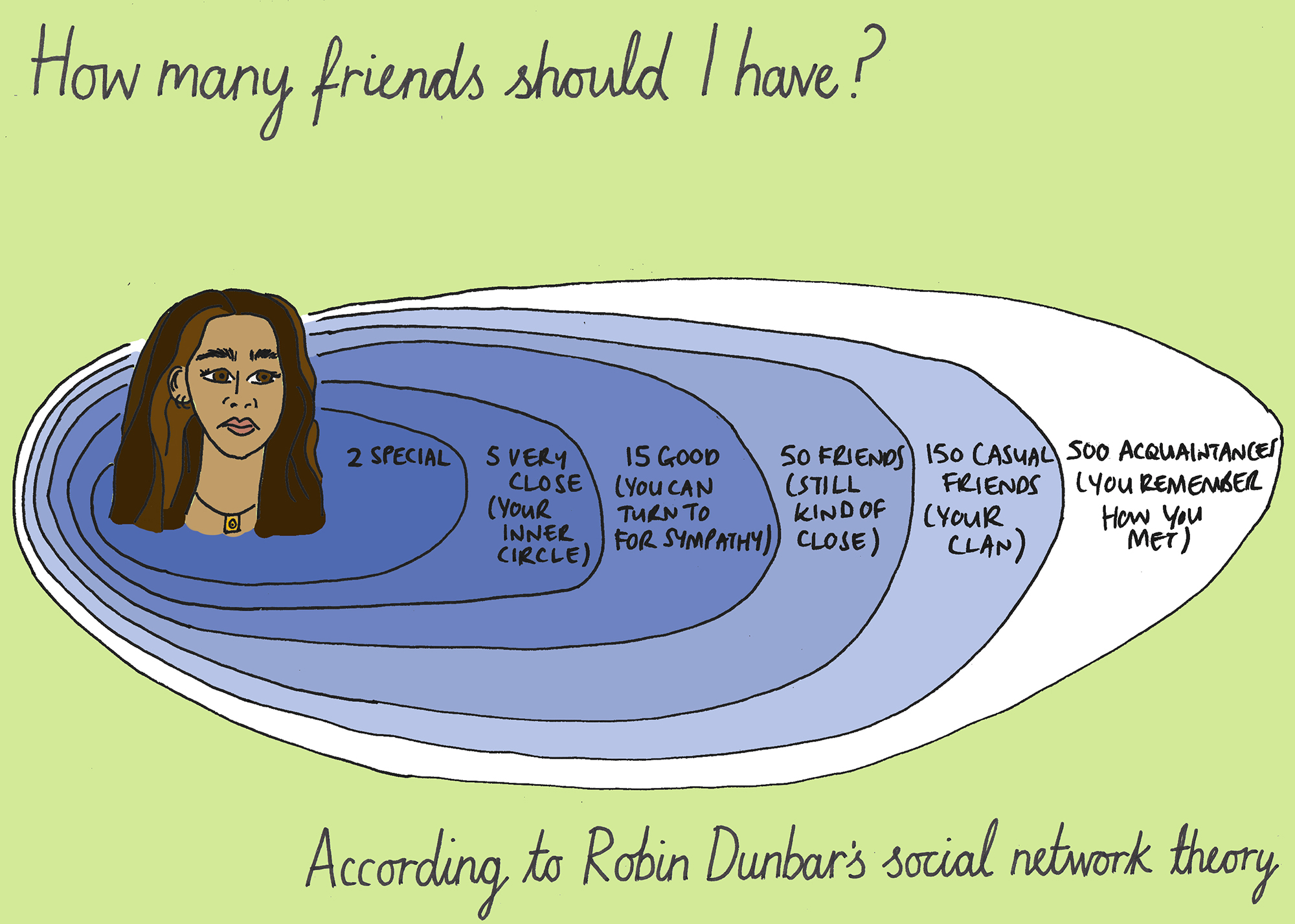
Chalabi: … You see, within that 100 – 250 friend range, there are layers or concentric circles. The first layer is about 1.5 people. That often represents your parents or your romantic partner.
Dunbar: Then the next layer out is somewhere around about 5 — we think of those as your intimate friends. The next layer out is 15 — those you might think of as best friends. Then there’s a layer at 50 — good friends. A layer at 150 — just friends. A layer at 500 — which we think of as acquaintances.
Chalabi: 50 good friends! Five-zero! That feels like a whole lot of people! And I think this is the tier where I’m having the most trouble.
… The more I think about it, part of the problem here might be that some of the people who were once part of that super-close friend group, maybe I just didn’t do enough to keep them there.
Dunbar: Certainly our research shows very clearly that if you fail to maintain that level of investment, friendships start to die slowly, but surely. Six months after you’ve not contacted them, they will have dropped down from being a good friend to maybe just a friend. And if it carries on for a couple of years, they will end up as an acquaintance.
Want to learn more? In her TED podcast Am I Normal?, data journalist, writer and illustrator Mona Chalabi dives into the numbers to get us answers to some of the most puzzling questions — like just how long does it take to get over a breakup and how bad is it to marry a cousin. But since statistics can’t tell the whole story, she also talks with experts, strangers and even her mother. Go here to listen to the irresistible episodes now.
You can also watch this TED original video with Mona Chalabi here:

Fun Facts That Will Amaze You
I’m so glad you are enjoying this weekend tradition of Fun Facts. I learn something new each week, even if it’s weird. I love hearing your comments!
Three presidents, all Founding Fathers—John Adams, Thomas Jefferson, and James Monroe—died on July 4. Presidents Adams and Jefferson also died the same year, 1826; President Monroe died in 1831. Coincidence? You decide. (constitutioncenter.org)
The Barbie doll’s full name is Barbara Millicent Roberts, from Willows, Wisconsin. Her birthday is March 9, 1959, when she was first displayed at the New York Toy Fair. (barbiemedia.com)
There actually aren’t “57 varieties” of Heinz ketchup, and never were. Company founder H.J. Heinz thought his product should have a number, and he liked 57. Hint: Hit the glass bottle on the “57,” not the bottom, to get the ketchup to flow. (heinz.com)
The tallest man ever recorded was American giant Robert Wadlow (1918–1940), who stood 8 feet 11 inches. Wadlow’s size was the result of abnormally enlarged pituitary gland. (guinnessworldrecords.com
The tallest living man is 37-year-old Sultan Kosen, from Turkey, who is 8 feet, 2.8 inches, who set the record in 2009. His growth is also due to a pituitary issue. (guinnessworldrecords.com)
Enjoy!
Melinda

Superfoods for winter — Guest Blogger My Name is Haifa

It is widely known that during winter season, people are in high risk of getting sick easily. What is more concerning, the number of covid19 cases has returned to increase again in some regions around the globe such as in Africa and Europe. I genuinely believe, It is preferable to adopt a healthy diet while […]
Superfoods for winter — My Name is Haifa

International Day of Persons with Disabilities
International Day of People with Disability on December 3 each year is an international observance promoted by the United Nations since 1992. 2012 marks the 20th anniversary of the International Day for People with Disabilities. The day aims to promote an understanding of people with disability and encourage support for their dignity, rights and well-being.

Around 15% of the world’s population, or one billion people, live with disabilities. People are often unaware of the great number of persons living with disabilities around the world and the challenges they face.
Persons with disabilities, “the world’s largest minority”, often face barriers to participation in all aspects of society. Barriers can take a variety of forms, including those relating to the physical environment or to information and communications technology (ICT), or those resulting from legislation or policy, or from societal attitudes or discrimination. The result is that persons with disabilities do not have equal access to society or services, including education, employment, health care, transportation, political participation or justice. The day aims to promote an understanding of disability issues and mobilize support for the dignity, rights and well-being of persons with disabilities. It also seeks to increase awareness of gains to be derived from the inclusion of persons with disabilities in every aspect of life.
One point I want to make is there are a large number of people with invisible disabilities. An invisible disability is one where you might say “you don’t look sick”.
Some people only think of disability applying someone in a wheelchair, or walking with a cane but there are many people who have difficulty with everyday functions who are disabled who don’t look disabled to you.
Please be polite and patient if you see someone in handicapped parking and never take advantage of the parking space, I don’t care how sick you are.
Enjoy the day.
Melinda
Friday Quote 12/03/2021
Have a great weekend!
So glad you stopped by today and look forward to hearing your comments.
Melinda
Book Review Adaptable by Alexa Carlin
I was kindly gifted a copy of Adaptable-How to Lead with Curiosity, Pivot with Purpose, and Thrive Through Change by Alexa Carlin from NetGalley, GracePoint Publishing, and Wex Press for a review.

Pub Date 14 Sep 2021
GracePoint Publishing, WEX Press

About the Author
At 17, Alexa Carlin became CEO of her first company, designing jewelry that made a difference, one bracelet at a time. But at 21, she was induced into a medical coma and given a one-percent chance to live. In Adaptable, she shares the stories of her journey, offering powerful insights into hope, courage, and life’s challenges.
Blurb
Life’s obstacles offer two distinct directions: They can push you backward or fuel you forward. The choice is up to you.
Written in a heartfelt and authentic tone, Adaptable invites readers to develop a new perspective on their past and current obstacles. The stories, lessons, and action steps that fill each chapter gently guide readers back to their true selves, allowing them to connect deeply to their inner light and shine brightly with their true purpose.
Alexa encourages and inspires readers to use their own challenges not as a reason to abandon dreams, but as a springboard from which to thrive.
Reviews
“Empowering, real, raw, and game-changing! Alexa’s stories within Adaptable will remind you of the potential you hold inside of you and the strength to push through any obstacle. An inspiring book by an inspiring woman!” – Jess Ekstrom, author of Chasing the Bright Side
“Adaptable is a must read for anyone trying to silence that negative voice in their head and go after their dreams. Alexa’s voice is so real, inspiring, and motivating that you can’t help but feel empowered to live your best life.” – Rachel DeAlto, author of relatable, Relationship Expert, and television personality
My Thoughts
Adaptable is a story about overcoming insurmountable odds and taking the bull by the horns. Alexa inspires you to stay focused on your dreams and to chart a course for success by using your own obstacles as a learning experience for achieving each and every goal you set.
Alexa takes the obstacles in her young life and turns them into the motivation she needs to chart her own course.
“This book is meant to be consumed in two ways. First, read it from front to back. Second, use it as a tool to help you find hope when it may be lost, to help you through times of self-doubt when pursuing your dreams, or for a beacon of light during some difficult times. Keep it near and anytime you feel you need a reminder, randomly flip open to a new chapter while asking for the answer you’re looking for, and read whatever chapter opens up.” I think this is the best way to read the book, it’s a story and a handbook to reflect on.
Adaptable is a great book for everyone, from college students, just started out to professionals on the way up the ladder.
Enjoy Reading!
Melinda

Daily Quote
Happy Thursday!

“I’ll never be content to stay forever in one place. I’m too madly in love with all the places I haven’t been, the people I haven’t met, the food I haven’t tried on the streets I haven’t danced on.”
Brook Hampton
Have a great day.
Melinda
Everyday Magic
Bella and Grace by Stampington
It is not often that we find ourselves in awe of something, but’s an incredible feeling. When was the last time you saw something so beautiful it took your breath away?
Enjoy your day!
Melinda
Book Review Manic Man by Jason Wegner and Dr. Kerry Bernes
I was kindly gifted a copy of Manic Man, How to Live a Successfully with a Severe Mental Illness by Jason Wegner and Dr. Kerry Bernes from Soraya Nair, Managing Editor at Cherish Editions for a review. Thank you, Manic Man was another great read from Cherish Editions.
Because this review was done many years ago I’m not able to make the changes to the layout that I would like to.
![Manic Man: How to Live Successfully with a Severe Mental Illness by [Jason Wegner, Dr. Kerry Bernes]](https://m.media-amazon.com/images/I/514vXptgEmL.jpg)
Published 2021
Cherish Editions
About the Authors
Jason Wegner
Lives with a severe mental illness, Bipolar Disorder 1.
Dr. Kerry Bernes
B.Ed., M.Sc., Ph.D., R.Psych., ABPP
Board Certified in Clinical Psychology (American Board of Professional Psychology)
Blurb
His courageous story begins with a glimpse of Jason’s normal life before the hypomanic stage of his illness kicks in. The mania starts when he tries the dangerous psychedelic drug LSD and takes off a few weeks later in Tanzania. He is in a full-blown manic episode while in Africa, and his behaviours and journaled thoughts demonstrate this. Weeks of mania continue after he returns from Africa until he is tricked into an ambulance and taken to the hospital’s emergency wing. He would be hospitalized in the acute psychiatry ward for 57 days, but his journey to improved mental health had just begun.
To lift Jason out of his severe depression, his psychologist Dr. Kerry Bernes developed “The Octagon of Life,” which represents the eight areas that Jason needed to focus on to rebuild his life. He shares this model in Manic Man, too.
Reviews:
“Jason gives an inside look into his brain during his mania, depression and recovery. It helped me to learn more about the bipolar disorder, as well as mental health in general. Thank you for sharing your story and breaking the stigma surrounding an invisible illness.”
“A must read for anyone who knows anyone going through a mental health crisis. Very well written. Thank you for writing this book.”
My Thoughts
I completely understand where Jason is coming from because I was diagnosed with Bipolar Disorder 1 at 19 years old. Being in a Manic in a state is hard to describe. You have firm beliefs that are not reality, they are grandiose, supernatural, and intoxicating. So intoxicating you don’t want the feelings to stop even when you realize how sick you are.
Jason was like a train going full steam with no brakes, ideas and thoughts coming at him like the changing of slides in a hand projector. They say is the higher you are the harder you fall and Jason fell hard.
He spent 57 days in a Phsychaitrict hospital after his parents intervened on his behalf when his behavior became so erratic they grew concerned for his wellbeing.
During his stay in the hospital, Jason learned about this illness, began to come to terms with his behavior, and started medication which is essential for Bipolar Disorder patients.
I highly recommend this book to anyone who has a friend or loved one with Bipolar Disorder, it will give you first-hand insight and you can’t get anywhere else. If you think someone has Bipolar Disorder this is a good book to help you better understand the signs and symptoms.
Cherish Editions
Cherish Editions is the self-publishing division of Trigger Publishing, the UK’s leading independent mental health and wellbeing publisher.
We are experienced in creating and selling positive, responsible, important and inspirational books, which work to de-stigmatise the issues around mental health, as well as helping people who read them to maintain and improve their mental health and wellbeing. By choosing to publish through Cherish Editions, you will get the expertise of the dedicated Trigger Team at every step of the process.
We are proud of what we do, and passionate about the books that we publish. We want to do the very best for you and your book, holding your hand every step of the way.
Enjoy Reading
Melinda

Are you mentorable?
IDEAS.TED.COM
May 2, 2019 / Lenora E. Houseworth
Are you open about the areas where you want help? Respectful of your mentor’s time and advice? Here are the characteristics that can make you someone whom other people would like to guide, from mentoring researcher Victoria Black.
This post is part of TED’s “How to Be a Better Human” series, each of which contains a piece of helpful advice from someone in the TED community; browse through all the posts here.
Finding the right mentor (or mentors) can change the trajectory of your life. Many people in the working world have one, or if we don’t, we’ve looked, wondering, “Would so-and-so make a good mentor?” But when was the last time you asked yourself, “Am I a good mentee?”
If you haven’t, that’s normal. Organizations typically place much greater emphasis on mentors than on mentees, says Victoria Black, director of a peer-mentoring and coaching program at Texas State University. At the program, she saw some pairings soar and others slump, and she wondered about the different outcomes. One day she heard education professor Richard Reddick use the word “mentorability” to refer to the ability of mentees to benefit from mentoring. A lightbulb went off.
She recalls, “I thought, ‘Gosh, we’re not doing a job of putting ownership back on the mentee or, at least, not talking to them about what it means to be mentorable. Often, you just assign a mentor to a mentee and let them go. I put a lot of effort and time into training the mentor and not the same into training the mentee.” A 2017 study coauthored by Black looked at postsecondary mentoring programs at public, four-year educational institutions in her state and found that programs were four times more likely to address mentors than mentees.
The key to mentorability is an open and reciprocal partnership between mentor and mentee. Think of it as being on a long car ride together, Black says: “The mentee is the driver, and the mentor is the copilot, helping them get to their destination.” Even though they may receive a lot of input, the mentee is the person in control, and they must respond to the mentor’s advice and give continual feedback about their needs. For mentees, she says, “Success is not just having a mentor tell you or show you what to do. It’s a two-way relationship.”
Are you a good mentee? Black shares the principal characteristics of mentorability.
1. You understand the value of their time.
Your mentor is giving you that most precious and rare of commodities: their time. Show them you appreciate it by arriving on time or early to see them and not cancelling at the last minute unless there’s an emergency. Prep for your meetings, and come with questions, comments or articles to share. Then, when the two of you are together, give your mentor your complete attention. If she sends you a text or email that requires a reply, try to respond within 24 hours; if you can’t, explain why. While this may sound incredibly basic, Black says carelessness about mentors’ time has been a common complaint in pairings that have faltered.
2. You’re clear about what you’re looking for from a mentor.
People seek out mentors for different reasons. Do you want overall career guidance, or do you have a specific goal — such as finding a new job or achieving a promotion — in mind? Are you looking for a more senior colleague who will actively champion you within your organization? Or do you want general life advice? Are you someone from an underrepresented group who wants a role model from a similar background to tell you how to navigate particular obstacles? The more specifically you can articulate your expectations and objectives, the more likely you are to receive the guidance you’d like.
Many of us feel like we want to show only our best face to prospective mentors, but you may need to expose your problems and limitations. One of Black’s most rewarding mentees was a student who was in danger of failing out of school. He showed up at her office and, she says, “admitted he was struggling in college and said he wanted to change.” After three semesters of weekly meetings with her and adhering to her schedules and timelines, he was able to get off academic probation and has gone on to succeed.
Showing vulnerability is equally important in your ongoing partnership. When she asked a group of mentors about mentees, she says, “They wanted somebody to be realistic, to be real with them and not sugar-coat their experiences but talk about their flaws in ways that helped them grow.”
3. You can accept input, advice and — sometimes — criticism.
You’ve turned to a mentor because they have knowledge or experience that you don’t possess. However, cautions Black, “you may not like what you hear all the time. Be ready to receive their feedback, and then decide whether or not you want to take it.”
If you disagree with them, examine your attitude. Remember, their advice most likely comes from a positive impulse: their desire to help you grow. Black says, “Ask yourself, Why do I not agree? Why does this make me feel uncomfortable? Is this pushing me past my boundaries?” Your reluctance may have more to do with a fear of leaving your comfort zone or an unwillingness to change than the quality of their instructions. It’s also possible that their suggestions may not fit your larger objective, so if this is the case, let them know.
If you decide not to follow their guidance, it’s still important to express your gratitude. After all, they’ve put time and thought into what they told you. Black has seen some mentees simply ignore input they don’t like. Social media has affected our behavior, she explains, “that if we don’t like what somebody has to say, we don’t think we need to respond.”
Instead, be your best self. In person or over email or text, say a simple “thank you”and briefly and politely explain your decision. As in any healthy partnership, communication is critical. Your feedback will enable your mentor to learn how they can best coach you. “With the best intentions, mentors might give you advice that works for them, but it doesn’t necessarily mean it’s going to work for you,” says Black. “Finding the best way for the mentee to thrive on their own and helping them make their own decisions is what good mentoring partnerships are about.”
4. For the lifespan of your relationship, you keep asking, “Am I a good mentee?”
Periodic reassessment is an important part of the process, according to Black. Two other questions to reflect on: “Am I committed to this partnership?” and “How can I be a a better mentee?”
5. You’re open to whatever you can learn from your mentor.
While you may not get what you want or expect from your partnership, it can still be immensely valuable. “Not all relationships are meant to be fruitful,” says Black. “That doesn’t mean they can’t help you develop.” Maybe you’ll come out of it with new information, a new skill, a new perspective, or a new friendship.
Watch her TEDxTexasStateUniversity talk now:https://www.youtube.com/embed/JzqyKn0IFO0?version=3&rel=1&showsearch=0&showinfo=1&iv_load_policy=1&fs=1&hl=en-US&autohide=2&wmode=transparent
ABOUT THE AUTHOR
Lenora E. Houseworth is a social media strategist and writer with a passion for communication and culture, and she is based in the New York City area.

3 Rules For Better Work-Life Balance

10 tips for cultivating creativity in your kids
IDEAS.TED.COM
Mar 31, 2020 / Mitch Resnick
Turns out, it’s less about “teaching” creativity to children — and more about creating a fertile environment in which their creativity will take root, grow and flourish. Researcher Mitch Resnick, director of the Lifelong Kindergarten Group at MIT, explains how we can do this.
There’s a common misconception that the best way to encourage children’s creativity is simply to get out of the way and let them be creative. Although it’s certainly true that children are naturally curious and inquisitive, they need support to develop their creative capacities and reach their full creative potential. Supporting children’s development is always a balancing act: how much structure, how much freedom; when to step in, when to step back; when to show, when to tell, when to ask, when to listen.
In putting together this list, I am combining tips for parents and teachers, because I think the core issues for cultivating creativity are the same, whether you’re in the home or in the classroom. The key challenge is not how to “teach” creativity to children, but rather how to create a fertile environment in which their creativity will take root, grow, and flourish.
The list is organized around the five components of what I call the Creative Learning Spiral, a process that encourages children to imagine what they want to do, create projects through playing with tools and materials, share ideas and creations with others, and reflect on their experiences.
For each of these five components, I’ve suggested two tips. However, these tips are just a very small subset of all of the things you might ask and do to cultivate children’s creativity. View them as a representative sample, and come up with more of your own.
IMAGINE
1. Show examples to spark ideas
A blank page, a blank canvas, and a blank screen can be intimidating. A collection of examples can help spark the imagination. When we run Scratchworkshops, we always start by showing sample projects — to give a sense of what’s possible (inspirational projects) and to provide ideas on how to get started (starter projects). We show a diverse range of projects, in hopes of connecting with the interests and passions of workshop participants.
Of course, there’s a risk that children will simply mimic or copy the examples that they see. That’s OK as a start, but only as a start. Encourage them to change or modify the examples. Suggest that they insert their own voice or add their own personal touch. What might they do differently? How can they add their own style, connect to their own interests? How can they make it their own?
2. Encourage messing around
Most people assume that imagination takes place in the head, but the hands are just as important. To help children generate ideas for projects, we often encourage them to start messing around with materials. As children play with LEGO bricks or tinker with craft materials, new ideas emerge. What started as an aimless activity becomes the beginning of an extended project.
We’ll sometimes organize mini hands-on activities to get children started. For example, we’ll ask children to put a few LEGO bricks together, then pass the structure to a friend to add a few more, then continue back and forth. After a few iterations, children often have new ideas for things they want to build.
CREATE
3. Provide a wide variety of materials
Children are deeply influenced by the toys, tools and materials in the world around them. To engage children in creative activities, make sure they have access to a broad diversity of materials for drawing, building and crafting. New technologies, like robotics kits and 3-D printers, can expand the range of what children create, but don’t overlook traditional materials. A Computer Clubhouse coordinator was embarrassed to admit to me that her members were making their own dolls with “nylons, newspapers, and bird seed,” without any advanced technology, but I thought their projects were great.
Different materials are good for different things. LEGO bricks and popsicle sticks are good for making skeletons, felt and fabric are good for making skins, and Scratch is good for making things that move and interact. Pens and markers are good for drawing, and glue guns and duct tape are good for holding things together. The greater the diversity of materials, the greater the opportunity for creative projects.
4. Embrace all types of making
Different children are interested in different types of making. Some enjoy making houses and castles with LEGO bricks. Some enjoy making games and animations with Scratch. Others enjoy making jewelry or soapbox race cars or desserts—or miniature golf courses.
Writing a poem or a short story is a type of making, too. Children can learn about the creative design process through all of these activities. Help children find the type of making that resonates for them. Even better: Encourage children to engage in multiple types of making. That way, they’ll get an even deeper understanding of the creative design process.
PLAY
5. Emphasize process, not product
Many of the best learning experiences happen when people are actively engaged in making things, but that doesn’t mean we should put all our attention on the things that are made. Even more important is the process through which things are made.
As children work on projects, highlight the process, not just the final product. Ask children about their strategies and their sources of inspiration. Encourage experimentation by honoring failed experiments as much as successful ones. Allocate times for children to share the intermediate stages of their projects and discuss what they plan to do next and why.
6. Extend time for projects
It takes time for children to work on creative projects, especially if they’re constantly tinkering, experimenting and exploring new ideas (as we hope they will). Trying to squeeze projects into the constraints of a standard 50-minute school period — or even a few 50-minute periods over the course of a week — undermines the whole idea of working on projects. It discourages risk taking and experimentation, and it puts a priority on efficiently getting to the “right” answer within the allotted time. For an incremental change, schedule double periods for projects. For a more dramatic change, set aside particular days or weeks (or months) when students work on nothing but projects in school.
SHARE
7. Play the role of matchmaker
Many children want to share ideas and collaborate on projects, but they’re not sure how. You can play the role of matchmaker, helping children find others to work with. In the Scratch online community, we have organized month-long Collab Camps to help Scratchers find others to work with — and also to learn strategies for collaborating effectively.
8. Get involved as a collaborator
Parents and mentors sometimes get too involved in children’s creative projects, telling children what to do or grabbing the keyboard to show them how to fix a problem; other parents and mentors don’t get involved at all. There is a sweet spot in between, where adults and children form true collaborations on projects. When both sides are committed to working together, everyone has a lot to gain.
A great example is Ricarose Roque’s Family Creative Learning initiative, in which parents and children work together on projects at local community centers over five sessions. By the end of the experience, parents and children have new respect for one another’s abilities, and relationships are strengthened.
REFLECT
9. Ask (authentic) questions
It’s great for children to immerse themselves in projects, but it’s also important for them to step back to reflect on what’s happening. You can encourage children to reflect by asking them questions about their projects. I often start by asking: “How did you come up with the idea for this project?” It’s an authentic question: I really want to know! The question prompts them to reflect on what motivated and inspired them.
Another of my favorite questions: “What’s been most surprising to you?” This question pushes them away from just describing the project and toward reflecting on their experience. If something goes wrong with a project, I’ll often ask: “What did you want it to do?” In describing what they were trying to do, they often recognize where they went wrong, without any further input from me.
10. Share your own reflections
Most parents and teachers are reluctant to talk with children about their own thinking processes. Perhaps they don’t want to expose that they’re sometimes confused or unsure in their thinking. But talking with children about your own thinking process is the best gift you could give them.
It’s important for children to know that thinking is hard work for everyone—for adults as well as children. And it’s useful for children to hear your strategies for working on projects and thinking through problems. By hearing your reflections, children will be more open to reflecting on their own thinking, and they’ll have a better model of how to do it. Imagine the children in your life as creative thinking apprentices; you’re helping them learn to become creative thinkers by demonstrating and discussing how you do it.
This article was originally published on the MIT Press Reader site.
Watch Mitch Resnick’s TED Talk here:https://embed.ted.com/talks/mitch_resnick_let_s_teach_kids_to_code
ABOUT THE AUTHOR
Mitch Resnick is professor of learning research at the MIT Media Lab. His research group develops the Scratch programming software and online community, the world’s largest coding platform for kids. He has worked closely with the LEGO company on educational ideas and products, such as the LEGO Mindstorms robotics kits, and he co-founded the Computer Clubhouse project, an international network of after-school learning centers for youth from low-income communities. He is the author of “Lifelong Kindergarten,” from which this article is adapted.
Sleep: What is the sweet spot? — Guest Blogger Soul Script

The reality is when you’re in your optimal sleep groove, pretty much everything else in life corrects itself. How much is best? Well, it depends on the individual. Too much or too little sleep has been linked to impaired brain function. Older adults who consistently get 6 to 8 hours of sleep per night delay […]
Sleep: What is the sweet spot? — Soul Script

Why You Think You’re Right-Even If You’re Wrong

Could the ways you cope with stress be undermining you? Here are healthier ways to respond
IDEAS.TED.COM
Good Anxiety is the title of the new book from NYU neuroscientist Wendy Suzuki PhD — but it’s one that will surprise those of us who think of anxiety as strictly bad news. However, through her work, Suzuki has come to find, as she writes, that “anxiety can shift from something we try to avoid and get rid of to something that is both informative and beneficial.”
The key is taking the information that your anxiety is telling you and using it to live in ways that support your well-being. Below, she explains how to evaluate the ways you cope with stress and change them for the better.
In the face of stressors and the anxiety they often trigger, we all develop coping strategies to manage and get ourselves back on track. These go-to behaviors or thought processes often function automatically, beneath our conscious awareness, and many were developed when we were younger and less mindful.
We developed these coping mechanisms to self-soothe or avoid uncomfortable feelings. But when these coping mechanisms stop working to manage stress, they tend to make matters worse, exacerbating our anxiety and undermining our belief that we are in control of our lives.
If you cope in ways that are productive for you, then your anxiety is probably under control. But if you cope in ways that undermine your health, job, safety or relationships, it may be time to consider your options.
What’s more, our coping strategies often reflect our relationship to anxiety.If you cope in ways that are productive for you, then you probably have your anxiety under control. If you cope with stress in ways that undermine your health, job, safety or relationships, it may be time to consider your options.
In general, coping mechanisms are considered to be either adaptive (good at helping us manage the stress) or maladaptive (bad for us because they cause other damage, through avoiding a problem that then gets bigger or giving us another problem, as with alcohol dependence or abuse). When the feelings underneath these behaviors are left untouched or unprocessed, those components of anxiety will grow and stay stuck. Then our negative coping behaviors only end up reinforcing our inability to manage or regulate our feelings.
Take Liza, a hard-driving career woman. A graduate of a top-ranked business school, she dove into a career in financial services and is well liked and well respected by colleagues. But suddenly she’s 41 with no life outside of work. She’s a workaholic, and up until now all of this dedication and motivation to succeed has paid dividends to her bank account and sense of self-worth.
But lately she goes home to her apartment feeling totally burned out. She drinks three to four glasses of wine to relax and fall asleep. Her alarm gets her up at 5AM so she can go for a run and make it to the office by 7AM. This is her cycle and it has worked for her for years, but not anymore. Liza now wakes up already feeling depleted. She is lonely, plagued with self-doubt, and beginning to question what is driving her so hard.
Then, if you respond by isolating yourself, you remove the opportunity for encouragement and support from your social relationships and take away a vital bad-anxiety buffer.
To better understand how this happens, it can help to take a look at what is actually happening in the body when bad anxiety takes the wheel. In short:
• When your brain-body is under chronic strain from anxiety, your capacity to manage emotions becomes downregulated — less effective at responding to internal or external stimuli. You become highly sensitive to stress of any kind and can begin to feel self-doubts and a loss of confidence.
• Next, when your body is depleted and doesn’t get enough restorative time and rest, it will not be able to kick up your motivation, the predominant emotion of a positive mindset. This inability to reset further erodes the capacity to maintain emotion regulation.
• Then, if you respond by isolating yourself, you remove the opportunity for encouragement and support from your social relationships and thereby take away a vital bad-anxiety buffer.
• Further, if you look to drugs or alcohol for relief, you may unintentionally exacerbate your anxiety once the “high” has passed. Indeed, drugs and alcohol act as a depressant on the nervous system. They also interfere with the brain-body’s processing of dopamine and serotonin, giving you a false sense of relief from anxiety.
It is entirely possible to change your current negative ways of coping with anxiety and also their underlying effects on your brain and body.
These responses represent a downregulation in functioning of various neural pathways of the brain-body. Yet for all these negative coping strategies and their drawbacks, a silver lining can emerge: It is entirely possible to change your current negative ways of coping with anxiety and also their underlying effects on your brain-body.
Restoring emotion regulation requires energy, curiosity and recognizing that you have a choice. But it is absolutely possible for any of us to learn to recognize signs of our own physical depletion and/or emotional dysregulation and begin to make changes. This is the essence of how using good anxiety works.
When you are anxious or upset what do you typically do to calm yourself? Without overthinking, read through the following common negative coping techniques. Which are familiar to you?
Negative Ways to Cope
• Use or abuse alcohol or drugs
• Act violently toward others
• Act out or misbehave on purpose
• Avoid conflict
• Rationalize or blame others for your problems
• Deny there is a problem
• Repress or forget what has happened
• Behave like someone you are not
• Disassociate yourself from a situation
• Exhibit controlling behavior
• Become a workaholic
• Isolate yourself and withdraw from activities and others
• Feel like you need to control or manipulate others
• Refuse to communicate
• Fantasize regularly
• Catastrophize
• Help others over helping yourself
Next, go through the list of positive coping techniques — these are beneficial ways of managing anxiety.
Positive Ways to Cope
• Name your feelings, positive or negative
• Control your anger
• Practice self-reflection
• Seek support from friends and family
• Communicate or talk about your feelings
• Exercise
• Participate in hobbies and/or sports
• Spend time outdoors
• Consider a situation from another point of view
• Remain flexible and open to new ways of thinking
• Keep a journal or engage in another form of conscious self-reflection
• Spend quality time with family, partner, friends
• Use positive self-talk and affirmations
• Meditate or pray
• Clean or organize your workspace or home
• Seek support from a health professional when you need it
• Playing or being with a pet or children
Without judging yourself, ask yourself this: What, if any, of your go-to ways of coping with stress are helping you? Are any hindering you, or having unwanted secondary effects? Also, which of these coping strategies could you do more of?
The more you stay unaware of how your coping mechanisms are no longer benefiting you or giving you the mental break you need, the more intense your bad anxiety will be.
It’s important to be aware of how we respond to stress and feelings of anxiety. The use of more than two or three negative coping strategies can be an indication of being stuck in bad anxiety; on the other hand, use of positive coping strategies shows a tolerance of stress and flexibility around emotions.
Our relationship with anxiety likely changes over time, as does our ability to process it, so our coping strategies necessarily have to be updated and ones that are maladaptive need to be addressed. And sometimes this process requires some work.
The more you stay unaware of how your coping mechanisms are no longer benefiting you or giving you the mental break you need, the more intense your bad anxiety will be and the more entrenched your negative coping strategies will become. But once you see your situation for what it truly is — a case of an overdue update to your coping strategies — you’ll be able to start changing aspects of your situation and orient yourself to a more satisfying life.
Excerpted from the new book Good Anxiety: Harnessing the Power of the Most Misunderstood Emotion by Wendy Suzuki PhD with Billie Fitzpatrick. Copyright © 2021 by Wendy Suzuki PhD. Reprinted by permission of Atria Books, a Division of Simon & Schuster, Inc.
Watch Dr. Wendy Suzuki’s TED Talk about the transformative power of exercise here:

Happy Hanukkah
I pray your heart and home are filled with light, joy, and love this holiday season.

Have a blessed Hanukkah.
Melinda

How To Stop Languishing And Start Finding Flow

Just Pondering

What’s your recipe for the perfect Fall day?
Melinda
 lookingforthelight.blog
